

Predictive AI is changing the way businesses approach cross-selling, turning guesswork into precise, data-driven strategies. By analyzing real-time customer behavior and purchase history, it identifies the right products to recommend at the right time, improving conversion rates and customer satisfaction.
Key Takeaways:
- Cross-selling efficiency: AI reduces costs and boosts profits by focusing on existing customers. For example, acquiring new customers costs $1.13 per dollar earned, while cross-selling costs only $0.27.
- Dynamic insights: Unlike outdated methods relying on static data, AI uses real-time analytics to create evolving customer profiles.
- Higher conversion rates: Businesses using AI report up to 20% better conversion rates and a 10-30% increase in revenue.
- Automation benefits: AI automates lead scoring, personalized campaigns, and workflow updates, saving time and reducing errors.
Platforms like Wrench.AI simplify AI integration by handling data analysis, segmentation, and automation, making it easier for businesses to implement effective cross-selling strategies.
Predictive AI not only drives revenue but also enhances customer relationships by delivering tailored, relevant recommendations. To succeed, businesses must focus on clean data, phased rollouts, and team training for smooth adoption.
Ai and the Art of Upselling and Cross-Selling
How Predictive AI Changes Cross-Selling Strategies
Predictive AI is reshaping the way businesses approach cross-selling. Instead of relying on guesswork or intuition, companies can now use data-driven strategies to identify opportunities and connect with customers at just the right time with tailored offers.
Using Customer Data for Better Predictions
One of the key strengths of predictive AI is its ability to turn massive amounts of customer data into actionable insights. By analyzing behavioral patterns, purchase history, browsing activity, and demographic details, AI creates dynamic customer profiles that evolve over time.
Unlike traditional segmentation methods, which are static and often outdated, predictive AI digs deeper – examining hundreds of data points, from email interactions to online browsing habits. This level of detail allows businesses to spot subtle buying signals that might otherwise go unnoticed.
For example, AI can identify critical cross-selling windows – those moments when a customer is most likely to respond to an additional offer. If a customer’s usage patterns suggest they’re outgrowing their current service plan or their browsing behavior hints at interest in a related product, AI can flag these opportunities instantly.
Predictive AI also takes customer lifetime value to the next level. Instead of just looking at past purchases, it forecasts future value based on engagement trends. This helps sales teams focus their efforts on customers with the highest potential.
Main Predictive AI Techniques for Cross-Selling
Predictive AI relies on several advanced techniques to deliver these insights. Each method plays a specific role in analyzing customer behavior and identifying opportunities:
- Machine learning continuously improves predictions by analyzing interactions and using approaches like collaborative filtering and content-based filtering.
- Propensity scoring ranks customers based on their likelihood to make a purchase, helping sales teams prioritize high-probability prospects.
- Real-time segmentation ensures customer categories are updated instantly as behaviors and preferences change.
- Predictive modeling uses statistical methods to forecast future actions, taking into account factors like seasonality, economic trends, and individual buying cycles.
Automation Benefits and Efficiency Gains
Integrating predictive AI into CRM systems doesn’t just improve accuracy – it also streamlines operations. One major advantage is automated lead scoring, which eliminates the need for sales teams to manually evaluate each opportunity. Instead, they can focus on building relationships and closing deals.
Predictive AI also automates workflows, triggering personalized emails, scheduling follow-ups, and updating product recommendations in real time. This ensures businesses act on opportunities when customer interest is at its peak.
Another game-changer is scalability. While human analysts can only handle a limited amount of data, AI can process thousands of customer profiles simultaneously, identifying cross-selling opportunities across the entire customer base. This real-time analysis ensures no potential revenue slips through the cracks.
AI also removes human error and bias from the equation. Sales reps might lean toward certain customers or products based on personal experience, but AI evaluates every opportunity objectively, using consistent criteria. This often uncovers profitable cross-selling possibilities that might have been overlooked.
With predictive insights, companies can allocate resources more effectively. Marketing budgets can be directed toward the most promising customer segments, sales territories can be adjusted based on cross-selling potential, and inventory planning can align with predicted demand.
Platforms like Wrench.AI bring all these capabilities together, offering tools that integrate data analysis, predictive modeling, and automated workflows. These systems simplify the cross-selling process, from identifying opportunities to engaging customers, ultimately driving better results and higher ROI.
Benefits of Predictive AI in Cross-Selling
Building on the strategies discussed earlier, predictive AI offers clear advantages when it comes to cross-selling. It doesn’t just streamline the process – it drives higher revenue and improves customer satisfaction.
Higher Revenue and Conversion Rates
Predictive AI transforms sales by delivering highly personalized offers to customers at just the right moment. Instead of relying on generic recommendations, this technology uses data to identify when customers are most likely to consider complementary products. The result? More purchases and a smoother buying experience.
This precision leads to higher revenue per customer by zeroing in on high-value opportunities. Conversion rates also improve because customers receive offers that feel relevant and well-timed, avoiding the pressure often associated with traditional sales tactics.
Better Customer Retention and Satisfaction
Beyond boosting sales, predictive AI helps build stronger customer relationships. By offering suggestions that align with individual needs, it reduces mismatched offers and fosters trust. This personalized approach not only keeps customers engaged but also minimizes churn, ensuring they stick around longer.
Traditional vs. Predictive AI Approaches
| Metric | Traditional Approach | Predictive AI Approach |
|---|---|---|
| Conversion Rate | Lower conversion outcomes | Higher conversion outcomes |
| Customer Targeting | Broad segments | Individualized, data-driven targeting |
| Timing Accuracy | Generic scheduling methods | Real-time behavioral adaptation |
| Resource Efficiency | Manual effort required | Automated identification and engagement |
| Customer Satisfaction | May feel impersonal | Relevant, resonant recommendations |
| Revenue Impact | Modest improvements | Significant revenue growth |
| Scalability | Limited by manual processes | Scales across large customer bases |
Traditional cross-selling methods often rely on manual processes, requiring teams to sift through customer data and guess the best timing for offers. This approach is not only time-consuming but also less effective. Predictive AI, on the other hand, automates much of the heavy lifting. It continuously monitors customer behavior, identifies opportunities as they arise, and provides actionable recommendations. This allows sales teams to focus on forging stronger relationships and handling more complex deals.
Additionally, predictive AI shifts the emphasis from broad marketing campaigns to targeted outreach. This often leads to lower customer acquisition costs and a better return on marketing investment. Businesses also benefit from enhanced customer lifetime value, as effective cross-selling fosters deeper engagement and longer-lasting relationships.
Take Wrench.AI, for example. Their platform combines advanced predictive modeling with automated workflows, enabling businesses to identify opportunities and personalize engagement without requiring extensive technical expertise.
These advantages lay the groundwork for the implementation strategies discussed in the next section.
sbb-itb-d9b3561
Setting Up Predictive AI for Cross-Selling Success
Getting predictive AI right for cross-selling requires quality data, the right technology, and a solid plan.
Data and Technology Requirements
For predictive AI to work effectively, clean and unified data is a must. If your customer data is messy or incomplete, even the smartest algorithms will struggle. Start by consolidating data from your CRM, e-commerce platform, email system, and customer service tools into one integrated source.
Your CRM system needs to be compatible with predictive AI tools. Older systems often can’t handle the real-time data processing required. Cloud-based CRMs, on the other hand, are typically better equipped, offering APIs that make integration with AI platforms much smoother.
Set up regular data cleaning and validation processes to maintain high standards. This ensures predictions are accurate and cross-selling efforts remain relevant. Also, make sure your tech infrastructure can handle large datasets and complex calculations. Many businesses find cloud-based solutions ideal – they’re scalable and reliable without requiring hefty upfront investments.
Once your data and tech are ready, you can move on to strategic execution.
Best Practices for Implementation
A thoughtful implementation plan is essential for success. Start by defining clear, measurable goals and segmenting your audience based on behavior, purchase history, and demographics.
A gradual rollout is often more effective than a full-scale launch. Begin with a smaller audience or a specific product category, monitor the results, and fine-tune your approach before scaling up. This minimizes risks and gives you a chance to learn from early feedback.
Training your team is another crucial step that’s often overlooked. Sales teams need to know how to interpret and act on AI recommendations, including when to trust or override them. Similarly, customer service teams should understand how to use AI insights to improve their interactions.
Ongoing optimization is key. While predictive AI systems get better over time as they process more data, they still need human oversight. Regularly review campaign performance to ensure recommendations stay relevant and effective.
Automate repetitive tasks, but don’t lose the human touch. For example, you can set up automated triggers for straightforward opportunities while keeping manual review processes for high-value or sensitive situations. This strikes a balance between efficiency and maintaining strong customer relationships.
Specialized platforms can help simplify this entire process.
Using Wrench.AI for Predictive Cross-Selling
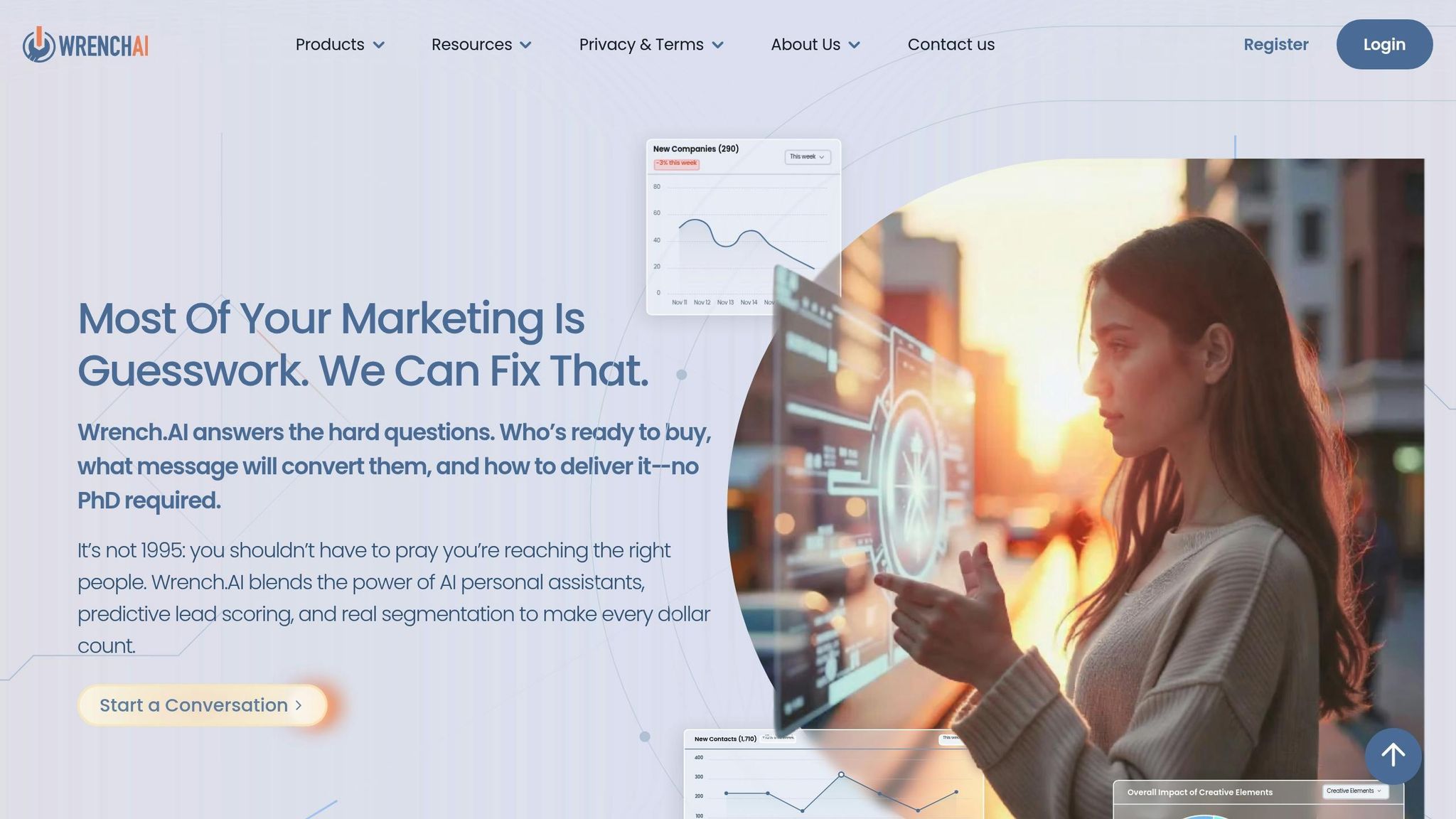
Wrench.AI makes implementing predictive AI for cross-selling easier by addressing both technical and strategic needs.
The platform’s data integration capabilities connect with over 110 sources, so you won’t need to build custom integrations for each tool in your tech stack. This saves time and reduces complexity.
With its audience segmentation features, Wrench.AI automatically identifies customer groups based on behavior and purchase history. This eliminates much of the manual effort involved in creating targeted customer segments for cross-selling campaigns.
The platform’s predictive analytics pinpoint the best timing and products for cross-selling opportunities. It learns continuously from customer interactions, refining its recommendations without requiring constant manual input.
Workflow automation is another standout feature. When an opportunity is identified, the system can automatically launch personalized email campaigns, update CRM records, or notify your sales team. This ensures no opportunity is missed while reducing your team’s workload.
Wrench.AI also offers transparent AI processes, so you can see exactly why a recommendation was made. This transparency builds trust in the system and makes it easier to explain decisions to customers when needed.
Pricing is flexible, with volume-based options starting at $0.03-$0.06 per output, making it accessible for businesses of various sizes. Custom API plans are available for companies with unique data requirements or integration needs.
For B2B companies, the account-based insights feature is particularly useful. It provides detailed views of customer behavior and preferences, enabling more personalized and effective cross-selling strategies. This is especially valuable for businesses with complex customer relationships or longer sales cycles.
Wrench.AI brings together the essential elements of predictive AI, offering a user-friendly solution that handles the technical heavy lifting. This lets your team focus on strategy and customer engagement instead of getting bogged down in technical details.
Solving Implementation Challenges and Maximizing ROI
Implementing predictive AI can be tricky, with various challenges that may limit its effectiveness. However, identifying these hurdles early and preparing solutions can transform potential frustrations into meaningful successes.
Common Implementation Problems
One of the biggest hurdles is data silos. Many companies store customer information across separate systems – sales data might live in one platform, marketing data in another, and customer service interactions somewhere else. This fragmentation makes it hard for predictive AI to access the full picture, which is essential for accurate recommendations.
Another issue is the lack of actionable insights. Some AI systems provide predictions that are either too vague or overly complex. If teams can’t clearly see the next steps, they may disregard the recommendations altogether.
Resistance to AI adoption is another common obstacle. For example, sales professionals who rely on their instincts may be hesitant to trust AI-based suggestions.
Poor data quality can also undermine AI’s potential. Duplicate records, outdated information, and incomplete data histories can lead to inaccurate predictions and missed opportunities.
Lastly, integration complexity poses a significant challenge. Older systems often lack the APIs necessary for seamless data sharing, which can lead to expensive custom development, delays, and budget overruns.
Solutions for Successful Adoption
Addressing these challenges requires a well-thought-out strategy that prioritizes centralized data and clear processes. Here’s how to tackle the most common issues:
- Centralize your data to eliminate silos. Start by auditing all your customer data sources and creating a unified database. You don’t need to replace every system right away, but ensuring smooth data flow between platforms is key.
- Build trust through transparency and training. Choose AI tools that explain their recommendations clearly. When sales teams understand why a product is being suggested, they’re more likely to trust and use the system. Regular training sessions can also help teams feel more confident about adopting AI.
- Roll out AI in phases. Start small with a pilot group of early adopters. Success stories from this group can help reduce resistance and build momentum across the organization. Plus, this approach allows you to identify and address any issues early on.
- Track performance continuously. Use dashboards to monitor key metrics like cross-selling conversion rates, average order values, and customer satisfaction. Comparing pre- and post-implementation results can highlight the value of AI and show areas for improvement.
- Focus on change management. Communicate clearly that AI isn’t here to replace employees but to enhance their capabilities. Highlight how predictive insights can make their work easier and more effective. Celebrate wins when AI-driven recommendations lead to successful outcomes.
- Improve data quality through governance protocols. Regularly clean your data, enforce validation rules, and assign ownership of data quality to specific team members. This ensures that your AI system works with reliable information.
Cross-Selling Challenges and AI Solutions Summary
Here’s how predictive AI addresses traditional cross-selling challenges:
| Challenge | Traditional Approach | Predictive AI Solution |
|---|---|---|
| Implementation Timing | Guesswork based on sales cycles | Real-time behavioral data to optimize timing |
| Product Selection | Generic or intuition-based choices | Customer preference-driven, data-backed recommendations |
| Dynamic Segmentation | Broad demographic categories | Real-time segmentation based on customer behavior |
| Process Standardization | Dependent on salesperson experience | Consistent, data-driven recommendations across teams |
| Performance Measurement | Basic conversion tracking | Detailed metrics and predictive success analysis |
Maximizing ROI
To get the most out of predictive AI, a systematic approach is essential. Start by investing in solid data preparation, team training, and phased rollouts. These steps not only ensure a smoother implementation but also help you see positive results faster.
When budgeting, remember to account for more than just the AI platform’s subscription fees. A significant portion of the expense often lies in preparing your data, training your team, and adjusting existing processes.
Lastly, align your success metrics with your broader business goals. While revenue growth is important, don’t overlook other indicators like customer satisfaction, improved team efficiency, and better data quality. Regularly refining your AI system ensures it stays relevant as customer behaviors and market conditions evolve.
Conclusion: Achieving Cross-Selling Success with Predictive AI
Predictive AI takes the uncertainty out of cross-selling, replacing guesswork with precise, data-driven strategies that drive both revenue and customer satisfaction.
Businesses leveraging predictive AI see real benefits: higher conversion rates, larger order values, and improved customer retention. By analyzing real-time customer behavior and purchase history, AI pinpoints the ideal moment to recommend the right product to the right person. This level of precision not only boosts sales but also eliminates the annoyance of irrelevant suggestions, creating a smoother and more personalized experience.
However, implementing predictive AI isn’t without its challenges. Issues like fragmented data and team pushback can hinder success. Companies that prioritize centralized data systems, thorough training programs, and gradual rollouts tend to see better results. The goal is to use AI as a tool that complements human expertise – not replaces it. With this mindset, integrating a strong AI platform becomes a game changer.
For organizations ready to take the leap, platforms such as Wrench.AI provide solutions that simplify the process. These platforms offer AI-powered personalization tools and integrate data from over 110 sources, all while maintaining user-friendly and transparent systems. This makes adopting predictive cross-selling much easier than it might seem at first glance.
As the market continues to evolve, waiting to adopt AI could mean falling behind competitors. Regularly monitoring performance and maintaining high-quality data ensures that your AI strategy stays aligned with changing customer behaviors and market trends.
FAQs
How does predictive AI improve customer engagement and satisfaction compared to traditional cross-selling methods?
Predictive AI takes customer engagement to the next level by analyzing massive datasets to predict individual preferences and needs. With this insight, businesses can deliver personalized recommendations and solutions ahead of time, crafting a customer experience that feels tailored and relevant.
On the flip side, traditional cross-selling often leans on broad, one-size-fits-all offers and reactive strategies. These approaches can come across as impersonal and less impactful. By anticipating what customers want before they even ask, predictive AI not only enhances engagement but also strengthens trust and loyalty, paving the way for better outcomes overall.
What challenges do businesses face when using predictive AI for cross-selling, and how can they address them?
Businesses face a range of challenges when adopting predictive AI for cross-selling. Some of the most common obstacles include data security concerns, the complexity of integrating AI tools with existing CRM systems, and the shortage of skilled professionals in data science and analytics. On top of that, managing imbalanced datasets and keeping up with ever-changing privacy regulations can create additional roadblocks.
To address these challenges, companies should begin by defining clear and measurable objectives for their AI projects. Building a skilled team through talent development and implementing strong data governance practices are also essential steps. By focusing on security and compliance from the outset, businesses can tap into the true potential of predictive AI to boost cross-selling efforts effectively.
How can businesses prepare their data to maximize the benefits of predictive AI for cross-selling?
To get the best results from predictive AI in cross-selling, businesses must start with accurate, consistent, and current data. This means regularly cleaning up CRM data, fixing errors, and eliminating outdated or duplicate records.
Using AI-driven tools to monitor data quality and setting up routine audits can make this process more efficient. Clean, well-organized data is crucial because it directly affects the precision of AI predictions and, ultimately, the effectiveness of cross-selling strategies.