

AI tutors are transforming higher education by offering personalized learning, 24/7 support, and cost-effective solutions. These AI-driven systems analyze how students learn, adjusting in real time to provide tailored feedback and resources. With the ability to assist thousands of learners simultaneously, AI tutors address challenges like accessibility, affordability, and diverse learning needs.
Key Points:
- Personalized Learning: AI tutors adapt to individual learning styles and pace, improving academic outcomes.
- Cost Savings: AI tutoring costs 5–15% of traditional tutoring, saving families up to $3,540 annually.
- 24/7 Availability: Students can access help anytime, making it ideal for busy schedules.
- Equity in Education: AI bridges gaps in underserved areas by providing quality support regardless of location.
- Evolving Educator Roles: Professors focus on mentorship and complex teaching tasks while AI handles repetitive activities.
- Ethics and Privacy: Institutions must address concerns like data security, algorithmic bias, and academic integrity.
AI tutors are not replacing educators but complementing their work, creating a balance between technology and human interaction. The future of education lies in using AI responsibly to improve learning experiences while maintaining ethical standards.
AI in Action | AI-Powered Tutoring in Higher Education: A Scalable Approach to Personalized Learning
How AI Tutors Work and Their Capabilities
Grasping how AI tutors operate sheds light on their expanding role in American higher education. These systems use advanced technologies to craft personalized learning experiences, reshaping how education is delivered in universities across the country.
Technology Behind AI Tutors
AI tutors are powered by Intelligent Tutoring Systems (ITSs), which integrate advanced technologies like machine learning and natural language processing. These systems analyze student interactions as they happen, allowing them to adjust feedback and content dynamically. This real-time data processing is what makes the tailored learning experience possible.
How AI Tutors Personalize Learning
AI tutors use performance data collected in real time to adapt the difficulty and pace of lessons based on each student’s progress. This personalized approach ensures that the support provided aligns closely with individual learning needs, helping students achieve better outcomes in their academic journey.
Key Benefits of AI Tutors in Higher Education
AI tutors are stepping up to meet the varied challenges of higher education by offering tailored learning experiences, 24/7 support, and significant cost savings. They’re changing the game by making quality educational assistance more accessible and affordable for students everywhere.
Personalized Learning at Scale
One of the standout features of AI tutors is their ability to provide customized guidance to a massive number of students all at once. While a traditional tutor might work with 20–30 students weekly, AI systems can handle up to 194 students simultaneously, all while maintaining a personal touch for each learner [1].
And here’s the kicker: this scalability doesn’t mean sacrificing quality. In fact, math students using AI tutoring tools improved their proficiency by 4–9 percentage points, all at just 5–15% of the cost of traditional human tutoring [1]. A Harvard study backs this up, showing that AI tutoring in physics doubled learning outcomes while cutting costs by 40%. For perspective, AI sessions averaged $49 compared to $85 for human-led sessions, delivering better results at a lower price [1].
This ability to scale effortlessly pairs perfectly with the constant availability AI tutors provide.
24/7 Accessibility
Unlike human tutors tied to office hours, AI tutors are always on. They respond in as little as 0.2 to 1.5 seconds [1], making them an ideal solution for students managing work, family, or living in different time zones.
This around-the-clock access is a game-changer for modern learners. A whopping 92% of remote students say they prefer AI tutors because of the convenience [1]. Whether it’s a late-night study session, an early-morning review, or a last-minute question, AI tutors are there to help. For students with packed schedules, this means they can stay on top of their studies without having to sacrifice other obligations.
Promoting Equity and Saving Costs
AI tutors don’t just enhance learning – they also level the playing field. By making quality educational support affordable, they help bridge economic and geographic divides. Families, for instance, save an average of $1,780 per year – a massive 86% reduction compared to traditional tutoring costs [2]. While human tutoring can cost $3,840 annually for two sessions a week at $40 per hour, AI tutoring costs drop to about $300 per year, saving families $3,540 [2].
"AI tutoring is fast, affordable, and scalable, while human tutoring offers personalized guidance and emotional understanding."
– Dialzara Team [1]
This affordability is especially impactful for lower-income families. Among households earning less than $50,000 annually, 72% turn to AI platforms for core subjects, reserving human tutors for specialized needs [1]. Schools also benefit, with districts typically paying just $25–$35 per student annually for AI tutoring platforms [2].
Geographic barriers are another hurdle AI tutors help overcome. In the U.S., 78% of counties lack qualified STEM tutors [1], leaving rural and underserved communities with limited options. AI platforms eliminate these barriers, providing equal access to students regardless of location.
For instance, in February 2025, Khan Academy’s AI-powered math tutor, Khanmigo, showcased its accessibility by offering services for just $35 per student. This aligns with the typical AI tutoring subscription model, which ranges from $20 to $60 per month for unlimited access [1]. Similarly, Tutorela’s premium plan offers over 10,000 math exercises for a small monthly fee, serving more than 50,000 students worldwide and delivering over 95% in savings compared to traditional tutoring costs [2].
sbb-itb-d9b3561
AI Tutoring Tools and Real-World Applications
Wrench.AI‘s Role in Education
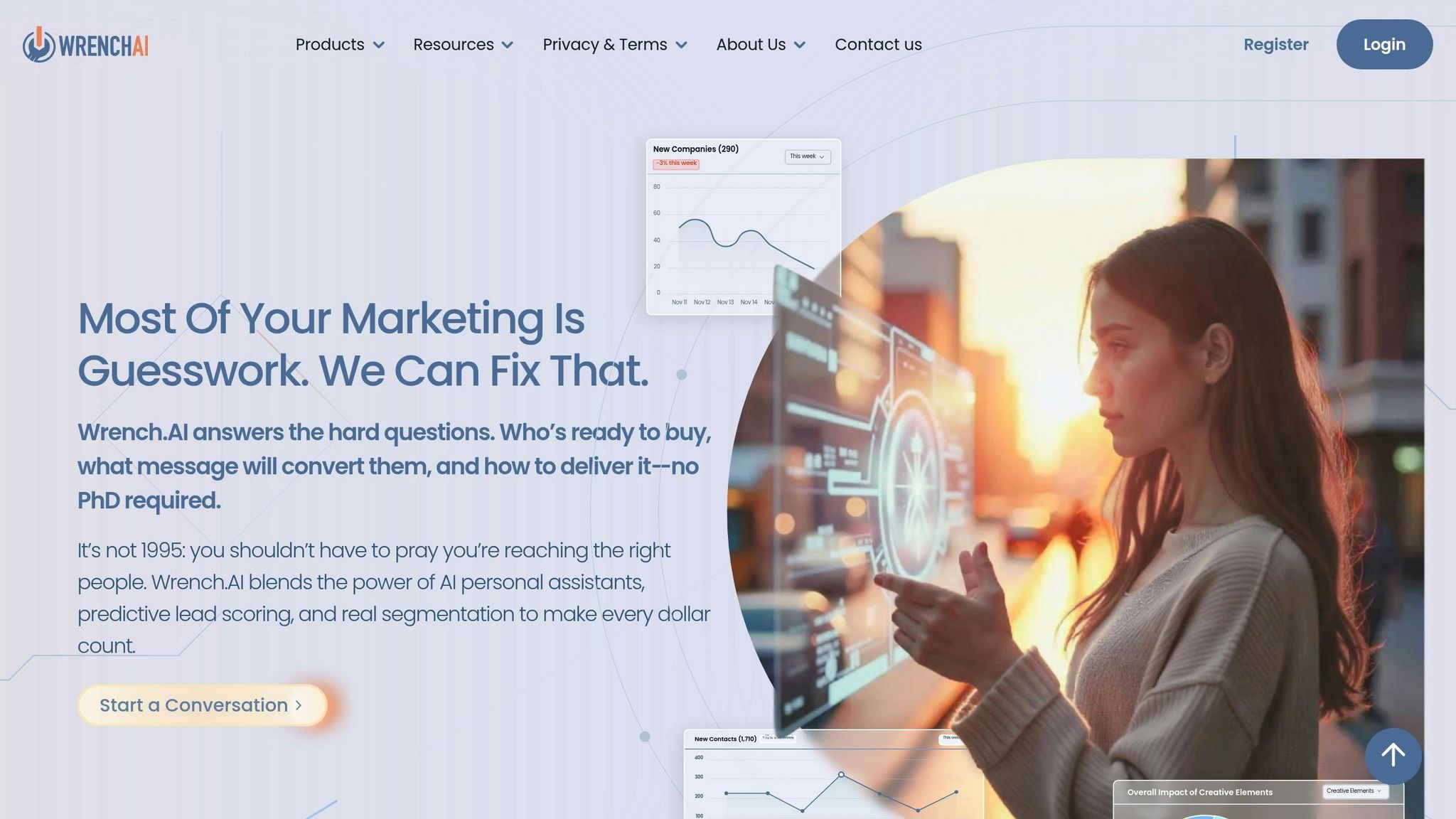
Wrench.AI takes the personalization and scalability of AI tutors and applies them to business education, showcasing how AI can deliver tailored learning experiences in specialized areas. With the ability to connect to over 110 data sources, Wrench.AI provides a powerful tool for students studying topics like marketing analytics, consumer behavior, and business intelligence.
In marketing education, Wrench.AI serves a dual purpose: it’s both a learning resource and a platform for hands-on application. Students get to work with live market data, learning how to master audience segmentation, optimize campaigns, and apply predictive analytics. This bridges the gap between classroom theory and real-world business demands, equipping students with the skills needed for data-driven careers.
Through AI-driven personalization, students can experiment with segmentation tools, gaining insights into crafting targeted marketing strategies. But the benefits don’t stop with students – Wrench.AI also supports instructional design. For those diving into business process optimization and marketing operations, the platform’s workflow automation tools provide valuable, practical learning opportunities. By creating and testing automated marketing workflows, students see firsthand how AI can handle repetitive tasks while still delivering personalized results at scale.
Educators, too, gain from Wrench.AI’s capabilities. With custom API setups and options like CSV/S3 ingestion, instructors can design assignments that incorporate real-world scenarios. This use of live data not only makes coursework more engaging but also ensures students are building skills that translate directly into their future careers.
The Future of Teaching and Learning with AI Tutors
How AI Changes Teaching Roles
AI isn’t here to replace professors – it’s here to redefine their roles. Instead of spending time on repetitive tasks like grading or answering basic questions, educators can now focus on more meaningful aspects of teaching. AI takes care of routine responsibilities, allowing professors to dedicate time to research, mentoring, and guiding students through complex problem-solving.
This shift is also reshaping how curricula are designed. Educators collaborate with AI systems to create dynamic learning environments, crafting assignments that tap into AI’s data-crunching power while ensuring students build critical thinking skills – something machines can’t replicate.
Even student assessments are evolving. Traditional tests are being replaced with project-based evaluations, where students demonstrate their ability to use AI tools effectively. Professors step into the role of coaches, teaching students how to balance AI assistance with independent thought. These changes are setting the stage for new trends that are transforming education.
New Trends and Developments
With teaching roles evolving, fresh trends are emerging in education. One standout is predictive analytics. Universities are using AI-driven algorithms to spot students who might be struggling before they fall too far behind. By identifying these issues early, schools can intervene in ways that improve retention and success rates.
AI tutors are also helping students personalize their learning journeys. These systems recommend courses and resources tailored to individual needs, which is especially valuable for working adults in professional development programs who need flexible, customized options.
Assessments are becoming more adaptive, too. Instead of one-size-fits-all standardized tests, AI systems now adjust question difficulty and format based on a student’s responses. This approach not only provides a more accurate picture of what students know but also helps reduce test anxiety.
Natural language processing is making AI tutors feel more approachable. Students can ask questions in plain English and receive clear, easy-to-understand answers, which can be a game-changer for those who struggle with traditional academic language.
Another exciting development is microlearning. AI breaks down complex topics into small, manageable chunks that students can tackle in short study sessions. This method fits today’s busy schedules and shorter attention spans while still delivering effective learning outcomes.
Ethics and Privacy Concerns
As AI tutors personalize education, they also raise critical questions about ethics and privacy. For example, the detailed profiles AI systems create – tracking everything from study habits to performance metrics – require strong protections. Universities must decide who owns this data, how long it’s stored, and who can access it.
Algorithmic bias is another concern. If AI systems are trained on biased data, they can unintentionally reinforce existing inequalities. This is particularly troubling for underrepresented groups who might not receive the same quality of AI support due to a lack of diverse training datasets.
Academic integrity is also a gray area. Institutions need clear guidelines to distinguish between acceptable AI assistance and cheating. Collaboration among educators, students, and tech providers is essential to ensure AI enhances learning without undermining academic standards.
Transparency is becoming non-negotiable. Both students and educators need to understand how AI systems make decisions, whether it’s grading assignments or making recommendations. The opaque, "black box" nature of some AI tools conflicts with the need for clear, explainable feedback.
Finally, there’s the issue of digital equity. While AI has the potential to make education more accessible, it could also widen the gap between students who have reliable internet and modern devices and those who don’t. Schools must address these disparities to ensure AI benefits everyone.
Balancing human oversight with AI efficiency is another challenge. Deciding when human intervention is necessary – like when an AI makes a recommendation about a student’s academic path – requires careful judgment. Striking the right balance is key to maintaining both the efficiency of AI and the value of human insight in education.
Conclusion and Key Takeaways
AI tutors are reshaping the landscape of higher education. Their growing presence highlights how essential they’ve become in modern learning environments. This shift demands a thoughtful approach that blends the precision of AI with the irreplaceable value of human mentorship.
When used effectively, AI doesn’t replace human interaction – it amplifies it. Universities that leverage AI for routine tasks, like administrative work and personalized learning pathways, allow professors to focus on mentoring and tackling complex challenges. This balance ensures that essential skills like critical thinking and creativity remain central to education. To fully unlock AI’s potential, institutions must prioritize comprehensive training, enforce clear policies, and establish ethical guidelines. For example, the U.S. Department of Education is already advocating for AI literacy and professional development through supplemental grants, signaling growing support for these initiatives [4].
The success of AI in education also depends on proactive planning and ethical implementation. Educators looking to integrate AI tutors should start by identifying clear learning objectives. From there, they can select tools that align with those goals and encourage a culture of experimentation. Teaching students about ethical AI use – covering topics like bias, privacy, and fairness – should be a key part of any program [3].
Addressing concerns like privacy and equity right from the start is equally important. Universities that embed these considerations into their AI design will foster more inclusive learning environments. Digital equity and transparent decision-making not only build trust but also ensure that all students benefit from these advancements.
Institutions that embrace AI as a collaborative tool are already seeing the rewards. Predictive analytics are helping identify and support struggling students, adaptive assessments are reducing test anxiety, and microlearning opportunities are catering to today’s fast-paced lifestyles. The key is striking the right balance – leveraging AI’s efficiency while preserving the human connections that make education meaningful.
AI is undeniably changing higher education. The real challenge lies in how quickly institutions can adapt to its potential while safeguarding the human elements that make learning a transformative experience.
FAQs
How do AI tutors ensure fair and unbiased support for all students, including those from underrepresented groups?
AI tutors aim to create a level playing field by using training data that reflects a broad range of backgrounds and experiences. This approach helps minimize bias and ensures students from various communities receive fair and equal support. Additionally, involving diverse teams during the design phase plays a key role in identifying and addressing potential biases early in the process.
Keeping these systems fair and effective also requires consistent updates to both algorithms and datasets. Together, these efforts enable AI tutors to deliver tailored, impartial learning experiences that cater to the needs of all students, including those from underrepresented groups.
How is student privacy and data security protected when using AI tutors in higher education?
Student privacy and data security are critical considerations when integrating AI tutors into higher education. Colleges and universities implement strong safeguards like data encryption, anonymization, and strict access controls to keep sensitive student information secure and prevent breaches.
Moreover, institutions adhere to privacy laws such as FERPA, ensuring that AI platforms operate within strict boundaries to limit data sharing. By prioritizing secure and transparent systems, schools can provide students with the benefits of AI-driven learning tools while protecting their personal information.
How can educators combine AI tutors with traditional teaching methods to improve learning while keeping the human connection in education?
Educators can integrate AI tutors into their classrooms by treating them as tools to support learning rather than replace traditional teaching methods. AI tutors excel at offering personalized guidance, adapting to individual learning styles, and delivering instant feedback. This frees up teachers to focus on what they do best – building meaningful relationships, encouraging critical thinking, and addressing students’ emotional and social needs.
To keep the human connection at the heart of education, teachers should see AI as a partner, not a substitute. This means staying updated through ongoing training, working alongside AI systems, and ensuring that technology enhances rather than overshadows the human qualities of teaching, like empathy and moral leadership. When used thoughtfully, this balance can lead to a richer, more impactful learning experience for students.