
CRM data is reshaping how businesses interact with customers by fueling conversational AI systems to deliver tailored experiences.
Here’s the core idea: By combining CRM data – like purchase history and preferences – with conversational AI, companies can create chatbots that act more like personal assistants. These systems analyze customer profiles in real-time, offering responses, product recommendations, and support that feel custom-made.
However, it’s not just about personalization. Privacy laws like the California Consumer Privacy Act (CCPA) mean businesses must balance tailored interactions with strict data protection measures. Advanced platforms like Wrench.AI lead the way, offering deeper insights and better results compared to generic systems, but they require more setup and expertise.
Key takeaways:
- CRM + AI Integration: Real-time data access enables smarter, context-driven conversations.
- Privacy Matters: Compliance with U.S. privacy laws is mandatory.
- Advanced vs. Generic Systems: Platforms like Wrench.AI outperform basic CRM tools by pulling data from 110+ sources and delivering precise customer insights.
This combination of CRM data and conversational AI can boost customer satisfaction, reduce churn, and even increase revenue by 10–20%, according to McKinsey.
How AI Agents Are Creating Hyper-Personalized Experiences for Customers | Salesforce CIO Corner
How CRM Data Powers Conversational AI Personalization
CRM systems and conversational AI work together to create personalized customer experiences by seamlessly integrating data. Modern AI platforms connect directly to CRM databases, ensuring a smooth flow of customer information that allows every interaction to feel tailored and relevant.
Data integration is the backbone of this process. Conversational AI systems access CRM platforms in real-time, pulling detailed customer profiles through APIs. These profiles include interaction history, preferences, and other key details. For example, when a customer starts a chat, the AI instantly retrieves their profile, enabling it to respond with context and precision.
Machine learning plays a key role in analyzing customer preferences. The AI picks up on patterns like preferred communication times, product interests, or even emotional tone. Let’s say a customer consistently buys premium products and tends to make decisions quickly – this insight allows the AI to prioritize high-value options rather than starting with basic suggestions.
Real-time personalization is where this integration truly shines. As conversations progress, the AI continuously references CRM data to refine responses, recommend products, or offer tailored support. For instance, if a customer recently bought a specific item, the AI might suggest complementary products or provide targeted support resources. Personalization goes beyond product recommendations – it can adapt communication styles, offer tier-specific pricing, or route complex issues to the right teams. These capabilities ensure every interaction feels thoughtful and accurate.
The system achieves this by processing CRM data through normalization techniques and using natural language processing (NLP) to interpret customer intent. By combining historical patterns with real-time inputs, the AI delivers responses that are not just contextually relevant but also personally meaningful.
To protect sensitive customer data, robust encryption and strict access controls are in place. AI systems in the U.S. must comply with privacy regulations, including consent management features that respect customer preferences. This might involve excluding certain data from AI processing or anonymizing interactions entirely, depending on state laws or customer requests.
Real-time synchronization keeps customer profiles up to date. Changes like new purchases, updated preferences, or profile modifications are reflected in the AI system within minutes. This ensures the AI always works with the most current data, avoiding the risk of outdated personalization that could frustrate customers or miss opportunities.
CRM data also powers predictive analytics, enabling the AI to anticipate customer needs. For example, if a customer regularly reorders a product every three months, the system can proactively send renewal offers before the next expected purchase. These predictive capabilities shift conversational AI from being reactive to becoming a proactive tool that drives engagement and boosts customer satisfaction.
1. Wrench.AI
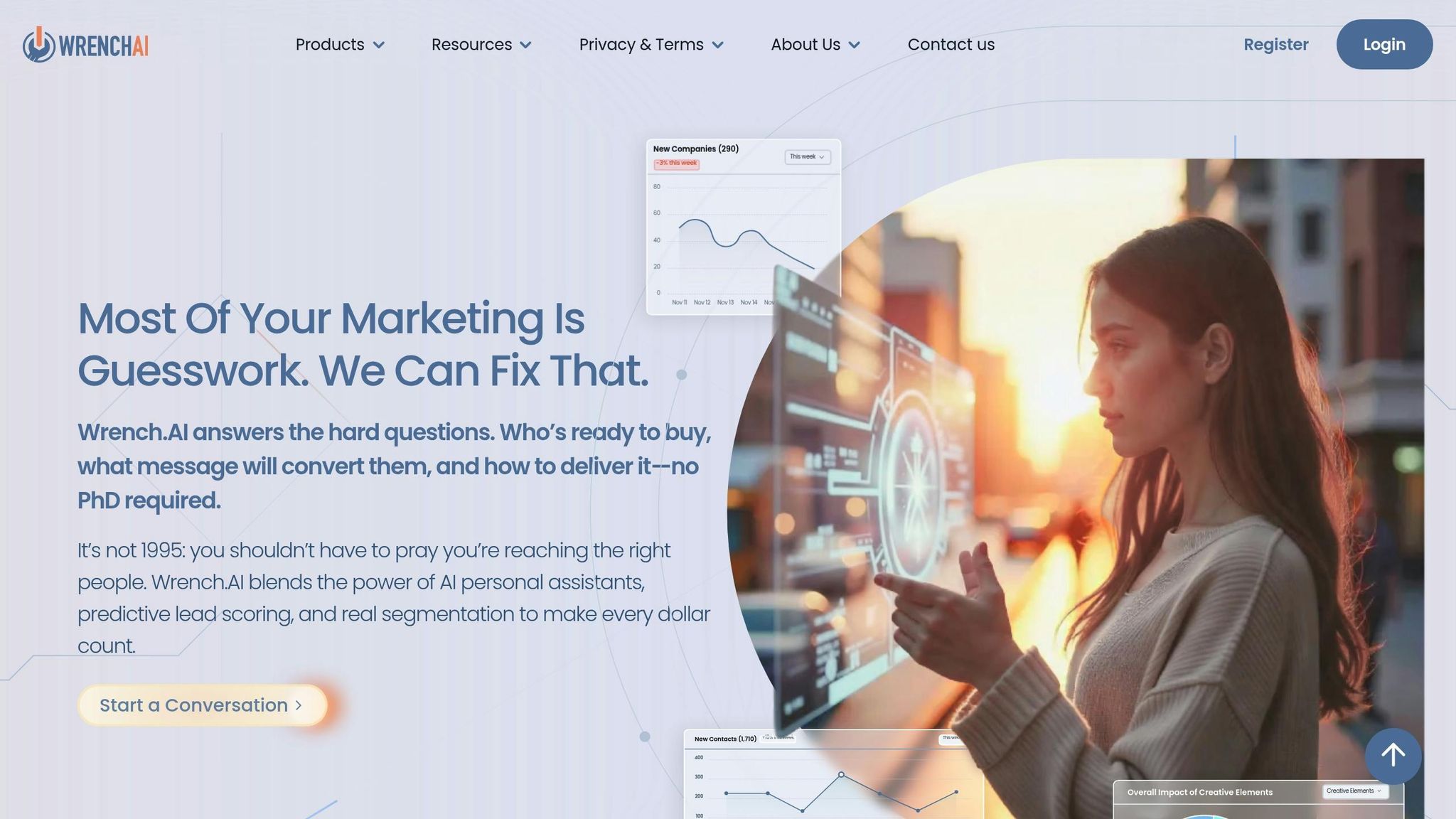
Wrench.AI takes CRM data to the next level, combining it with advanced AI insights to deliver highly targeted and personalized customer interactions. This platform transforms how businesses engage with their customers by seamlessly integrating data and tailoring interactions with precision.
Data Integration
Wrench.AI stands out by connecting with over 110 data sources, pulling information from CRMs, marketing automation systems, social media, and third-party databases. What makes it unique is its ability to blend CRM data with public data, incorporating details like company growth metrics, industry trends, and behavioral signals. It processes both historical and real-time data, ensuring businesses have the most up-to-date insights into customer behavior.
Personalization Depth
The platform uses an AI-driven affinity score (ranging from 0 to 100) to measure the strength of connections between customer profiles and brand elements. This scoring system enables Wrench.AI to craft responses that are highly relevant to individual interests and challenges. The results speak for themselves: engagement rates are five times higher than industry norms, response rates hit 16%, and high-potential leads are identified with 183% greater accuracy compared to traditional CRM lead scoring systems [1].
Business Outcomes
The impact on business performance is impressive. Users report achieving up to 10 times more acquisitions compared to traditional lists and three times more than manual prospecting efforts. Sales teams have seen productivity gains of 12.5–25% without additional costs, while opportunities convert three times more effectively. On top of that, customer churn is significantly reduced [1].
Wrench.AI also offers a flexible pricing model, charging between $0.03 and $0.06 per output. This makes advanced personalization affordable and scalable for businesses of all sizes, adapting effortlessly to their growth. Up next, we’ll explore how Wrench.AI stacks up against standard CRM-driven conversational AI systems.
sbb-itb-d9b3561
2. Generic CRM-Driven Conversational AI Systems
Platforms like Wrench.AI set a high bar for CRM integration, but generic systems often stick to the basics. These systems rely on standard customer data and offer limited personalization. While they can handle fundamental tasks, they often fall short when it comes to deeper insights, broader integration, and adaptability.
Data Integration
Generic platforms usually connect to well-known CRMs and marketing tools, pulling data from internal sources like customer interactions, purchase history, and demographics. However, they rarely incorporate external data or real-time market trends, which limits their ability to provide a complete picture.
The integration process often involves manual setup and batch updates, which slows down the flow of actionable insights. In fast-paced sales environments, this delay can mean missing out on key opportunities as customer needs change quickly.
Personalization Depth
Most generic systems rely on rule-based methods for personalization, segmenting customers into broad groups based on simple criteria like past purchases or company size. This often leads to messaging that feels impersonal and fails to resonate on an individual level. Unlike advanced platforms, these systems struggle to adjust messaging in real time to reflect a customer’s unique profile, which can directly affect engagement and business outcomes.
Business Outcomes
For companies using these systems, the results are typically better than manual processes but far from groundbreaking. While they may see some gains in productivity and lead conversion, scalability and accuracy often remain challenges. Misaligned efforts, such as chasing poorly qualified leads, can waste valuable resources. On top of that, fixed monthly pricing per user can become a financial strain as teams grow, making it harder to scale while maintaining a personalized customer experience.
Pros and Cons
When comparing CRM-driven conversational AI systems, the differences between advanced platforms like Wrench.AI and more generic options become clear. These distinctions are crucial for businesses to weigh, especially when balancing personalization goals with budget considerations. Let’s break down the trade-offs to better understand how each system can influence business outcomes.
| Criteria | Wrench.AI | Generic CRM Systems |
|---|---|---|
| Data Integration | Pros: Connects with over 110 data sources for comprehensive insights Cons: Complex setup and configuration may be needed |
Pros: Basic integration with CRM tools Cons: Limited to internal data and slower batch processing workflows |
| Personalization Depth | Pros: Uses AI for highly tailored, predictive personalization Cons: Requires high-quality data to perform effectively |
Pros: Simple, rule-based segmentation for quick results Cons: Broad, static groupings limit personalization |
| Pricing Structure | Pros: Volume-based pricing ($0.03–$0.06 per output), scaling with usage rather than team size Cons: Costs rise with high usage |
Pros: Predictable monthly fees for budgeting Cons: Per-user pricing can become expensive as teams grow |
| Business Outcomes | Pros: Boosts conversion rates through precise targeting, improves lead quality, and supports scalable growth Cons: Requires proper implementation and data strategy |
Pros: Automates manual processes for moderate productivity improvements Cons: Limited scalability and lower-quality leads |
| Technical Capabilities | Pros: Offers custom API configurations, workflow automation, and transparent AI processes Cons: Advanced features may need technical expertise |
Pros: Simple, user-friendly interfaces with minimal technical know-how required Cons: Limited customization and rigid automation rules |
In fast-paced sales environments, the differences in performance become more evident. Generic systems, which rely on batch updates, often struggle to keep up with real-time market or customer changes, leading to missed opportunities for engagement.
Another key factor is the learning curve. Generic platforms are easy to use right out of the box but may lack the scalability to support long-term growth. On the other hand, platforms like Wrench.AI demand an upfront investment in setup and training. However, once teams become proficient, they can unlock far greater potential through advanced personalization and automation features.
Conclusion
CRM integration is transforming how businesses engage with their customers. By combining CRM data with conversational AI, companies can deliver a level of personalization that feels tailored to each individual.
The numbers speak for themselves. McKinsey & Company reports that using AI-driven insights to create customer-focused experiences can lead to a 10–20% increase in revenue [3]. On top of that, businesses leveraging AI see a 30% boost in productivity without needing additional resources [3]. These advancements are particularly crucial in a market where 76% of consumers express frustration when their experiences lack personalization [3]. These stats highlight the importance of adopting more advanced and responsive systems.
Advanced platforms that integrate CRM data effectively stand out from basic systems. They not only lower customer acquisition costs but also improve retention rates. For U.S. businesses, this kind of integration supports long-term growth. While simpler CRM systems might seem easier to implement, they often fail to scale or deliver the sophisticated personalization that modern customers expect. Considering that acquiring a new customer can cost 5 to 7 times more than retaining an existing one, tapping into CRM data for predictive modeling and proactive engagement becomes a business necessity.
The projected $80 billion reduction in agent labor costs by 2026 [2] further emphasizes the need for strategic investments in advanced technology. Companies that adopt platforms capable of integrating over 110 data sources and delivering AI-driven personalization will be better positioned to capture this value. Those sticking to basic CRM solutions may find themselves struggling to keep up.
The key to success lies in using CRM data as the backbone for predictive modeling and automation. This blend of technology and data doesn’t just improve one-on-one customer interactions – it also creates a lasting competitive edge. For businesses in the U.S. aiming to thrive in an increasingly personalized marketplace, platforms like Wrench.AI provide the tools needed to turn customer data into a meaningful and sustained advantage.
FAQs
How does integrating CRM data improve conversational AI personalization?
Integrating CRM data with conversational AI gives businesses a powerful tool to create deeply personalized customer experiences. By tapping into detailed insights like purchase history, preferences, and past interactions, AI systems can craft responses that feel more relevant and in tune with the customer’s needs.
With access to CRM data, conversational AI can anticipate what customers might need, customize recommendations, and offer real-time support. This level of personalization not only enhances engagement but also increases satisfaction, helping businesses strengthen customer relationships and achieve better results.
How can businesses ensure they comply with privacy laws when using CRM data to personalize AI interactions?
To stay within the bounds of privacy laws while using CRM data for AI-powered personalization, businesses should prioritize data minimization – collecting only the data that’s absolutely necessary to meet their objectives. Being upfront with customers is equally important. Make sure to clearly explain how their data is gathered, stored, and used. This level of transparency goes a long way in building trust.
Protecting sensitive information requires robust security practices. This includes using encryption, implementing strict access controls, and conducting regular audits to ensure data safety. On top of that, securing explicit customer consent and providing options for them to manage their data are essential steps. These practices help businesses stay compliant with regulations like GDPR and CCPA, which are being enforced more rigorously across the United States.
What makes platforms like Wrench.AI better for personalization than standard CRM-based conversational AI systems?
Platforms like Wrench.AI take customer relationship management to the next level by pulling data from various sources to build rich customer profiles and personas. This approach helps businesses tailor their interactions with customers in a way that feels more personal and relevant.
On top of that, Wrench.AI includes advanced features like predictive analytics, audience segmentation, and automation. These tools empower businesses to deliver customized, real-time experiences on a larger scale. The result? Better customer engagement and improved conversion rates – making it an effective choice for businesses looking to refine their marketing and sales strategies.