
AI tools are reshaping marketing and sales, but they often fall short in critical areas. Here’s the key takeaway: while AI brings speed and efficiency, it struggles with understanding context, flawed data, and personalization errors. These issues can harm customer relationships, waste resources, and undermine trust.
Main Challenges with AI in the Workplace:
- Personalization Failures: Irrelevant or poorly timed messages due to outdated or incomplete data.
- Bias and Misinterpretation: AI can misread customer behavior and reinforce biases.
- Over-Personalization: Narrow targeting can fragment teams and lose sight of broader goals.
- Privacy and Ethics Risks: Excessive data collection without clear consent damages trust and invites legal issues.
How to Solve These Problems:
- Clean and update data regularly.
- Use human oversight to review AI decisions.
- Balance personalization with broader messaging.
- Implement strong privacy policies and transparent data practices.
Platforms like Wrench.AI can help by improving data quality, reducing errors, and supporting ethical AI usage. The key is to treat AI as a tool to assist human decision-making, not replace it.
AI-Powered Marketing: How to Personalize Without Overstepping Customer Trust
Why AI Personalization Fails
AI promised to revolutionize customer experiences with personalized interactions, but the reality often falls short. Instead of delivering tailored messages, many AI systems churn out irrelevant, poorly timed, or even inappropriate communications that alienate customers.
This disconnect between expectation and reality usually arises from core issues in how AI systems handle and apply customer data. These aren’t just minor glitches – they’re systemic problems that can derail marketing efforts and strain customer relationships.
What Causes Personalization Mistakes
The root of most personalization failures lies in flawed data. When customer information is inaccurate or outdated, AI systems make misguided decisions. For instance, a customer who moved months ago might still receive promotions for their old location. Similarly, someone who canceled a subscription could keep getting upgrade offers long after they’ve left.
Another major issue is limited training data. AI systems require large, diverse datasets to accurately recognize customer behavior patterns. Without this variety, the AI ends up making broad, oversimplified assumptions – like assuming all individuals in the same age group share identical preferences.
Algorithm configuration problems add to the challenge. Many businesses deploy AI tools without adjusting them to fit their specific audience or industry. As a result, algorithms might misinterpret customer signals, weigh factors incorrectly, or overlook seasonal trends in behavior.
Fragmented data systems further complicate things. When AI can’t access a complete view of customer activity – such as sales history, support interactions, website behavior, and email engagement – it operates with an incomplete picture. This often leads to contradictory or irrelevant messaging.
These missteps in data management and algorithm setup directly contribute to the negative outcomes outlined below.
How Bad Personalization Hurts Business
The fallout from poor personalization goes well beyond awkward customer interactions. It can have serious repercussions for a company’s bottom line and reputation.
- Customer satisfaction declines when people are repeatedly targeted with irrelevant content. They may start to see the brand as disconnected or careless with their personal information.
- Email engagement plummets when personalization misses the mark. Customers lose interest, unsubscribe, or flag messages as spam. This not only damages email sender reputation but also reduces the effectiveness of future campaigns.
- Marketing budgets are wasted on poorly targeted efforts. Time and resources spent on irrelevant content result in minimal returns, while genuine opportunities may be missed because the AI misinterpreted customer intent.
- Brand trust erodes when customers feel misunderstood or bombarded with irrelevant messages. Even after the issues are resolved, the damage to trust can linger, making it harder to rebuild relationships.
Meanwhile, competitors with better personalization strategies gain an edge, strengthening customer loyalty and increasing their market share. Businesses struggling with AI failures risk falling behind.
How to Fix Personalization Problems
Addressing these challenges requires a combination of better data practices, refined algorithms, and human oversight. Here are some actionable steps to get personalization back on track:
- Clean and update data regularly: Ensure customer records are accurate and standardized. Implement validation rules to catch errors before they enter your system.
- Integrate data systems: Connect sales, support, analytics, and email platforms to give AI a complete view of customer behavior.
- Continuously test and refine algorithms: Use A/B testing to evaluate different personalization strategies and identify what works best. Regularly monitor performance and adjust as needed.
- Introduce human oversight: Have marketing teams review AI-generated content before it goes out. This extra layer of quality control can catch obvious mistakes or inappropriate messaging.
- Leverage tools like Wrench.AI: Platforms like Wrench.AI help businesses create more accurate customer segments using detailed behavioral data. Their campaign management tools also improve timing and messaging, reducing the risk of sending irrelevant content.
- Start small: Gradual implementation often works better than trying to personalize everything at once. Begin with basic personalization, like using customer names correctly or segmenting by simple preferences. Refine processes before moving on to more complex strategies.
Finally, keep a close eye on email engagement, customer feedback, and conversion rates. These metrics can help pinpoint what’s working and highlight areas that need adjustment. By addressing these personalization pitfalls, businesses can rebuild trust, improve engagement, and make better use of their marketing efforts.
Data Mistakes and AI Bias
AI’s ability to personalize experiences is impressive, but it’s not without its flaws. Beyond the noticeable personalization missteps, deeper issues like data misreads and biases can quietly undermine AI’s effectiveness. These challenges aren’t just about technical errors – they reveal a fundamental struggle in grasping context, which can harm customer trust and business outcomes over time.
How AI Misinterprets Data
AI systems excel at processing massive amounts of data in record time, but they often miss the nuances that come naturally to humans. For example, if a customer suddenly changes their purchasing habits, the AI might interpret this as a sign of disengagement or heightened price sensitivity. In reality, the shift could be influenced by external factors, like a temporary financial situation or a one-time need.
Seasonal or regional spending patterns are another area where AI can stumble. What might seem like a drop in engagement could actually reflect holiday traditions or economic cycles. Additionally, AI can confuse correlation with causation. Take this scenario: the system notices that customers frequently checking pricing details are more likely to cancel subscriptions. The AI might conclude that price-checking behavior is the problem, overlooking the real issue – confusion about the pricing structure. Similarly, relying on outdated data can lead to recommendations that feel irrelevant to customers’ current needs.
These misinterpretations can snowball, introducing biases that skew how AI handles diverse customer data.
The Issue of Biased AI
Bias in AI systems is often unintentional but can have serious consequences. When training data doesn’t adequately represent the full spectrum of customer behaviors and demographics, certain groups can be unfairly excluded or misrepresented. For instance, if the data heavily reflects one geographic or demographic group, insights from underrepresented groups may be undervalued or ignored entirely.
Historical bias is another hurdle. It reinforces past patterns, meaning the AI may favor certain groups simply because they were prioritized in the past. Behavioral bias can also creep in when limited data leads to overly simplistic assumptions about customer intent, unfairly categorizing individuals who deviate from the "norm."
Strategies to Minimize Bias and Data Errors
Addressing these challenges requires businesses to rethink how they collect, process, and oversee data. Here are some steps to help:
- Diversify Data Sources: Broaden the range of data inputs to capture a more representative picture of customer behaviors and preferences.
- Conduct Bias Testing: Regularly analyze outcomes to spot disparities across different customer groups.
- Build Feedback Loops: Allow customers to flag inaccurate recommendations, providing valuable insights to retrain AI models.
- Introduce Human Oversight: For critical decisions that impact customer relationships, ensure a knowledgeable reviewer validates the AI’s conclusions.
- Use Contextual Data: Incorporate information like seasonal trends, economic indicators, or situational factors to give the AI a more complete understanding of customer actions.
- Monitor Performance Metrics: Track how the AI performs across various demographic and behavioral segments to ensure improvements benefit everyone equally.
Routine algorithm audits can reveal both strengths and weaknesses, giving businesses the opportunity to fine-tune their strategies. By maintaining transparency and a commitment to fairness, companies can build trust and create systems that better serve all customers.
Too Much Personalization and Isolated Teams
Over-personalization isn’t just a customer experience challenge – it can also disrupt internal team dynamics. When AI systems focus too much on hyper-targeted personalization, they risk fragmenting teams and creating operational silos, making collaboration and cohesive strategies harder to achieve.
Problems with Excessive Personalization
Over-personalization can narrow customer segments so much that teams lose sight of bigger market opportunities. For instance, marketing teams might find themselves running countless micro-campaigns, each tailored to a specific audience. While this sounds efficient, it often leads to fragmented outreach, making it difficult to identify overarching themes or maintain consistent brand messaging.
The issue becomes even more complicated when various departments rely on separate AI-driven insights. This creates a disconnect, resulting in inconsistent customer experiences – where potential customers receive mixed messages depending on the touchpoint they engage with.
Another drawback is the strain on resources. Teams stretched thin by juggling too many micro-campaigns often produce content that lacks impact, leading to diminishing returns. Additionally, focusing heavily on existing customer patterns can stifle creativity. When AI systems rely solely on historical data, they can discourage teams from exploring new ideas, products, or markets that fall outside established personalization models.
To address these problems, businesses need to rethink their approach to personalization and find a balance that works.
Finding the Right Balance
The key to effective personalization lies in striking a balance between relevance and scalability. Companies should prioritize the customer attributes that genuinely influence business outcomes and focus their personalization efforts on those areas.
For example, instead of running separate campaigns for customers who prefer emails on Tuesday mornings versus Wednesday afternoons, businesses can group customers into broader categories based on general communication preferences. This keeps the messaging relevant while avoiding operational overload.
Testing boundaries is another essential step. Not all customer interactions require deep personalization. Some touchpoints perform better with standardized messaging that appeals to a wider audience. By experimenting, companies can determine where personalization adds value and where it complicates operations unnecessarily.
Flexibility is also crucial. AI systems should assist teams, not dictate every decision. Teams should be empowered to override AI recommendations when human judgment suggests a more effective approach.
How to Prevent Team Isolation
Over-personalization doesn’t just affect customers – it can also disrupt teamwork. Without a coordinated strategy, departments risk working in silos, undermining collaboration and shared goals.
To combat this, companies should use centralized platforms and hold regular cross-team reviews. Shared customer insights and performance metrics help align efforts, ensuring departments don’t send conflicting messages. For example, when marketing, sales, and customer success teams access the same AI-driven recommendations, they can better coordinate their strategies and present a unified message to customers.
Measuring teams on shared outcomes, like customer lifetime value or overall conversion rates, also encourages collaboration. Teams are more likely to work together when their success depends on collective results rather than individual AI-driven metrics.
Automated workflows can further streamline operations. Tools like Wrench.AI allow teams to incorporate personalization into standardized processes, reducing the need for manual coordination. This approach ensures personalization remains effective without overwhelming teams or creating inefficiencies.
Finally, setting clear boundaries for personalization is essential. Not every interaction or piece of content needs to be hyper-customized. By deciding which areas benefit most from AI-driven personalization and which should remain standardized, teams can focus on high-impact opportunities without getting bogged down in endless customization.
Balancing personalization with team alignment is a critical step in refining a company’s overall AI strategy.
sbb-itb-d9b3561
Privacy, Security, and Ethics Issues
AI systems bring undeniable benefits to workplace efficiency, but they also introduce significant challenges in privacy, security, and ethics. While these tools can streamline operations, they often come with risks that many businesses might not fully anticipate. These concerns extend beyond just data breaches, touching on how companies manage and safeguard sensitive information.
Privacy Problems in AI Systems
AI tools used in marketing and sales often collect more data than necessary. Many systems automatically gather emails, customer interactions, browsing habits, and even internal communications – often without clear guidelines defining what is truly essential for their functionality.
The problem arises when excessive data collection occurs without explicit consent. For instance, combining customer calls, social media activity, and purchase histories can create privacy risks and leave companies vulnerable to regulatory penalties. Such practices can undermine trust and expose businesses to legal scrutiny.
Another issue lies in ambiguous consent processes. Employees and customers are frequently left in the dark about what data is being collected and how it will be used. On top of that, retaining data indefinitely – even after users request its deletion – can lead to violations of privacy laws, such as the California Consumer Privacy Act (CCPA).
How to Use AI Ethically
To ensure ethical AI usage, companies need to implement clear policies and maintain ongoing oversight. Establishing robust data governance policies is a critical first step. These policies should define what data AI systems can access, how long it will be stored, and under what circumstances it can be shared.
Adopting privacy-by-design principles is another key measure. This approach involves configuring AI systems to gather only the minimum amount of information needed for their specific tasks. Regular audits can ensure that data collection remains limited and purpose-driven, reducing the risk of privacy violations.
Transparency is equally important. Employees and customers should be fully informed about what data is being collected, how it will be used, and what options they have to control it. This includes providing clear opt-out mechanisms and promptly honoring data deletion requests. Regular ethical reviews, combined with employee training on privacy and bias in AI systems, can further support responsible AI practices.
By prioritizing these measures, businesses can build the trust necessary to deploy AI effectively and responsibly.
How Wrench.AI Supports Ethical AI
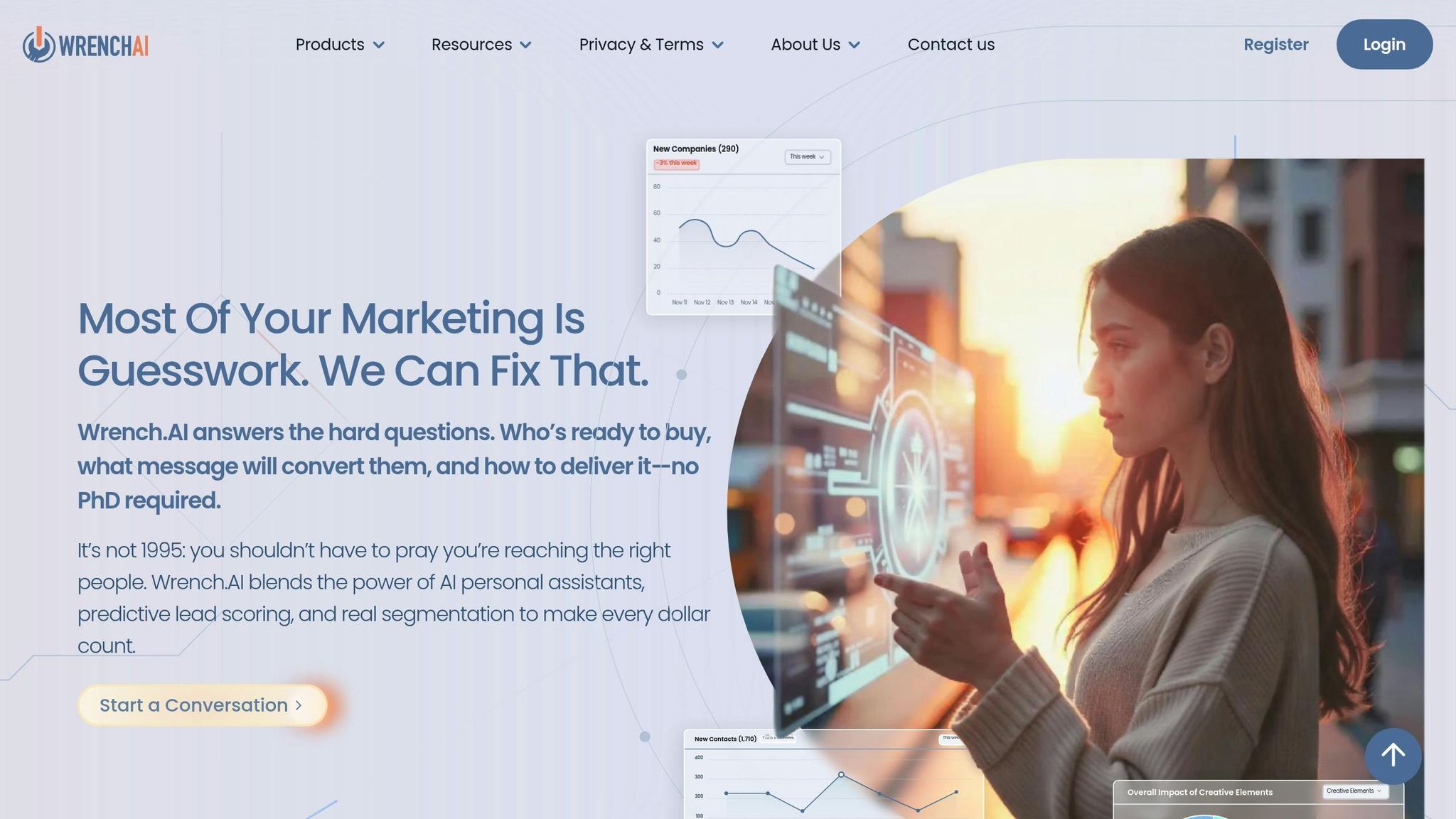
Wrench.AI stands out as a platform that prioritizes privacy and ethical AI practices. It provides users with clear visibility into how their data is being used, addressing many common concerns around transparency. The platform integrates seamlessly with over 110 data sources, allowing businesses to connect AI systems to existing tools without compromising established data controls.
A key feature of Wrench.AI is its selective data processing capability. This allows companies to determine exactly what information their AI tools can access, ensuring that data usage aligns with specific business needs. Additionally, its volume-based pricing model helps organizations manage costs while maintaining a focused and intentional approach to data handling.
Wrench.AI also promotes consistent data management through workflow automation, ensuring that teams and campaigns follow the same ethical standards. By aligning robust data controls with ethical practices, the platform helps businesses use AI responsibly without disrupting their current security protocols. This balance makes it easier for organizations to leverage AI while maintaining trust and compliance.
Practical Steps to Fix AI Problems
Tackling AI challenges requires a systematic approach. Taking proactive steps ensures smoother operations and better outcomes.
Main Lessons for US Companies
For American businesses, avoiding AI pitfalls starts with a solid framework. Focusing on four key areas can help ensure AI systems deliver consistent and effective results.
Start with personalization accuracy, which hinges on clean data and thorough validation processes. This involves setting up clear protocols for collecting, verifying, and updating customer information across all platforms and interactions.
Address data interpretation issues by maintaining ongoing monitoring and human oversight. Many successful companies schedule weekly review sessions where teams compare AI-generated insights with actual business outcomes. This practice helps identify and correct errors before they affect customer relationships or revenue streams.
Finding the right balance in personalization is essential. Too much customization can dilute brand identity, while too little can feel impersonal. The ideal approach personalizes content and timing while keeping core brand messaging consistent across all customer groups.
Lastly, privacy and security compliance should be managed proactively. Establish clear data handling policies and document who has access to system data. This ensures compliance with regulations and builds trust with customers.
By following these lessons, businesses can craft a robust and actionable AI plan.
Creating a Strong AI Plan
A solid AI strategy rests on three pillars: continuous monitoring, team education, and regular system evaluations.
- Continuous monitoring involves daily, weekly, and monthly checks. Daily checks confirm that the AI system is functioning properly. Weekly reviews focus on whether AI recommendations align with business objectives. Monthly assessments take a broader view, evaluating whether AI tools are delivering measurable value.
- Team education is just as important. Training teams to recognize errors, understand AI limitations, and know when to step in and override decisions can prevent costly mistakes. This also helps build trust in AI-assisted processes.
- Regular system evaluations keep AI tools aligned with business goals. Quarterly reviews should focus on data quality, algorithm performance, and overall business impact. Annual assessments can determine whether current tools still meet the company’s needs or if newer technologies might offer better results.
Additionally, companies should establish clear escalation procedures for unexpected AI outcomes. Define who is responsible for overriding AI decisions and create a system to document these instances. This not only improves accountability but also provides valuable insights for refining the system.
How Wrench.AI Helps
Platforms like Wrench.AI make it easier to put these strategies into practice. Here’s how:
- Its audience segmentation tools help companies avoid over-personalization by grouping customers based on real behavior patterns rather than assumptions. This ensures personalization feels relevant and impactful.
- The predictive analytics features add context to AI-generated insights, making data easier to interpret. By explaining the patterns behind its recommendations, the system helps teams validate and act on AI outputs confidently.
- Workflow automation ensures AI insights are applied consistently across marketing and sales efforts. This minimizes the risk of inconsistent personalization across different customer touchpoints.
- With integration across over 110 data sources, Wrench.AI addresses data quality issues by creating a unified view of customer information. A comprehensive data foundation reduces errors and improves personalization accuracy.
- Its volume-based pricing model, starting at $0.03-$0.06 per output, allows companies to scale AI usage gradually. This measured approach helps businesses test and refine their AI strategies without overcommitting resources too early.
- The selective data processing feature directly tackles privacy concerns. Companies can control what information their AI systems access, ensuring compliance with regulations like CCPA while still leveraging AI for growth.
Conclusion: Managing AI Problems for Better Results
AI agents have become indispensable for many American businesses, but their effectiveness hinges on thoughtful management and careful execution. The challenges discussed – like personalization missteps or data misinterpretation – aren’t roadblocks but manageable hurdles that can be addressed with the right approach.
Ignoring these issues only increases costs and erodes trust. Businesses that prioritize monitoring, invest in team training, and ensure ongoing human oversight consistently achieve better outcomes from their AI systems.
At the heart of successful AI performance is data quality. Clean, accurate, and well-organized data is non-negotiable. Without it, even the most advanced algorithms will falter. This makes proper data collection and routine validation critical steps – not optional ones. Strong data practices create the foundation for balancing automation with human decision-making.
While AI excels at crunching numbers and spotting patterns, it lacks the context, creativity, and ethical judgment that only humans can provide. In areas like marketing and sales, AI should complement – not replace – human interaction. It can help refine strategies and respond to customer needs, but the human touch remains irreplaceable.
Looking ahead, companies that see AI as a partner to human expertise – not a substitute – will reap the greatest rewards. This involves training teams, setting clear guidelines, and choosing platforms that prioritize transparency and control.
As technology evolves, the core principles of effective AI management – strong data practices, human oversight, ethical considerations, and continuous monitoring – will remain unchanged. Master these today, and you’ll be ready to embrace tomorrow’s advancements.
FAQs
How can businesses use AI in marketing and sales to personalize experiences without compromising customer privacy?
To find the right balance between creating personalized experiences and respecting privacy, businesses should embrace privacy-by-design principles. This means using AI tools that safeguard user data, such as anonymization techniques or contextual personalization methods that don’t rely on building detailed user profiles. These approaches allow companies to tailor experiences without crossing privacy lines.
Relying on first-party and zero-party data – information that customers willingly provide – can also strengthen trust while enabling relevant and engaging content. Clear communication about how data is used, paired with strict adherence to U.S. privacy laws, is essential for maintaining customer confidence and staying compliant. By combining these approaches, businesses can deliver meaningful interactions that respect individual privacy.
How can companies reduce AI bias and ensure fair treatment of all customer groups?
To address AI bias and ensure systems treat all users fairly, companies should begin with diverse, well-rounded datasets. These datasets need to reflect the full spectrum of customer groups to avoid skewed outcomes. Regular audits of AI systems are equally important – they help spot and correct biases as models are updated and refined.
Another key step is adopting fairness-focused algorithms. These algorithms are designed to minimize bias during decision-making processes. Equally important is building diverse development teams, as varied perspectives can lead to more balanced and inclusive AI solutions. Finally, setting clear ethical guidelines for AI use helps ensure that fairness and inclusivity remain central throughout the design and deployment process.
How does human involvement make AI systems more effective in managing customer interactions and interpreting data?
Human involvement is crucial for making AI systems work better by ensuring accuracy, fairness, and trustworthiness. People play a key role in spotting and fixing errors, addressing biases, and managing unintended outputs – especially in more complicated scenarios.
By offering ethical guidance and fine-tuning AI responses, humans help ensure these systems stay aligned with a company’s values and meet customer expectations. This partnership not only produces more dependable results but also enhances customer experiences, particularly in situations that require sensitivity or a nuanced approach.