

AI depends on high-quality, well-organized data to deliver accurate insights and personalized experiences. Poor data – riddled with errors, duplicates, or outdated entries – leads to flawed AI outcomes like irrelevant recommendations or wasted marketing efforts. To make your data AI-ready, focus on these steps:
- Audit Your Data: Catalog all data sources, check for gaps, duplicates, and inconsistencies, and assess integration between systems.
- Clean and Validate: Standardize formats, remove duplicates, and ensure data is complete, accurate, and up-to-date.
- Integrate Systems: Use APIs or data warehouses to unify customer data across platforms for a consistent view.
- Govern Your Data: Assign ownership, enforce access controls, and comply with privacy regulations like CCPA and GDPR.
- Leverage Tools: Platforms like Wrench.AI automate data integration, segmentation, and real-time updates to simplify preparation.
TECH TALK: Preparing Your Data for Use with AI
How to Assess Your Current Data Readiness
Evaluating your current data setup is essential to understanding how well it aligns with the demands of AI. A data readiness assessment helps you identify gaps in your infrastructure and determine whether your data can support AI-driven initiatives. This process lays the groundwork for crafting an AI-powered marketing strategy.
How to Conduct a Data Audit
A data audit is the first step in grasping the state of your data environment. Start by cataloging all your data sources – these might include tools like CRMs, marketing platforms, e-commerce systems, social media, email tools, and third-party data providers.
For each source, note the type of data it contains, the volume of data it holds, and how often it’s updated. For instance, customer data might include contact details, purchase history, website activity, email engagement stats, and demographic information.
Next, assess the quality and completeness of each data source. Look for missing fields, duplicate entries, outdated records, or inconsistencies in formatting. These issues can hinder the effectiveness of AI systems.
Examine how accessible and integrated your data is across different platforms. Can your marketing team easily pull data from customer service tools? Do your sales and marketing systems share information without friction? Identifying silos and integration challenges is crucial for streamlining data flow.
Don’t forget to evaluate your data storage and processing infrastructure. Consider whether your current systems can handle the computational demands of AI, factoring in storage capacity, processing speeds, and scalability to meet future needs.
Finally, review your data governance practices. Who has access to specific data? How are quality standards maintained? What security measures are in place to protect sensitive information? Addressing gaps in governance is critical before diving into AI implementation.
Signs Your Data Is Ready for AI
Once your audit is complete, look for key indicators that show your data is prepared to support AI initiatives.
- Completeness across key fields: When essential customer details – like contact information, purchase history, and engagement metrics – are consistently recorded, AI models can better identify patterns and generate insights.
- Standardization across systems: Uniform formats for data, such as consistent naming conventions and product categories, reduce the need for extensive preprocessing, allowing AI systems to function more efficiently.
- Real-time or frequent updates: Systems that refresh data in real-time or near-real-time ensure your AI tools work with the most current information, enabling timely and relevant recommendations.
- Minimal duplicates and inconsistencies: Clean data, free from redundancies, allows AI models to focus on genuine patterns rather than being skewed by errors.
- Strong governance frameworks: Clear ownership, access controls, and ongoing quality checks show that your organization understands the importance of data management. Teams that follow established protocols are more likely to see successful AI outcomes.
- Seamless system integration: When your primary platforms communicate effortlessly, AI tools can access a diverse range of data sources, leading to richer customer insights.
- Robust datasets for specific use cases: AI models thrive on comprehensive datasets that capture a wide range of customer interactions. This depth supports better personalization and segmentation efforts.
Organizations with these characteristics are well-positioned to implement AI solutions effectively, ensuring smoother transitions and more impactful results.
How to Build a Strong Data Foundation
Creating a solid data foundation means setting up reliable processes for collecting, cleaning, and integrating data. The goal is to turn scattered information into dependable datasets that AI systems can process effectively.
How to Collect and Organize Quality Data
Start by gathering first-party data from your website, app, email interactions, and customer service channels. Use tracking systems to monitor user behavior, preferences, and engagement. This data forms the base for understanding your customers.
Consistency is key. Standardize naming conventions for customer and campaign data. When teams use inconsistent labels for similar stages in the customer journey, it can confuse AI systems and disrupt data analysis.
Use gradual profiling to collect customer information over time. Instead of overwhelming visitors with lengthy forms, start with basic details and gather more information through follow-up interactions. This approach improves form completion rates while building detailed customer profiles.
Automation can make data collection more efficient and accurate. Tools like customer relationship management (CRM) systems can automatically log email opens, website visits, and purchase history. Marketing automation platforms can track campaign performance and customer responses without manual effort. Automation minimizes human error and ensures consistent data capture.
Involve multiple departments in data collection workflows. For example:
- Customer service teams can document support ticket details.
- Sales representatives can log meeting notes and deal updates.
- Marketing teams can track campaign results.
When these processes follow consistent formats and timelines, they create a complete picture of your customers that AI systems can analyze.
To ensure data accuracy from the start, implement validation rules at the point of entry. For instance, check that email addresses are formatted correctly, phone numbers include area codes, and required fields are filled out before submission. These checks help prevent bad data from entering your systems.
How to Clean and Validate Your Data
Once you’ve collected data, the next step is ensuring it’s accurate and usable for AI applications.
Start by identifying and merging duplicate records. Consolidating these duplicates into single profiles ensures you’re working with complete and accurate customer data.
Standardize formatting across all data fields. For example, make sure addresses follow the same structure, phone numbers include country codes, and product names match exactly across systems. Consistency like this helps AI algorithms recognize patterns and make better predictions.
Keep your data up to date. Use automated tools or manual checks to flag records that haven’t been updated in a while. Customer details and preferences change, so maintaining current information is critical for reliable AI recommendations.
Automated tools can also validate emails, addresses, and phone numbers, improving overall data quality. For missing data, take a strategic approach. Decide which fields are essential and which are optional, and develop rules for keeping, supplementing, or removing incomplete records based on your needs.
Assign data quality scores to each record. Points can be based on how complete, accurate, and recent the information is. High-quality records can be prioritized for AI training, while low-quality ones may need further cleaning.
Set up ongoing monitoring to catch emerging issues. Automated reports can flag anomalies, like spikes in bounced emails or incomplete forms, so you can address problems before they affect AI performance.
Clean, validated data is the backbone of effective system integration, which we’ll dive into next.
How to Connect Data Across Multiple Systems
After organizing and cleaning your data, integration is the next step to create a unified view of your customers.
Start by mapping relationships between platforms. For example, ensure CRM customer IDs link seamlessly to email, e-commerce, and support systems. A master customer identifier can tie all touchpoints together.
Use application programming interfaces (APIs) for real-time data connections between systems. Many modern platforms, like marketing and sales tools, offer APIs that allow for automatic data sharing. For instance, a CRM can instantly update when a purchase is made, triggering personalized email campaigns.
Consider data warehousing solutions to centralize information from different sources. Services like Amazon Redshift, Google BigQuery, and Microsoft Azure Synapse Analytics can store and process large amounts of data efficiently. Costs for these solutions typically depend on usage.
Create unified customer profiles that combine various data points, such as browsing history, purchase patterns, email engagement, customer service interactions, and even social media activity. These comprehensive profiles help AI systems make more accurate predictions and recommendations.
Set up synchronization schedules to keep data fresh without overloading your systems. Some data, like website activity, might sync in real time, while other updates – like monthly summaries – can follow a set schedule. High-priority actions, such as major purchases or urgent support issues, should trigger immediate updates.
Ensure data from different systems is converted into consistent formats. For instance, if one platform uses percentages and another uses raw numbers for engagement data, establish rules to standardize these metrics for AI processing.
Before deploying AI systems, thoroughly test your integrations. Make sure information flows smoothly between platforms, updates are reflected consistently, and data relationships stay intact. Errors in integration can lead to inaccurate AI outputs and poor customer experiences.
Finally, monitor data flow continuously. Set up alerts for failed transfers, missing records, or delays to ensure everything runs smoothly.
Data Governance and Compliance Best Practices
Strong data governance not only protects your organization but also ensures that your data is ready for AI applications. Clear, well-defined policies safeguard your data while building trust with stakeholders. Effective governance secures data and enhances its utility as the foundation for AI-driven personalization. Once governance is in place, the next step is aligning with privacy regulations and maintaining high data quality.
How to Set Up Data Ownership and Access Rules
To promote accountability, assign data stewards to oversee specific types of information. For example, customer service data might fall under the support team, while marketing data remains the responsibility of the marketing department. These stewards ensure data quality and manage access within their areas.
Role-based access is another essential practice. For instance, sales representatives might need access to customer contact details and purchase histories but not sensitive financial records or internal analytics. Similarly, marketing teams may require visibility into engagement metrics and campaign performance but should not access individual customer support tickets.
Document all access rules in a central policy. This policy should outline who approves new access requests, the duration of permissions, and the schedule for periodic reviews. Conduct quarterly reviews to confirm that employees have access only to the data necessary for their current roles.
Audit logs are a valuable tool for tracking data access. Many modern platforms automatically record access activities, making it easier to detect unusual behavior or unauthorized attempts. Regularly monitoring these logs helps address potential issues early.
For sensitive data requests, implement approval workflows. For example, if someone needs access to customer financial details or personal information, require managerial approval and document the business purpose. This step discourages casual browsing while ensuring legitimate needs are met promptly.
Consider adopting data classification levels, similar to how organizations handle confidential documents. Public data, like product descriptions, might require minimal protection, while personal customer information demands stricter controls. AI training data often falls somewhere in the middle, requiring both protection and broader access for analysis.
How to Meet U.S. Data Privacy Laws
Navigating U.S. data privacy laws can be complex, as regulations vary by state and industry. Currently, 20 states have enacted comprehensive data privacy laws, many of which will take effect in 2025 and 2026 [1][2][4]. This patchwork of laws often requires businesses to comply with multiple regulations simultaneously.
California’s Consumer Privacy Act (CCPA) and its enhancement, the California Privacy Rights Act (CPRA), serve as benchmarks for many other state laws. These regulations grant consumers rights such as knowing what personal data you collect, requesting its deletion, and opting out of its sale or use for targeted advertising.
A common principle across most state laws is data minimization. Businesses can only collect information that is necessary and proportionate to their stated purposes [1][2][4]. For AI, this means clearly defining what data is needed for training and personalization, and limiting collection to those specific requirements.
Consumer rights often include access to personal data, the ability to correct errors, and options to delete or opt out of certain uses [4]. Businesses must handle these requests efficiently, typically within 30 to 45 days, depending on the law.
Universal opt-out tools, like Global Privacy Control, must be respected where required [4]. If a user activates this browser signal, your systems should automatically honor their preference to opt out of data sales and targeted advertising.
For AI, pay close attention to Automated Decision-Making Technology (ADMT) regulations. Proposed updates to the CCPA specifically address AI systems, requiring clear opt-out options and access rights [1][2].
If your business processes data from European residents, the EU General Data Protection Regulation (GDPR) also applies [3][4]. This adds requirements such as obtaining explicit consent for data processing and providing the right to data portability.
For high-risk activities like targeted advertising, conduct Data Protection Impact Assessments (DPIAs). These assessments help identify privacy risks and document the steps taken to address them. Once compliance is ensured, focus on maintaining data quality through ongoing checks.
How to Maintain Data Quality Over Time
Over time, data naturally degrades as customer details change, systems evolve, and new data sources are introduced. Regular maintenance is crucial to prevent this deterioration from affecting your AI systems.
Schedule monthly quality audits to identify common issues like duplicate records, outdated contact details, and missing fields. Automated tools can detect most problems, but human oversight ensures corrections are contextually accurate. Use triggers to prompt updates when specific events occur, such as a customer changing jobs or making significant purchases.
Each department that handles customer information should have a designated data steward. While these stewards don’t need to be full-time data professionals, they should understand quality standards and have the authority to make corrections.
Track data freshness by monitoring how long it’s been since records were last updated or verified. For example, customer contact information older than 12 months might require verification, while behavioral data could become outdated in just 90 days. Set different standards based on how quickly each type of data typically changes.
Establish feedback loops to capture and address quality issues as they arise. For instance, if a sales representative discovers an incorrect phone number, they should be able to flag it for correction across all systems, not just their local copy.
Validation rules can prevent new issues from entering your system. For example, ensure email addresses follow proper formatting, phone numbers include area codes, and required fields are completed before records are saved.
Finally, use automated monitoring to detect sudden changes in data patterns, and conduct regular integration checks to confirm data flows correctly between platforms, especially after software updates or configuration changes.
sbb-itb-d9b3561
Tools and Technology for Data Readiness
Having the right tech stack can completely change how you handle data for AI. It automates tedious tasks, reduces mistakes, and frees up time for more strategic work. Let’s dive into how Wrench.AI simplifies data integration and automation for your business.
Wrench.AI Platform Features Overview
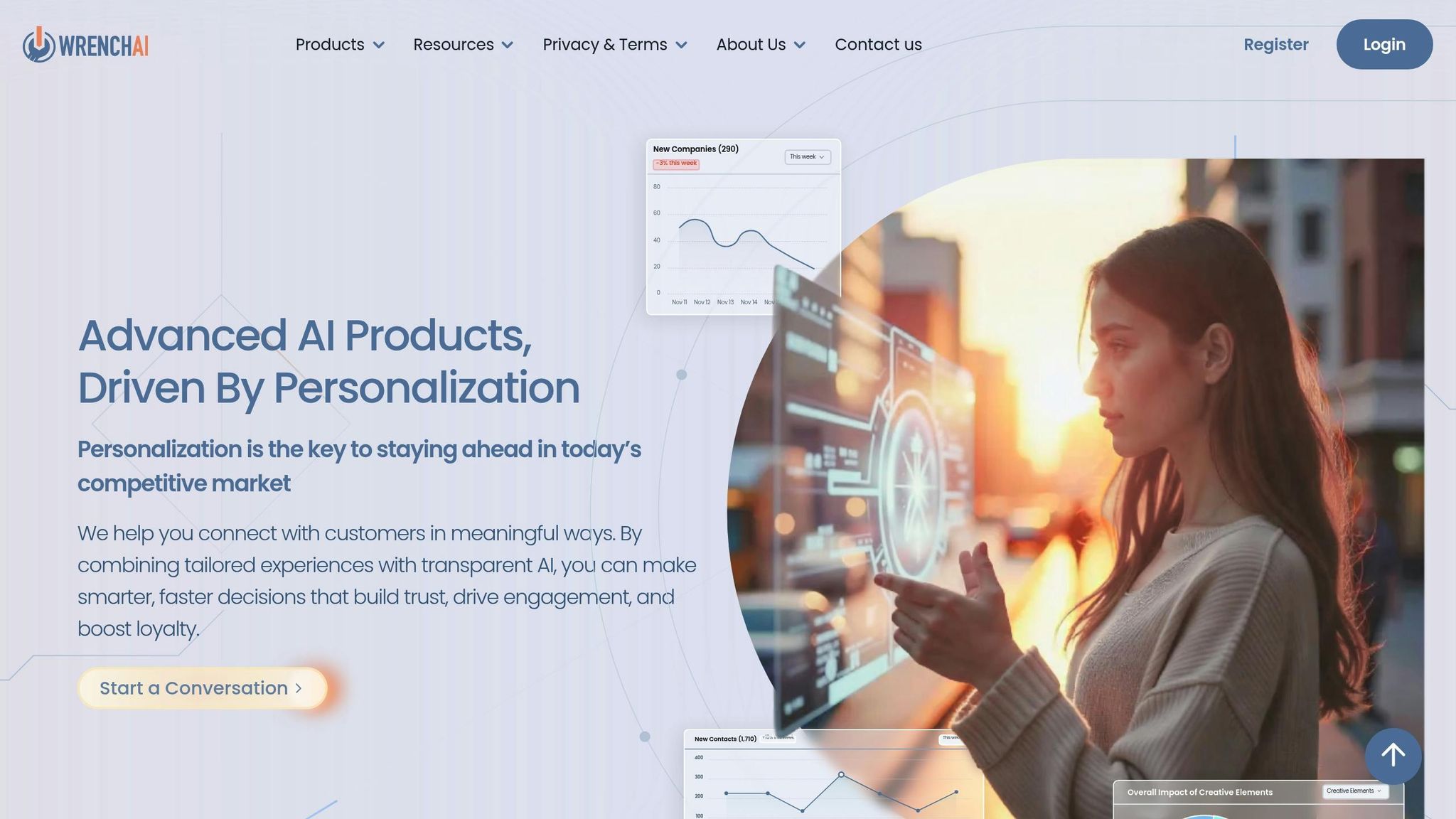
Wrench.AI takes the hassle out of preparing data for AI-powered marketing. It connects with over 110 data sources, eliminating the need for manual data transfers between systems. This integration pulls together customer information from your CRM, website analytics, email campaigns, and social media platforms into one unified system.
The platform also uses automated audience segmentation to analyze behavioral trends, purchase history, engagement stats, and demographics. This helps identify detailed customer groups. Its predictive analytics feature enables marketing teams to anticipate customer actions, while account-based insights offer a deep understanding of high-value leads and current clients. Additionally, campaigns are continuously fine-tuned through automated testing and real-time performance tracking, ensuring your messaging and targeting stay sharp.
How Automation Improves Data Processes
Automation is a game-changer when it comes to streamlining data workflows for AI. By reducing manual input, it eliminates bottlenecks and ensures your data is always clean, validated, and enriched in real time.
For example, when a prospect hits a specific engagement level, the system can automatically flag them, trigger personalized email sequences, and alert your sales team. This ensures no opportunity slips through the cracks, and follow-ups are timely.
On top of that, predictive data appending enhances customer profiles with up-to-date insights. Real-time processing keeps marketing strategies flexible and responsive to the latest data. Plus, continuous error detection ensures your data quality remains top-notch.
Wrench.AI Features and Benefits Comparison
Wrench.AI’s features, powered by automation, optimize every step of data preparation. These tools ensure your AI systems are working with accurate, integrated, and current information.
| Feature | Benefit |
|---|---|
| 110+ Data Source Integration | Combines data from all channels into one AI-ready system |
| Automated Audience Segmentation | Identifies highly specific, dynamic customer groups |
| Predictive Analytics | Forecasts customer actions and uncovers new opportunities |
| Real-time Data Processing | Reacts quickly to customer behaviors |
| Account-based Insights | Provides detailed profiles of high-value leads and customers |
| Campaign Optimization | Continuously improves marketing strategies based on real-time feedback |
| Data Quality Monitoring | Automatically detects and resolves inconsistencies |
| Workflow Automation | Simplifies repetitive tasks, allowing teams to focus on strategy |
Wrench.AI also offers flexible pricing, starting at $0.03 to $0.06 per output, with custom API configurations available for businesses with unique needs. This pricing model lets you gradually adopt AI capabilities while maintaining your current data workflows.
How to Improve Data Readiness Over Time
Improving data readiness is not a one-time task – it’s an ongoing effort that grows alongside your business and advancements in AI technology. As your company evolves, so must your data strategies. By building processes that allow for continuous improvement, you can ensure your organization remains competitive and maximizes the returns on its AI investments.
How to Monitor and Improve Data Strategies
Regularly evaluating your data strategies is crucial to maintaining their effectiveness. Start by conducting monthly data quality assessments – these should measure factors like completeness, accuracy, and how well your data integrates across different systems. Don’t just focus on the technical side; also assess how well your data strategies align with business goals.
Customer feedback can be a goldmine for spotting data gaps. For example, irrelevant recommendations or poorly targeted campaigns could indicate issues with your data collection or processing. Keep an eye on metrics like customer engagement rates, unsubscribe rates, and support tickets related to personalization problems. These indicators often reveal flaws that technical audits might miss.
Experimentation is another key tool. Use A/B testing to refine data enrichment, segmentation, and attribution methods. Once you identify what works, document and standardize those successful practices for future use.
Additionally, benchmarking against industry standards can provide valuable insights. Industry surveys and reports can help you identify areas where your organization may be lagging or excelling compared to competitors. This external perspective ensures you’re not operating in a vacuum.
These ongoing assessments not only improve your data strategies but also set the stage for more effective training and clearer measurements of your AI-driven marketing efforts.
How to Train Teams for AI and Data Management
A strong data strategy is only as good as the people implementing it. That’s why training your teams to work effectively with AI-driven processes is essential.
Cross-functional training programs are a great starting point. These programs ensure that every team member understands their role in maintaining data quality. For instance, marketing teams should see how campaign tagging impacts data collection, while sales teams need to understand how their CRM entries affect AI model accuracy. Tailor training to specific roles so employees can connect their daily tasks to broader data objectives.
When it comes to technical skills, focus on practical, hands-on learning. Teach team members how to use data visualization tools, run basic SQL queries, and interpret AI-generated insights. They don’t need to become data scientists, but they should feel comfortable making decisions based on data-driven recommendations.
Encourage collaboration through knowledge-sharing sessions. Monthly meetings where teams discuss data successes, challenges, and innovative ideas can foster a culture of continuous learning. These sessions often uncover creative approaches to data that can be scaled across the organization.
Invest in professional development opportunities like conferences, online courses, and certifications. Also, make it a priority to update standard operating procedures (SOPs) with new best practices. This ensures that institutional knowledge doesn’t disappear when employees change roles or leave the company.
How to Measure AI Marketing Results
The combination of well-trained teams and improved data strategies leads to measurable results. Here’s how to track the impact of your efforts.
Revenue attribution is a critical metric. Set up systems that map customer journeys from their first interaction with AI-powered tools to their final purchase. For example, track how AI-generated email subject lines influence open rates, click-through rates, and ultimately sales.
Another key indicator is customer lifetime value (CLV). Compare CLV before and after implementing AI-driven personalization to see how your data readiness efforts are affecting long-term outcomes. Look beyond immediate revenue gains – also measure improvements in customer retention and cross-selling success.
Operational efficiency is another area where data readiness pays off. Measure time saved through automation, reductions in manual data entry errors, and faster campaign deployment cycles. These efficiency gains can help justify ongoing investments in your data systems and AI capabilities.
For a clear picture of AI’s impact, compare the performance of AI-powered campaigns to traditional ones. Metrics like conversion rates, cost per acquisition, and engagement rates can highlight the advantages of AI-driven strategies.
Finally, link improvements in data quality to better marketing outcomes. For instance, track how higher data completeness rates lead to more accurate customer segmentation and improved campaign performance. Faster data processing speeds can also enable more timely and relevant customer interactions.
To keep everyone aligned, create monthly scorecards that combine these metrics into a comprehensive overview of your AI marketing performance. Include both hard numbers and qualitative feedback, like team confidence in data-driven decision-making. Share these scorecards with leadership to ensure everyone stays focused on improving data readiness.
Conclusion: Your Next Steps for AI-Ready Data
Taking the steps to prepare your organization for AI-driven marketing may feel daunting, but the payoff is worth the effort. The groundwork you lay today will shape your ability to stay competitive in a rapidly evolving landscape.
Start by conducting a data audit to uncover gaps in completeness, accuracy, and system integration. This helps you identify immediate areas for improvement that could otherwise hinder your AI initiatives. Knowing where your data stands is the first step toward building a reliable foundation.
Next, focus on data governance to ensure compliance and maintain long-term data quality. Establish clear ownership rules, align with U.S. privacy regulations like CCPA, and set processes to keep your data organized as your business scales. Strong governance not only protects your data but also keeps it ready for AI applications.
Once you have a solid foundation, leverage technology to enhance your efforts. Tools like Wrench.AI can streamline data integration, processing, and analysis across more than 110 sources. However, these platforms deliver the best results only when fed clean, well-structured data. The combination of governance and technology creates a feedback loop for continuous improvement.
Take a long-term view from the start. Implement monitoring systems, training programs, and measurement frameworks to help your team adapt to new AI capabilities and shifts in the market. Companies that treat data readiness as an ongoing effort consistently achieve better outcomes with their AI investments.
The key is to begin with one priority – whether it’s a data audit, refining governance policies, or team training – and take action right away. Waiting for perfection can delay progress. By starting now, even with small steps, you’ll build momentum, see results, and gain the confidence to extend these efforts across your organization.
As AI marketing continues to transform industries, being prepared ensures you stay ahead. Companies with AI-ready data will seize opportunities, while those struggling with poor data quality risk falling behind. The real question isn’t whether you need better data – it’s how quickly you can make it happen.
FAQs
How can organizations prepare their data for successful AI implementation?
To get your data ready for AI, start by defining your goals and use cases. This ensures your data aligns with your business objectives and serves a clear purpose. Pay close attention to data quality – clean, validate, and organize it to remove errors and inconsistencies. Strong data governance is also key. This includes managing metadata, controlling access, and staying compliant with any relevant regulations.
You’ll also need to focus on processes like data collection, transformation, and labeling to make the data usable for AI systems. Don’t forget to evaluate your infrastructure to ensure it can scale and handle the demands of AI technologies. Following these steps will help set the stage for using AI effectively in your marketing and sales strategies.
How can organizations ensure their data stays high-quality to support effective AI results over time?
Keeping data in top shape over time calls for a hands-on strategy. One key step is leveraging automated tools to keep an eye on your data around the clock. These tools can spot and flag anomalies or inconsistencies as they happen, making it easier to address issues before they snowball. On top of that, regular data cleansing and profiling is a must to ensure datasets stay accurate and dependable for AI systems.
Another cornerstone of strong data management is setting up clear data governance policies. This means defining who’s responsible for what, outlining access rules, and ensuring compliance with relevant regulations. When these practices work together, businesses can supply their AI systems with clean, reliable data – paving the way for better, more consistent results.
Why is data governance important for AI, and how can businesses ensure they comply with privacy laws?
Data governance plays a key role in AI by ensuring the data used is accurate, safeguarding sensitive information, and adhering to privacy laws. With well-defined policies on data management and access, businesses can lay the groundwork for AI systems that users can trust.
To meet privacy regulations such as GDPR or CCPA, companies should implement structured privacy frameworks, routinely evaluate potential risks, and leverage tools to monitor and control who has access to data. These steps not only minimize legal exposure but also build confidence in AI-powered solutions.