
AI simplifies campaign tracking by consolidating data from various channels like email, social media, and ads into one dashboard. Tools like Wrench.AI analyze over 110 data sources, offering real-time insights and predictive analytics. Unlike older systems, these platforms eliminate fragmented data, automate workflows, and provide dynamic audience segmentation. While older methods are simpler and quicker to adopt, they often lack the depth and forecasting ability of AI solutions. For complex, multi-channel campaigns, AI tools are a smarter choice, enabling better budget allocation and performance tracking.
| Feature | AI Platforms (e.g., Wrench.AI) | Older Methods |
|---|---|---|
| Data Integration | Automatic, 110+ sources | Manual, siloed |
| Segmentation | Behavior-based, dynamic | Demographics-based |
| Predictive Analytics | Real-time insights | Historical reporting |
| Workflow Automation | Automated adjustments | Manual effort required |
| Cost | Usage-based ($0.03-$0.06/output) | Fixed licensing fees |
| Ease of Use | Steeper learning curve | Simple setup |
AI platforms excel in handling large-scale, complex campaigns, while older systems may suffice for basic needs. For marketers managing budgets over $50,000 annually, AI tools are worth the investment.
Creating Your Measurement Marketing Strategy With AI
1. Wrench.AI
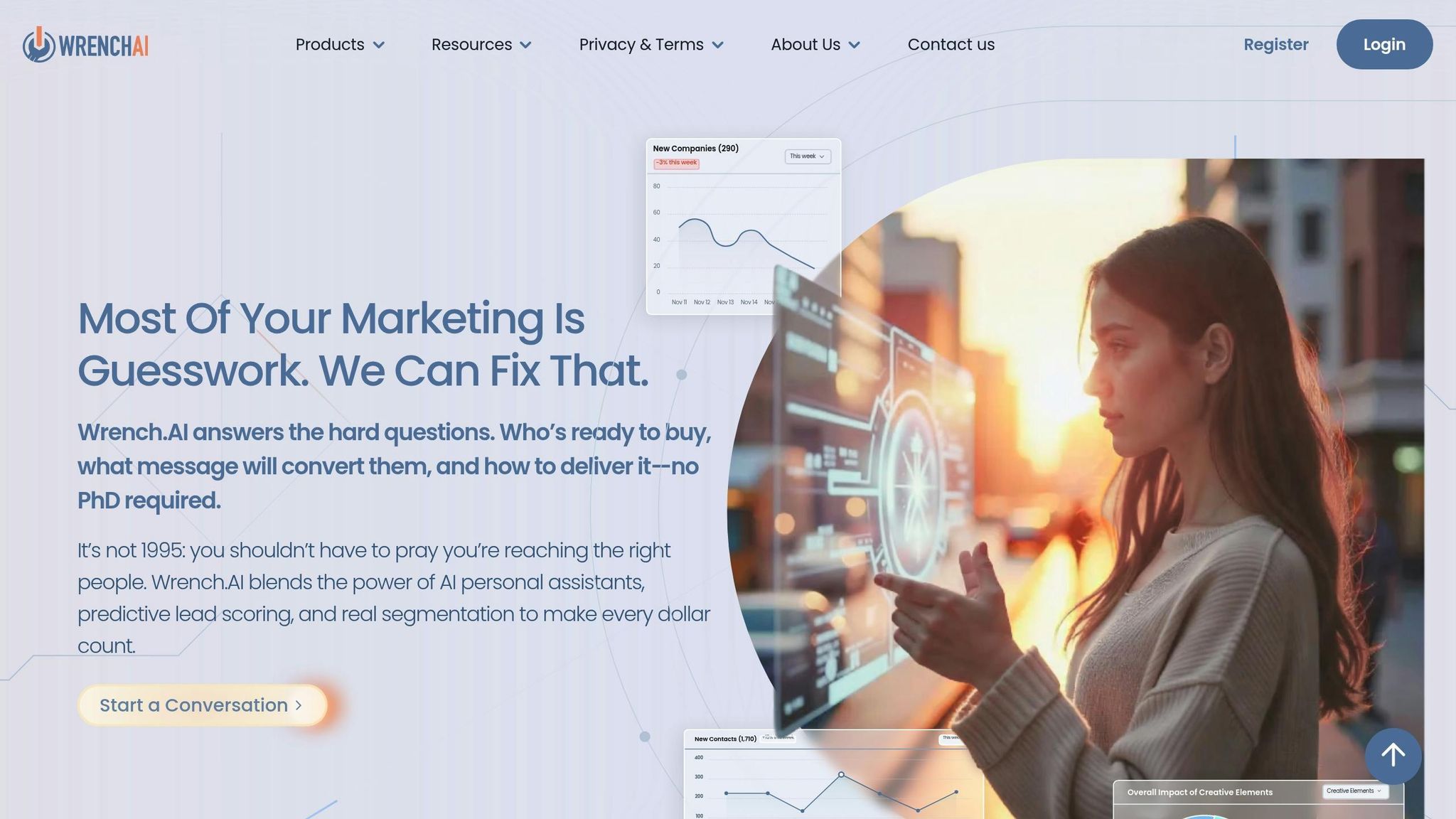
Wrench.AI uses artificial intelligence to pull together data from over 110 sources at once, offering a centralized view of campaign metrics. This means you can track everything from email open rates to social media engagement and website activity – all in one place. By merging these insights, the platform allows for a deeper level of analysis that would be hard to achieve manually.
The platform’s personalization engine relies on AI to spot patterns across various channels, uncovering trends that might otherwise go unnoticed. With real-time mapping of customer journeys, Wrench.AI ensures you’re always up-to-date on how users interact across different touchpoints.
To make this possible, Wrench.AI uses automated connectors to gather data from tools like CRM systems, advertising platforms, email marketing software, and analytics tools. Its machine learning capabilities adapt to the complexity of your campaigns, with pricing starting at $0.03–$0.06 per output.
The segmentation feature takes things further by moving beyond simple demographics to analyze behavior across channels. As customer actions change, these segments update automatically. This keeps your marketing strategies relevant and ensures your messaging stays consistent.
Wrench.AI also offers predictive analytics, which uses past campaign data to forecast future performance. By identifying proven patterns, you can allocate budgets more effectively and plan campaigns with greater confidence.
Workflow automation simplifies the process by creating unified, real-time dashboards. This eliminates the need for manual data reconciliation, allowing marketers to adjust quickly based on campaign performance.
For B2B marketers managing complex sales cycles, the account-based insights feature is a game-changer. It tracks how organizations engage with campaigns across multiple channels and touchpoints, making it easier to navigate multi-decision processes effectively.
2. Traditional Campaign Metrics Frameworks
Traditional metrics frameworks, while functional in their time, often relied on intuition and surface-level data. They reported on what happened but rarely delved into why it happened or what might come next. Without the ability to integrate data or predict outcomes, these methods lacked the sophistication of today’s AI-driven tools.
One major drawback was the isolation of data across different channels. This siloed approach often resulted in fragmented insights and even double-counted conversions when customers interacted with multiple touchpoints[1][3]. The lack of integration made it nearly impossible for marketers to get a clear, unified picture of their campaign performance.
Another challenge was the reliance on basic attribution models like last-click attribution. By giving all the credit to the final interaction, these models ignored the complexity of customer journeys. This oversimplification often led to skewed insights and misinformed budget allocations[1][2].
Ultimately, traditional measurement frameworks were good at describing past performance but offered little help in shaping forward-looking strategies. Their inability to forecast or provide deeper insights highlighted the need for more advanced, integrated approaches.
sbb-itb-d9b3561
Advantages and Disadvantages
Switching from traditional metrics frameworks to AI-powered platforms marks a major shift in how campaigns are measured. To better understand this evolution, let’s compare AI-driven tools with their traditional counterparts and see where each excels.
AI-driven platforms, such as Wrench.AI, bring a level of sophistication that traditional systems can’t match. By seamlessly integrating data from over 100 sources, these platforms eliminate the fragmented insights that often plague manual methods. This gives marketers a complete picture of the customer journey without the hassle of piecing together data from different channels.
One standout feature of AI systems is their predictive analytics. Unlike traditional frameworks that only provide insights after a campaign ends, AI tools analyze trends in real time. They can forecast performance and highlight optimization opportunities, allowing marketers to make proactive tweaks instead of scrambling to fix issues after the fact.
Another game-changer is workflow automation. Tasks like audience segmentation and campaign adjustments, which used to require hours of manual effort, are now handled automatically. This frees up marketing teams to focus on strategy and creativity rather than repetitive tasks.
That said, traditional frameworks still have their place. Their simplicity and transparency can be appealing, especially for straightforward campaigns with clear attribution paths. In these cases, traditional systems can deliver clear, actionable insights without the complexity of AI.
However, adopting AI platforms comes with a learning curve. Teams accustomed to basic reporting dashboards may find the advanced features of AI systems overwhelming at first. In contrast, traditional frameworks are typically easier to implement and require less training, making them a quicker option for organizations to roll out.
Here’s a side-by-side comparison of key differences:
| Aspect | AI-Driven Platforms (Wrench.AI) | Traditional Frameworks |
|---|---|---|
| Data Integration | Automatically connects 110+ sources | Manual integration, often siloed |
| Audience Segmentation | Dynamic, based on behavior | Static, based on demographics |
| Predictive Analytics | Real-time forecasting and optimization | Limited to historical reporting |
| Workflow Automation | Automated campaign adjustments | Requires manual monitoring |
| Implementation Time | Longer setup, ongoing optimization | Quick deployment |
| Cost Structure | Usage-based ($0.03-$0.06 per output) | Fixed licensing fees |
| Learning Curve | Requires training on advanced tools | Minimal training needed |
Cost structures also vary significantly. Traditional frameworks often come with fixed licensing fees, which might be easier to predict but can feel steep for smaller campaigns. On the other hand, Wrench.AI uses a volume-based pricing model, meaning costs scale with usage. This ensures you’re paying for the value you’re getting.
Another key consideration is transparency. Traditional systems are straightforward, offering metrics that are easy to understand. AI platforms, however, have faced criticism for being "black boxes", where the decision-making process isn’t always clear. Fortunately, many modern AI tools are addressing this by incorporating features that explain their logic and processes.
Lastly, scalability is a major advantage of AI-driven platforms. Traditional systems can struggle as campaigns become more complex or span multiple channels. In contrast, AI tools thrive in these scenarios, becoming even more effective as data volume and campaign sophistication grow.
Final Analysis
Switching to AI-powered tools is reshaping how U.S. marketers approach cross-channel campaigns. After weighing both traditional and AI-driven methods, the evidence leans heavily toward AI solutions for delivering better marketing ROI.
Platforms like Wrench.AI offer clear, measurable benefits that older systems simply can’t compete with. By automatically consolidating data from various sources, these tools eliminate the long-standing issue of data silos. This unified approach not only enhances attribution but also improves decision-making across multiple channels – a major step forward for marketers struggling with fragmented data.
On top of integration, the financial advantages are hard to ignore. Traditional systems often burden businesses with fixed licensing fees, regardless of usage. In contrast, Wrench.AI employs a flexible volume-based pricing model, ranging from $0.03 to $0.06 per output. This is especially useful for businesses running seasonal campaigns or testing new markets, where adapting spending to match actual needs is a game-changer.
Real-time optimization is another standout feature of AI platforms. With predictive analytics, marketers can adjust strategies on the fly – essential in a market where consumer behavior evolves quickly and competition is fierce.
For U.S. marketers, the complexity of engaging with diverse audiences across different time zones and cultural groups adds another layer of difficulty. Traditional tools often fall short here. Wrench.AI’s dynamic audience segmentation, which adapts to real-time behavioral patterns, is particularly effective for reaching the wide-ranging U.S. consumer base.
Implementation does require some upfront effort. AI platforms typically demand more initial training and setup time compared to traditional systems. However, the long-term rewards – like automated workflows and actionable insights – far outweigh the short-term challenges. Once teams experience the efficiency gains, the learning curve becomes a minor concern.
For businesses managing multi-channel campaigns with budgets over $50,000 annually, AI-driven platforms are the way to go. Their ability to integrate data, deliver predictive insights, and automate workflows justifies the investment by improving performance and reducing manual labor.
Smaller operations or single-channel campaigns might still find traditional frameworks sufficient for basic needs. But as marketing grows more complex and customer expectations continue to rise, transitioning to AI-powered solutions will become less of an option and more of a necessity.
The future belongs to marketers who embrace AI to unify and act on their campaign data. Those who delay risk falling behind competitors already using these advanced tools to refine their strategies and get the most out of their marketing budgets.
FAQs
How does AI make campaign metrics more accurate and efficient?
AI brings a whole new level of precision to campaign metrics by leveraging advanced algorithms. It can process massive data sets, spot patterns, and predict outcomes with impressive accuracy. This means marketers get insights they can actually act on – far beyond what traditional methods can offer.
On top of that, AI takes efficiency to the next level. It automates the collection and analysis of data in real time, so businesses can tweak strategies on the fly, allocate resources more wisely, and fine-tune campaigns for better performance and higher conversion rates. By simplifying these tasks, AI equips marketers to make quicker, smarter decisions that deliver tangible results.
What should businesses focus on when moving from traditional metrics to AI-powered tools like Wrench.AI?
To move from traditional metrics to AI-powered tools like Wrench.AI, businesses should start by taking a close look at their current technology stack, the quality of their data, and their overall readiness for adopting AI. Setting clear goals that align with your business strategy is key, and getting all stakeholders on the same page will make the transition much smoother.
Investing in team training and upskilling is another critical step. This ensures your team has the expertise needed to effectively use AI tools. At the same time, focus on preparing your data infrastructure – making sure your data is clean, well-integrated, and easy to access. This is essential for getting the most out of AI-driven analytics. Lastly, building a culture that prioritizes data-driven decision-making will not only ease the transition but also help you fully tap into AI’s potential for optimizing campaigns.
How does a volume-based pricing model help businesses manage campaign costs more effectively?
A volume-based pricing model is a smart way for businesses to control campaign costs by tying expenses directly to actual usage. This approach allows companies to adjust spending in line with the intensity of their campaigns, making it an ideal choice for those with marketing needs that tend to fluctuate or are hard to predict.
Unlike fixed licensing fees, which demand a consistent payment no matter how much or how little you use, volume-based pricing adapts in real-time to reflect campaign activity. This means businesses only pay for what they actually use, providing a more cost-effective option and greater control over their budgets. It’s a flexible way to fine-tune marketing strategies without sacrificing financial oversight.