

Scattered customer data makes marketing harder. Without a unified view, teams waste time, miss opportunities, and struggle to improve ROI. Scalable data integration fixes this by combining data from multiple sources, cleaning it, and turning it into actionable insights. This approach helps businesses:
- Create consistent customer profiles.
- Improve targeting and personalization.
- Save time and reduce manual work.
- Boost campaign performance and ROI.
Key benefits include a 20–30% increase in ROI, 35% higher deal closures, and faster campaign adjustments. Companies using tools like Wrench.AI streamline processes, reduce costs, and make smarter decisions. Real-time integration and enriched customer insights ensure better marketing outcomes and measurable growth.
Data and AI: Harnessing Your Marketing Data for Better ROI
How Scalable Data Integration Boosts Marketing ROI
When marketing teams bring together scattered data sources through scalable integration, the financial benefits often appear quickly. This process strengthens campaign performance, improves operational efficiency, and drives better bottom-line results.
Better Campaign Performance and Targeting
Unified data takes the guesswork out of marketing by creating detailed customer profiles that highlight key purchase drivers.
Real-time personalization plays a big role here. Businesses using integrated data to deliver dynamic content see conversion rates jump by 25–35% compared to static campaigns [4]. With this unified view, marketers can tweak messaging, offers, and timing to match current customer behavior.
AI-driven tools take things even further. By analyzing purchase history, browsing habits, and engagement data, AI-powered systems provide personalized recommendations that resonate with customers. Companies using these tools report up to 26% higher order values [2].
Access to mobile CRM tools also makes a difference, boosting sales quota attainment threefold (65% vs. 22%) by enabling timely and tailored customer interactions [2].
Anthony Grandich from AiAdvertising shared how their Campaign Performance Platform has transformed their approach:
"The true value of our Campaign Performance Platform is fusing ‘marketer + machine.’ As we expand the predictors from our platform – into the minds of our marketing and creative team, this fuels our client’s success. We are constantly seeking to create more insightful and in-depth persona behaviors, triggers, and persuasion tactics. The Wrench team has been a strategic and technical contributor in this process, and they have exceeded our expectations constantly." [1]
These advances in targeting lead to reduced costs and more efficient use of resources.
Lower Costs and Better Resource Use
Automation is a game-changer for cutting costs. Large organizations save an average of $3.9 million annually by reducing manual tasks and speeding up reporting [2]. This efficiency not only saves time but also allows teams to focus on strategic initiatives that drive growth.
Sales development representatives (SDRs) see productivity gains of 12.5% to 25% without adding extra costs [1]. By spending less time searching for information and more time engaging with prospects, sales teams can lower customer acquisition costs.
Wrench.AI’s pricing model reflects these efficiency gains, with services like segmentation, insights, and predictive analytics costing between $0.03 and $0.06 per output [1]. Additionally, companies using marketing automation with integrated data achieve 15–25% higher marketing ROI compared to traditional methods [5]. Tasks like A/B testing, campaign audits, and performance optimization become more streamlined, freeing marketers to focus on creative strategies.
Measurable ROI Gains
When cost savings and improved performance come together, the result is measurable ROI growth. Scalable data integration delivers financial benefits across various revenue streams. For example, Salesforce‘s use of Data Cloud achieved a 299% ROI over three years, thanks to advanced segmentation and scoring that shortened sales cycles and improved customer retention [2].
Personalized recommendations and targeted promotions can increase average order values by up to 35% [2]. Integrated systems also help identify high-value prospects, boosting marketing-generated lead revenue by as much as 60% through timely and relevant content.
Enhanced customer profiles amplify these results. Businesses report up to 2.5× higher customer retention rates and a 35% increase in deal closures within six months [4]. When marketing and sales systems work seamlessly together, organizations achieve 38% higher sales win rates and 36% higher customer retention rates [5].
Integrated data also improves sales forecast accuracy by 25–32%, helping businesses allocate resources and plan budgets more effectively [2]. Early adopters of real-time data integration have reported 27% faster campaign optimization cycles and a 35% increase in personalized offer acceptance rates [4].
| ROI Metric | Impact | Timeframe |
|---|---|---|
| Overall ROI | 299% return | 3 years |
| Average Order Value | 35% increase | 6–12 months |
| Lead Revenue | 60% increase | 6–12 months |
| Deal Closures | 35% boost | 6 months |
| Customer Retention | 2.5× improvement | 12 months |
As these systems interact with more customer data, their ability to predict and refine improves. Often, businesses find that the initial investment in scalable data integration pays for itself within a year.
Better Customer Insights Through Unified Data
When businesses consolidate marketing data from various sources, they gain a clear and comprehensive view of how customers interact with their brand. Instead of dealing with scattered touchpoints, this unified data approach transforms raw information into actionable insights, enabling smarter marketing strategies and stronger customer connections. It also sets the stage for more accurate attribution and timely, data-informed decisions.
Tracking the Full Customer Journey
By integrating data across multiple channels, businesses can piece together the entire customer journey – from the first interaction to the final purchase and beyond. This approach replaces fragmented, isolated events with a cohesive view of how customers engage at every step.
Take Wrench.AI, for example. Their platform integrates data from over 110 sources, including CRMs, eCommerce systems, and analytics tools, ensuring no interaction is overlooked [1]. But they don’t just collect data – they enhance it. By combining first-party data with trusted third-party insights, Wrench.AI enriches customer profiles. As the company puts it:
"The Wrench platform combines your unique customer information with 3rd party public data to enrich your customer profiles, and deliver more accurate personas and segments" [1].
Imagine a customer discovering your brand on social media, researching products on your website, receiving an email campaign, and then making a purchase in-store. With integrated data, you can connect these dots and identify which touchpoints resonate most with specific customer segments. This streamlined approach reduces the time spent on manual data matching and accelerates the creation of targeted campaigns.
Using Multi-Touch Attribution
Multi-touch attribution acknowledges that customers typically interact with several channels before making a purchase. Unified data makes it possible to track and evaluate every touchpoint, providing a clear picture of how channels like social media, email, and retargeting ads work together to drive conversions.
The results speak for themselves. Companies using multi-touch attribution models report up to 35% higher conversion rates compared to those relying on single-touch models [4]. Additionally, businesses that can pinpoint and replicate effective acquisition paths enjoy 2.5x higher customer retention rates [4]. With this level of insight, marketers can fine-tune their entire marketing strategy to maximize impact.
Real-Time Insights for Faster Decisions
Marketing today demands agility. Customer behavior can shift rapidly, and businesses need to respond just as quickly to seize opportunities. Real-time data integration provides the tools to do just that.
Currently, only 7% of marketers use real-time data integration, despite its proven benefits [4]. Early adopters are already seeing the advantages, including faster decision-making and more responsive campaigns. For instance, organizations report a 27% reduction in the time it takes to optimize campaigns and a 35% increase in acceptance rates for personalized offers [4].
This capability isn’t just about speed – it’s also about precision. If a campaign underperforms, marketers can reallocate resources to better-performing channels within hours instead of days. Real-time insights also enable immediate responses to customer actions. For example, if a customer abandons their shopping cart, an integrated system can trigger a personalized email offer within minutes, boosting conversions by 22% through instant retargeting [4].
The cumulative effect of these faster, more informed decisions is substantial. Businesses using real-time integration report a 20–30% improvement in ROI by continuously optimizing campaigns based on live data rather than relying solely on historical reports [4]. This agility is especially valuable during high-stakes moments like seasonal promotions, product launches, or sudden market shifts.
| Real-Time Integration Benefit | Performance Impact | Business Value |
|---|---|---|
| Campaign optimization speed | 27% faster cycles | Quicker response to market changes |
| Personalized offer acceptance | 35% increase | Higher conversion rates |
| Instant retargeting conversions | 22% increase | Reduced cart abandonment |
| Overall ROI improvement | 20–30% better | Sustained competitive edge |
sbb-itb-d9b3561
Building a Scalable Data Integration System
Creating a data integration system that can grow alongside your business starts with a solid technical foundation. The best systems combine adaptable architecture with automated processes to manage increasing data volumes. When implemented effectively, these systems become the heart of marketing operations, supporting everything from basic reporting to advanced AI-driven personalization. This foundation ensures your systems can evolve as your business needs change.
Core Features of Scalable Data Integration
Cloud-based data pipelines are the backbone of any scalable system. These pipelines, built on cloud-native architectures, automatically adjust resources based on demand. This means they can handle traffic surges during peak marketing periods without requiring manual adjustments. Continuous data ingestion replaces scheduled sync cycles, eliminating delays that could result in missed opportunities.
Real-time data processing sets high-performing systems apart from basic tools. This feature allows marketers to respond immediately to customer behavior, cutting campaign optimization times by 27% and boosting conversion rates by up to 35% through dynamic content delivery [4]. Real-time processing ensures campaigns adapt on the fly for maximum efficiency.
API connectivity is essential for integrating various marketing tools. Systems with robust API libraries enable seamless communication between a growing array of platforms. Support for both standard APIs and custom configurations ensures compatibility with your current tools and any you may add in the future.
Automated data quality management tackles one of the most common challenges in data integration. With 68% of real-time data integration projects facing data quality issues, automated processes for cleaning and validating data are critical [4]. These systems continuously monitor incoming data, reducing errors and improving forecast accuracy by up to 32% [2][3]. Automation eliminates the need for manual oversight, which becomes unmanageable as data volumes grow.
| Essential Component | Primary Benefit | Impact on Performance |
|---|---|---|
| Cloud-based pipelines | Automatic resource scaling | Handles traffic spikes seamlessly |
| Real-time processing | Instant response capability | 27% faster optimization cycles |
| API connectivity | Seamless tool integration | Amplified growth effects |
| Automated quality management | Error reduction | 32% better forecast accuracy |
Wrench.AI‘s Role in Data Integration
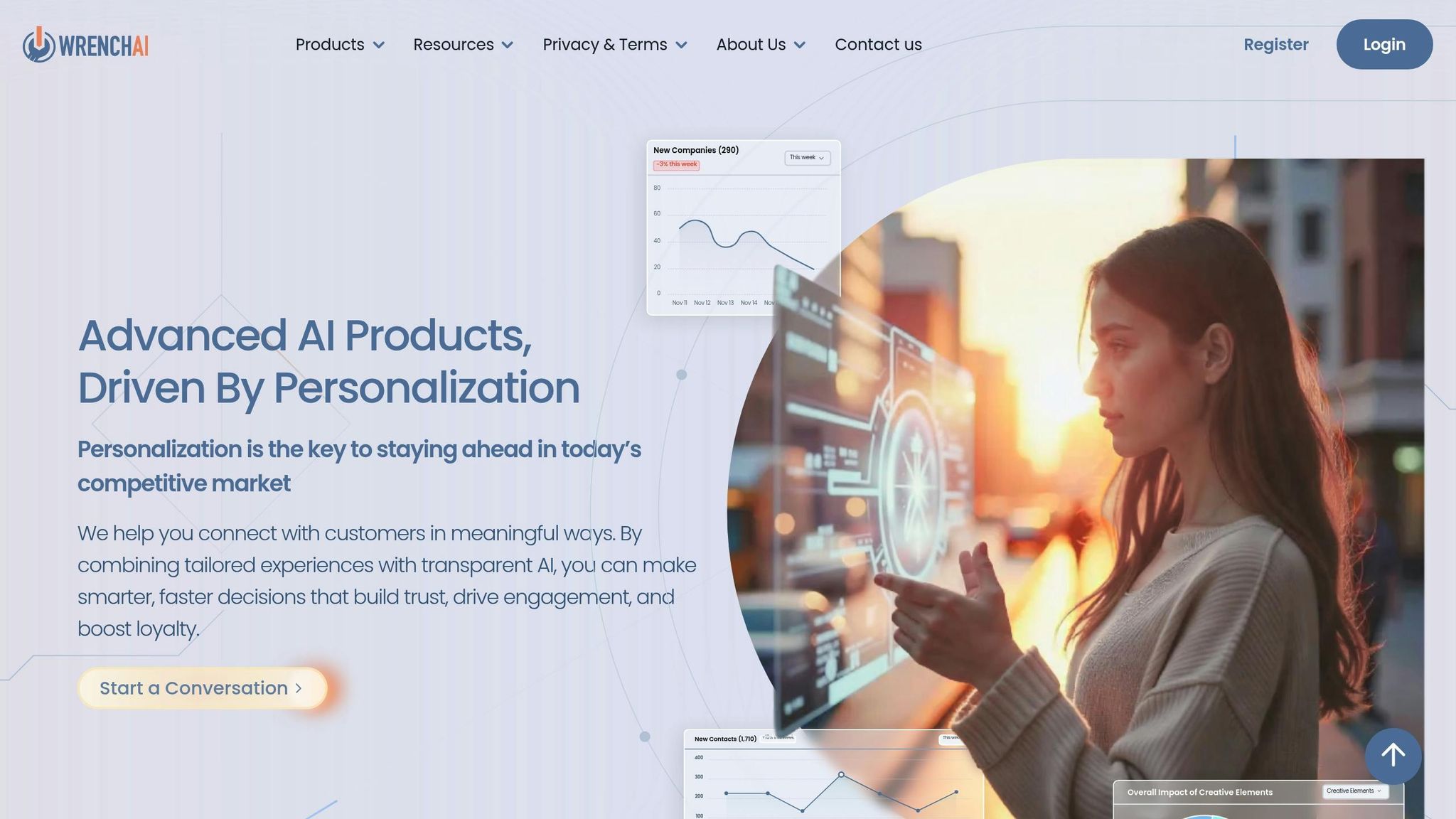
Wrench.AI exemplifies how modern platforms address scalability challenges with comprehensive integration capabilities. It connects to a wide range of data sources, including CRMs, eCommerce systems, behavioral analytics tools, and custom enterprise databases [1]. This connectivity helps eliminate data silos that can slow down business growth.
The platform’s data enrichment capabilities highlight advanced integration principles. By merging first-party customer data with third-party public information, Wrench.AI creates enriched customer profiles that improve over time. For example, Joy Schoffler of Casoro Capital shared how automated segmentation saved time while building precise, targeted prospect databases.
AI-driven segmentation and workflow automation represent the next step in scalable integration. Wrench.AI’s AI tools transform fragmented data into actionable insights, enabling personalization efforts that deliver engagement rates five times higher than the industry average [1]. As data volumes increase, this automation becomes even more valuable, allowing teams to manage larger audiences efficiently [5].
The platform’s pricing model, based on usage (ranging from $0.03 to $0.06 per output), reflects the scalability of modern integration systems [1]. This approach ensures costs align with actual usage, avoiding the prohibitive fixed fees that can stifle growing businesses.
Scaling to Support Business Growth
Scalable integration systems are designed to grow with your business. Flexible data ingestion methods allow these systems to adapt to new data sources and formats as your marketing strategies evolve. Whether it’s CSV uploads, S3 bucket connections, standard APIs, or custom configurations, this adaptability ensures the system can handle new tools, markets, or campaign types with ease.
Modular expansion capabilities let businesses add new integrations and analytics features without overhauling existing systems. Companies using scalable platforms have reported up to 299% ROI and a 60% increase in lead revenue over three years [2]. This success stems from the ability to enhance capabilities without starting from scratch.
Hybrid architecture options offer flexibility for businesses with specific compliance or data governance needs. By combining on-premise databases with cloud analytics, these systems can meet requirements like GDPR compliance while still benefiting from scalable performance [3].
The impact of scalable systems is clear in performance metrics. Businesses using automation-driven data for decision-making achieve 15-25% higher marketing ROI compared to those relying on traditional analytics [5]. Anthony Grandich of AiAdvertising captures this value:
"The true value of our Campaign Performance Platform is fusing ‘marketer + machine.’ As we expand the predictors from our platform – into the minds our marketing and creative team, this fuels our client’s success" [1].
Resource allocation controls ensure systems maintain performance as they scale. The best platforms let businesses decide which data gets processed, how often updates occur, and which analytics run automatically. This level of control prevents system overload while prioritizing critical processes, ensuring consistent performance during periods of rapid growth.
Implementation Tips and ROI Measurement
Rolling out scalable data integration successfully requires careful planning and a solid strategy for tracking results. Jumping into integration without preparation often leads to messy data and difficulty proving the value of the investment. The secret is to lay a strong foundation before launching and to set up reliable tracking systems from the start. These steps ensure that the benefits of integration – like smoother data flows – translate into real, measurable marketing improvements.
What to Prepare Before Implementation
Start with a data quality check. Before connecting systems, audit your existing data to find and fix issues like duplicates, inconsistencies, or missing values. Poor data quality is a frequent stumbling block in integration projects and can undermine your ROI if left unchecked [4].
Take stock of all your current data sources across departments. This inventory helps you understand how fragmented your customer information is and what needs to be unified.
Get everyone on the same page. Misaligned goals can derail an integration project. Before any technical work starts, define shared objectives and set clear KPIs using SMART criteria. When departments agree on goals, it’s easier to achieve better sales results and improve customer retention rates [5].
Build a cross-functional team with representatives from key areas. Marketing can identify campaign tracking needs, sales can outline lead scoring requirements, and IT can handle security and compliance concerns. This collaboration ensures the system works for everyone without requiring costly changes later.
Plan your API connections. Map out how your core systems will interact. Modern integration platforms simplify this process by enabling seamless API connections, reducing the need for custom development.
Set up data governance policies to control who can access information and how often updates occur. These rules become even more critical as your system grows and more team members rely on integrated data. A well-thought-out integration strategy sets the stage for the real-time insights and cost savings we’ve discussed earlier.
How to Measure ROI Effectively
Once you’ve laid the groundwork, the focus shifts to tracking the ROI of your scalable data integration efforts.
Compare before and after. The simplest way to measure impact is to document baseline metrics for key KPIs a few months before implementation. Track figures like conversion rates, cost per lead, customer acquisition costs, and campaign response rates to establish benchmarks.
For instance, Salesforce’s Data Cloud implementation tracked improvements in lead revenue and customer lifetime value, achieving a 299% ROI over three years [2].
Track cost savings. Efficiency gains often make up a big chunk of ROI. Measure the time saved by automating tasks like data entry, report creation, and campaign setup. On average, enterprise deployments report annual benefits of $3.9 million thanks to integration platforms [2].
Also, track improvements in data accuracy. Automated data management can boost sales forecast accuracy by 25–32%, which directly influences revenue planning and resource allocation [2].
Analyze revenue attribution. Understand how integration impacts sales by using multi-touch attribution models. These models help identify which campaigns and touchpoints drive the most conversions, allowing for smarter budget decisions.
Real-time integration also enables quicker campaign adjustments, improving results. Early adopters have reported 27% faster optimization cycles and a 35% increase in personalized offer acceptance rates [4].
Metrics That Highlight Success
Tracking the right metrics not only proves the value of integration but also reinforces the benefits discussed earlier.
Marketing efficiency metrics show how well your integration is working:
- Lower marketing spend per acquisition through better targeting
- 15–35% higher marketing ROI thanks to automation [5]
- 22% increase in conversions through instant retargeting [4]
Customer satisfaction metrics reflect the improved user experience:
- Higher Net Promoter Scores (NPS) and better retention rates
- 2.5× higher customer retention rates [4]
Operational performance metrics demonstrate scalability:
- Faster data processing and fewer errors
- 25–32% gains in forecast accuracy [2]
Revenue growth metrics confirm the ultimate ROI:
- Increased revenue from marketing-driven efforts
- 35% improvement in deal closure rates within six months [4]
| Success Metric Category | Key Indicators | Typical Improvement Range |
|---|---|---|
| Marketing Efficiency | Cost per acquisition, conversion rates | 15–35% improvement |
| Customer Satisfaction | NPS scores, retention rates | 2.5× higher retention |
| Operational Performance | Processing speed, error reduction | 25–32% accuracy gains |
| Revenue Impact | Deal closure rates, pipeline value | 35% increase in closures |
The metrics you prioritize should align with your organization’s main goals for data integration. Whether your focus is on cutting costs, boosting revenue, or improving efficiency, consistent tracking from the beginning ensures you can clearly demonstrate ROI and make the case for ongoing investment in integration.
Conclusion: Improving Marketing ROI with Scalable Data Integration
Scalable data integration takes scattered marketing efforts and transforms them into a coordinated, data-driven strategy that drives revenue growth. Companies adopting strong integration systems experience significant gains, with an average 299% ROI over three years and $3.9 million in annual benefits thanks to streamlined processes and smarter decision-making [2].
When customer touchpoints are seamlessly connected, the financial benefits become clear. Businesses leveraging integrated systems see marketing-generated lead revenue increase by up to 60% and are 86% more likely to exceed sales goals [2]. By tracking complete customer journeys and using multi-touch attribution models, every interaction becomes a source of actionable insights, eliminating the confusion caused by fragmented data.
Real-time capabilities also play a crucial role, enabling faster adjustments to strategies. Organizations report 27% quicker campaign optimization cycles and a 35% increase in deal closures within six months of implementation [4]. This agility not only enhances competitiveness but also drives measurable revenue growth.
Operational efficiency sees a boost as well, freeing up resources for strategic initiatives while improving accuracy. Sales forecast precision improves by 25-32%, and teams achieve 38% higher sales win rates when marketing and sales systems are aligned [2][5]. Additionally, automation-powered marketing yields 15-25% higher ROI compared to traditional methods, proving how technology enhances human expertise [5].
These results highlight the game-changing potential of scalable data integration in modern marketing. For businesses looking to grow, platforms like Wrench.AI offer the tools needed to succeed. With features like audience segmentation, campaign optimization, and workflow automation, organizations can deliver personalized customer experiences that drive real, measurable growth.
FAQs
How does scalable data integration boost marketing ROI compared to traditional approaches?
When businesses bring together customer data from various sources into a single, accurate view, they open the door to smarter marketing and better results. Scalable data integration makes this process seamless, giving marketers a detailed understanding of their audience. With this unified perspective, businesses can spot trends, create precise audience segments, and craft highly personalized campaigns.
Traditional approaches often struggle with fragmented or outdated data, making it harder to act effectively. Scalable integration changes the game by ensuring all relevant information is available in real-time. This means marketers can make smarter, data-backed decisions, fine-tune campaigns more effectively, and focus resources where they’ll have the biggest impact – leading to stronger engagement and a better return on investment.
What are the first steps to successfully implement a scalable data integration system?
To build a data integration system that can grow with your business, start by pinpointing your business goals and determining which data sources need to come together. This step ensures your integration efforts directly support your marketing strategies and ROI goals.
Then, select a platform or tool that allows for smooth integration, can scale as your business expands, and offers features like audience segmentation and campaign optimization. Make sure it can handle your current data load while being ready to adapt as your needs evolve. Lastly, set up a plan for regular data monitoring and maintenance to keep everything accurate and consistent over time.
How can businesses track the ROI of their data integration efforts over time?
Measuring the return on investment (ROI) of data integration means assessing how well your unified data enhances marketing results and decision-making. To get started, pinpoint key performance indicators (KPIs) such as conversion rates, customer acquisition costs (CAC), or campaign performance metrics before diving into integration efforts.
As time goes on, compare these KPIs with your pre-integration benchmarks to gauge progress. To dig deeper, evaluate how data integration influences areas like customer engagement, campaign personalization, and overall revenue growth. By keeping a close eye on these metrics, businesses can gain a clearer picture of the long-term benefits their data integration strategies bring.