
AI is transforming how businesses set subscription prices by using real-time data to make smarter decisions. Traditional fixed pricing often fails to meet the demands of today’s dynamic markets, leading to lost revenue or customer churn. AI-driven pricing offers a solution by analyzing customer behavior, market trends, and operational costs to create flexible, data-informed pricing strategies.
Key Takeaways:
- Dynamic Pricing: AI adjusts prices in real-time based on customer segments, market conditions, and competitor activity.
- Customer Retention: Personalized pricing helps retain users by offering discounts to price-sensitive customers and premium options to high-value users.
- Data-Driven Insights: AI leverages customer demographics, usage patterns, and payment history to predict behavior and optimize pricing.
- Risk Reduction: Predictive analytics identify churn risks early, enabling targeted retention efforts.
- Automation: AI systems automate price changes, test strategies, and integrate with CRMs for seamless implementation.
Businesses can use platforms like Wrench.AI to simplify this process, offering tools for data integration, customer segmentation, and predictive analytics. This allows for precise pricing adjustments that improve revenue and customer satisfaction.
Data-driven Pricing: How AI and Analytics are transforming pricing in organizations
Data Requirements for AI Pricing Models
AI-driven pricing thrives on a foundation of accurate, up-to-date data from diverse sources. This data is essential for implementing dynamic, demand-responsive pricing strategies. The more comprehensive the dataset, the better the AI can understand your business landscape, enabling precise pricing adjustments in real time.
Customer Data and Behavior Analysis
Customer demographics play a key role in crafting personalized pricing strategies. Details like age, income, location, occupation, and household size can reveal how sensitive different groups are to price changes, allowing you to tailor subscription offers to match their preferences.
Behavioral insights, such as purchase history and engagement metrics, provide a deeper understanding of customer value and willingness to pay. Information like subscription start dates, plan upgrade or downgrade trends, billing cycles, payment methods, feature usage frequency, and time spent on the platform can highlight which users are more likely to respond positively to pricing adjustments. These insights also help identify engaged customers versus those at risk of canceling their subscriptions.
Payment patterns offer another layer of valuable insights. Tracking when customers pay, how they recover from failed transactions, and how they respond to billing communications can help predict their lifetime value and guide pricing decisions.
Competitor and Market Data
Staying informed about your competitors is crucial. Regularly monitoring rival subscription services for pricing changes, promotions, feature updates, and customer acquisition strategies ensures your AI models remain responsive to market movements.
Market trends also shape pricing strategies. Broader economic factors like unemployment rates, consumer confidence, and disposable income levels can influence how price-sensitive customers are. For instance, during times of economic uncertainty, customers may demand more affordable options. Seasonal trends further affect demand, guiding when and how to adjust pricing.
Industry benchmarks, such as average revenue per user (ARPU), churn rates, and customer acquisition costs, provide context for your pricing decisions. These metrics help validate whether your AI-driven strategies align with industry norms and customer expectations.
Operational and Supply Chain Data
Understanding your cost structure is essential for maintaining profitability. Direct costs – such as licensing fees, infrastructure expenses, customer support, and payment processing – help establish a sustainable pricing floor that supports both revenue growth and healthy margins.
As your subscription base grows, scaling costs like server capacity, bandwidth, and cloud computing become more significant. AI pricing models can factor in these variable expenses to ensure that lower price points still protect profitability.
Customer service metrics also play a role. Tracking support ticket volumes, resolution times, and labor costs can reveal which customer segments require higher service levels. Pricing adjustments can then account for these additional costs.
Operational data should be tailored to your business type. For SaaS companies, this might include development costs and feature rollout expenses. For businesses dealing in physical products, inventory, shipping, and supplier costs are key. Incorporating these factors into your AI models ensures pricing strategies adapt as business conditions evolve.
To keep your AI models accurate, establish automated processes for updating customer behavior metrics, competitor intelligence, and operational costs. Real-time data integration ensures your pricing strategies remain relevant and responsive to current market dynamics, rather than relying on outdated information.
Using Predictive Analytics for Subscription Pricing
Predictive analytics turns raw data into actionable pricing strategies. By leveraging AI models, businesses can analyze customer behavior, payment history, and engagement patterns to predict how pricing changes will impact revenue and customer retention. This approach not only helps anticipate market trends but also aligns pricing with customer needs.
At the heart of effective predictive pricing are two critical metrics: customer lifetime value (CLV) and churn probability. These metrics guide decisions on which customers might accept premium pricing and which ones may need retention-focused offers. Machine learning processes historical data to uncover patterns that might go unnoticed, such as how frequently a customer uses specific features and their willingness to pay for upgrades. These insights naturally complement the dynamic pricing strategies discussed earlier.
Building Customer Segments for Targeted Pricing
Effective segmentation starts with customer behavior rather than just demographics. AI algorithms analyze a wide range of data points – like usage trends, payment habits, support interactions, and feature adoption rates – to create meaningful customer groups.
Value-based segmentation is the cornerstone of targeted pricing. For example:
- High-value customers: These users consistently engage with the platform, utilize premium features, and maintain stable payment habits. They’re often more open to price increases.
- Mid-tier customers: This group regularly uses core features but rarely explores advanced options, making them potential candidates for upselling.
- Low-engagement customers: These individuals are more price-sensitive and require careful handling, as they are more likely to churn.
Behavioral patterns can also uncover pricing opportunities within each group. For instance, customers who frequently upgrade during specific seasons might represent opportunities for tailored expansion offers. On the other hand, customers who downgrade often may benefit from flexible pricing tiers or usage-based options. Engagement scoring adds another layer of precision by identifying high-engagement customers who spend less than expected – prime candidates for targeted upgrade campaigns. Regional and seasonal factors further refine this approach, as price sensitivity and usage patterns often vary across locations and timeframes.
Applying Predictive Models to Prevent Churn
Churn prediction models identify early warning signs that suggest a customer might cancel their subscription. These signals often appear weeks – or even months – before the actual cancellation, giving businesses a chance to act before it’s too late.
Risk scoring assigns each customer a probability of churn based on their behavior. High-risk customers can trigger automated retention workflows, while moderate-risk customers might receive more subtle retention efforts. Regular calibration of these scores ensures they remain accurate as customer behavior evolves.
Addressing churn effectively requires a tailored approach. For instance:
- Price-sensitive customers might respond well to targeted discounts or alternative pricing plans.
- Low-engagement customers could benefit from personalized onboarding or feature recommendations to boost usage.
- Customers facing technical issues may need priority support or training to resolve their challenges.
AI models can help pinpoint the best time to intervene based on individual customer patterns. For some, an immediate offer might work best, while others may need more time to consider personalized recommendations. These models also learn from past interventions, improving future retention efforts.
Personalized retention offers often outperform generic discounts. For example, some customers may prefer a discount on annual billing, while others might value temporary promotional pricing or added features. AI can analyze past responses and similar customer behaviors to craft offers that not only retain customers but also enhance their long-term value.
Measuring success involves tracking both immediate retention and the overall impact on customer lifetime value. Regular testing and refinement of intervention strategies ensure predictions stay accurate as market dynamics shift. This ongoing cycle of prediction, action, and feedback leads to increasingly effective retention strategies over time.
sbb-itb-d9b3561
Setting Up Dynamic Pricing for Subscription Services
Dynamic pricing relies on integrating real-time data, automation, and performance tracking through AI-powered systems. These tools turn raw data into actionable pricing adjustments that adapt to changing conditions.
Connecting Real-Time Data Sources
At the heart of dynamic pricing is real-time data integration. Your AI model needs constant access to various data streams to make informed decisions.
- CRM systems: These provide insights into customer behavior and transaction history. By analyzing interactions, purchase patterns, and support tickets, AI can gauge price sensitivity and predict customer lifetime value.
- Payment processors: Real-time payment data, including successful transactions, failed payments, and refunds, helps identify patterns. For instance, customers with payment difficulties may benefit from adjusted pricing, while reliable payers might be targeted with premium offers.
- Analytics tools: Data on feature usage, session duration, and overall engagement can guide pricing decisions. For example, highly engaged users who frequently use premium features may be ideal candidates for higher-tier pricing, while less active users might respond better to retention-focused offers.
- Market data feeds: Competitor pricing, seasonal trends, and economic indicators provide essential context. By monitoring these external factors, your AI system can adjust pricing to remain competitive and align with customer expectations.
Automating Price Changes
Automation is key to implementing dynamic pricing efficiently. While AI-driven models recommend changes, automation ensures these adjustments happen smoothly and within predefined boundaries.
- Rule-based automation: Set clear limits for price adjustments to avoid sudden changes that could alienate customers. Trigger-based rules can respond to shifts like increased churn risks or seasonal demand spikes.
- A/B testing: Experiment with different pricing strategies on similar customer segments to validate AI recommendations before rolling them out on a larger scale.
- Approval workflows: For major pricing changes, human oversight is essential. Require manual approval for adjustments that exceed specific thresholds or impact large customer groups to maintain strategic control.
- Automated communication: Notify customers about pricing updates through personalized emails. These messages should explain the changes, highlight added value, and, if needed, offer alternative options. Pairing automation with ongoing monitoring ensures pricing stays effective without causing disruptions.
Tracking and Improving Pricing Performance
Regularly tracking performance ensures your pricing strategies remain effective and adaptable. By analyzing key metrics, you can refine your approach and improve outcomes.
- Revenue and behavior metrics: Monitor monthly recurring revenue (MRR), average revenue per user (ARPU), feature usage trends, and customer support activity to measure the impact of pricing changes.
- Churn and competitive analysis: Understand how pricing affects customer retention and compare your performance to competitors. Metrics like market share, customer acquisition costs, and win rates provide valuable benchmarks.
- Segment analysis: Different customer groups respond to pricing in unique ways. High-value customers may accept moderate increases, while price-sensitive segments require a more cautious approach.
- Dashboards: Consolidate data into user-friendly dashboards for teams across sales, finance, and marketing. These tools make it easier to track how pricing influences revenue, customer acquisition, and deal closures.
Frequent reviews of these metrics can uncover seasonal trends, customer lifecycle patterns, and market shifts. This creates a feedback loop that sharpens your AI model’s accuracy and supports better business decisions.
Using Wrench.AI for Subscription Pricing Optimization
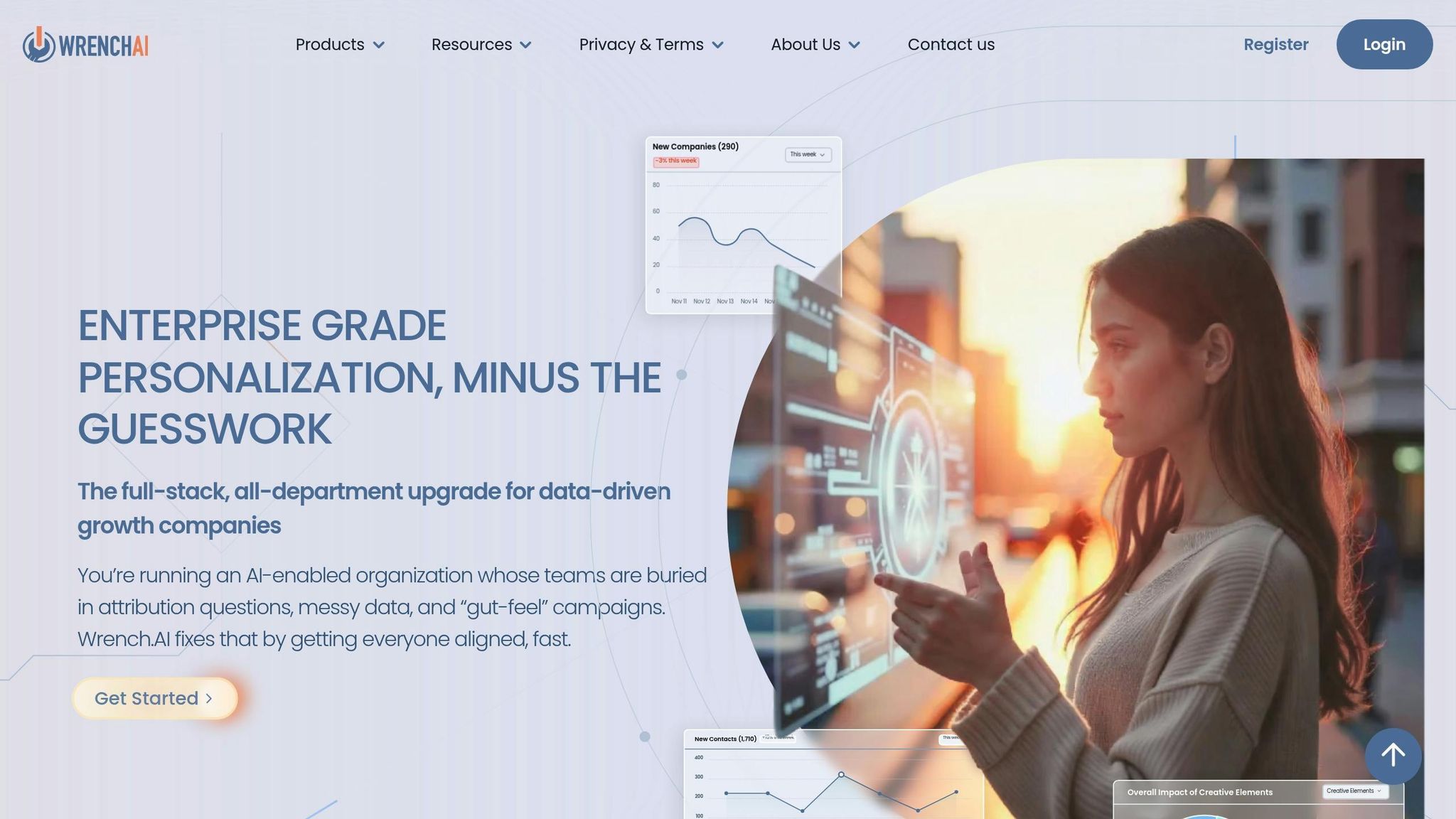
Building on the dynamic pricing strategies we’ve touched on earlier, Wrench.AI offers a powerful, tailored solution to optimize subscription pricing. By combining data integration, customer segmentation, and automated pricing, Wrench.AI helps businesses refine their strategies and make data-driven decisions.
Data Integration and Customer Segmentation
Wrench.AI connects with over 110 data sources, streamlining the process of gathering all the information needed for smarter pricing strategies. This connectivity allows you to consolidate customer data from your CRM and other systems into one centralized platform.
Once the data is collected, Wrench.AI automatically segments customers based on their behavior and overall value. These actionable segments can guide targeted pricing decisions and retention efforts. Plus, the platform’s account-based insights feature dives even deeper, offering detailed views of individual customers. This makes it easier to understand what drives each subscriber’s pricing decisions, enabling more personalized and effective strategies.
Predictive Analytics and Process Automation
Wrench.AI’s predictive analytics take the guesswork out of pricing. The platform helps forecast customer behavior and their response to price changes. It can anticipate which customers might be sensitive to adjustments, pinpoint the best timing for changes, and estimate potential revenue impacts.
Once you set your pricing rules and parameters, Wrench.AI handles the rest with workflow automation. It can trigger adjustments based on real-time data, shifting customer behavior, or market trends. This ensures pricing updates happen quickly and align with your overall goals.
The platform also integrates seamlessly with your CRM, feeding pricing insights and recommendations directly into your sales and customer success workflows. This not only supports your team in driving upgrades and retention but also ensures transparency by providing clear explanations for every pricing decision. You’ll always understand why a change was made and how it supports your business objectives.
Flexible Pricing and Cost Control
Wrench.AI offers a volume-based pricing model, ranging from $0.03 to $0.06 per output, making it scalable to fit any subscription business. This pricing structure ensures you only pay for what you need, with the flexibility to adapt as your subscriber base grows.
For businesses with unique needs, custom API plans are available. These plans include advanced options for custom data ingestion and specialized API configurations, making it easy to integrate Wrench.AI into your existing subscription management systems.
The platform’s scalability means you can start small – focusing on basic segmentation and insights – and expand into more advanced predictive analytics and automation as your pricing strategy evolves. On top of that, Wrench.AI’s creative content generation tools help you craft personalized messages for different customer segments, ensuring effective communication during pricing changes. This approach aligns with operational cost management, helping you maintain profitability while engaging your subscribers.
Key Points for AI-Driven Subscription Pricing Success
AI-driven subscription pricing relies on a thoughtful mix of technology, high-quality data, and clear business objectives. To get reliable results, it’s essential to gather data from customer behavior, market trends, and operational metrics. Without accurate and comprehensive data, even the most advanced AI models can deliver misleading outcomes.
One of AI’s standout strengths is its ability to enable dynamic pricing, which outperforms static models. By processing data quickly and implementing changes seamlessly, AI can adjust prices in real time based on factors like customer segments, market shifts, or churn risk predictions. This adaptability makes pricing strategies more responsive and effective.
Segmentation is another critical factor. By grouping customers based on usage habits, sensitivity to price changes, or their lifetime value, businesses can fine-tune pricing strategies for specific audiences. This targeted approach not only maximizes revenue but also reduces the likelihood of customer churn.
Predictive analytics further enhance AI’s capabilities by anticipating customer behavior and market changes. These insights offer a distinct advantage over traditional pricing methods, especially for subscription-based businesses. Even small pricing adjustments, when informed by predictive analytics, can lead to significant long-term benefits.
Automation and workflow integration simplify the pricing process. Manual adjustments are not only time-consuming but also prone to errors. AI systems that automatically adjust prices based on pre-set rules and real-time data ensure consistency and free up team resources for more strategic initiatives.
Choosing the right platform is equally important. For example, Wrench.AI provides robust solutions with features like integration with over 110 data sources, automated customer segmentation, and straightforward pricing ($0.03 to $0.06 per output). Its combination of predictive analytics, automated workflows, and flexible APIs delivers the scalability needed for growing subscription businesses while keeping costs in check.
Transparency and explainability are key to successful implementation. Teams must understand the reasoning behind pricing decisions and how they align with broader business goals. This clarity not only builds trust in the system but also allows for ongoing adjustments to refine the strategy.
FAQs
How does AI use customer data to optimize subscription pricing?
AI uses customer data – like purchase history, engagement habits, and preferences – to spot patterns and build detailed customer segments. By combining this data with market trends and competitor pricing, it can predict how various customer groups might react to specific price changes.
With these predictions, businesses can adopt dynamic and personalized pricing strategies that not only boost revenue but also enhance customer satisfaction. By relying on real-time data, AI eliminates the guesswork, helping companies set prices that are both strategic and impactful.
What challenges do businesses face when using AI to implement dynamic pricing models?
Implementing AI-powered dynamic pricing models comes with its fair share of challenges. One of the biggest issues is data quality and availability. For these systems to make accurate pricing decisions, they need access to clean, reliable, and well-rounded data. If the data is incomplete or messy, the results can fall short of expectations.
Another challenge lies in customer perception. Dynamic pricing can sometimes spark concerns about fairness and transparency, leading to potential trust and loyalty issues. To address this, businesses must communicate their pricing approach openly and ensure it feels fair to their customers.
There are also technical and organizational hurdles to consider. Integrating AI tools with existing systems isn’t always straightforward. On top of that, businesses need to tackle ethical concerns and ensure their teams are equipped with the right skills to manage these advanced tools. Success in this area requires thoughtful planning and effective change management to make the most of AI-driven pricing strategies.
How can businesses ensure their AI pricing models use accurate and relevant data to avoid errors?
To make sure AI pricing models deliver accurate and dependable results, businesses need to prioritize high-quality data. This means leveraging tools that automate tasks like data cleansing, validation, and monitoring to catch and fix errors or inconsistencies. Regular audits and performance reviews are equally important to ensure the data remains up-to-date and aligned with shifting market conditions.
On top of that, companies should adopt thorough validation processes. This could include testing models under real-world conditions and keeping an eye on key metrics to spot any potential problems. By focusing on data accuracy and staying relevant, businesses can avoid misleading outcomes and make smarter, more informed pricing decisions.