
I had two conversations today that landed in the same place.
The first was with a policy advisor who works on AI regulation in the EU. We were talking about why large organizations keep stalling on AI rollouts. Not the technology. The people. She said something I keep thinking about: “It’s almost always a human issue.”
The second was me, by myself on a screen recording, walking my team through how to actually pull off an AI rollout. Different angle, same conclusion.
So here’s the whole thing in one post.
The Mistake Most Companies Make
They treat AI rollout like a software install. Pick a tool. Send a memo. Run a training. Done.
Then they’re surprised when half the team won’t use it and the other half is using it without telling anyone (shadow AI is a separate disaster, and I’ve written about that one already).
The problem isn’t the software. It’s that you’re trying to push a new technology through a workforce that doesn’t all want it at the same speed. Some people are already three steps ahead of you. Others are going to fight it like you’re trying to take their stapler.
That’s not a bug. That’s how every disruptive technology has rolled out for the last 70 years.
The Adoption Curve Is Older Than You Think
Everett Rogers documented this in the 1950s. Geoffrey Moore turned it into Crossing the Chasm in 1991. The curve hasn’t changed. It just keeps showing up.
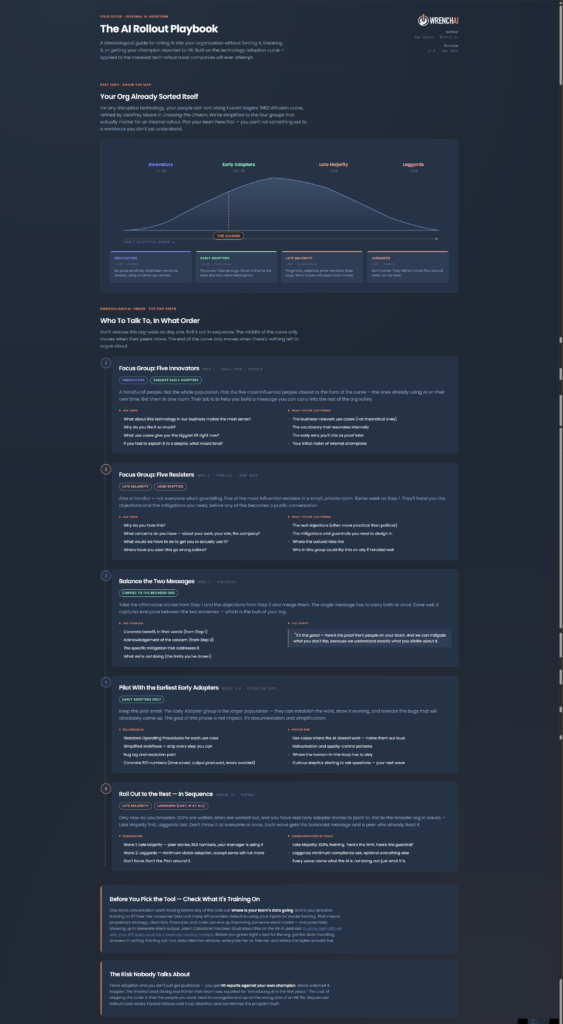
For any disruptive technology — golf shoes, mobile phones, AI — your organization self-sorts into four groups that actually matter:
- Innovators. They’ll build their own tools. No price sensitivity. Already using it.
- Early Adopters. They’ll stand in line for it. Pay more. Tolerate bugs.
- Late Majority. Skeptical. Need cheap, simple, proven. Won’t move until peers have moved.
- Laggards. Won’t move. Period.
Right now, in AI, the gap between Innovators and Laggards inside the same company is the widest I’ve ever seen it. My own team is 30 times more productive than we were a year ago. The Innovators across our client base are pulling away at a similar speed. Meanwhile the Laggards are still doing their job exactly the same way they did it in 2019.
And here’s the part nobody wants to say out loud: when people talk about the 40% of white-collar workers about to get cut, they’re talking about Late Majority and Laggards. The people who aren’t leaning into it at all. That’s who it is.
So if you care about your team — and I mean genuinely care, not in the LinkedIn-corporate way — your job isn’t to fire the resisters. It’s to roll this out in an order that actually works.
The Rollout Order That Works
Don’t throw it at everyone at once. You roll it out chronologically, using the curve as a map. And — this part matters — the first two conversations are focus groups, not surveys. A handful of influential people in a small room. Not the whole population. The point is to set your message safely with a few people who actually move opinion in the building.
- Focus group with five Innovators. Pick the five most influential people closest to the front of the curve. Already using AI on their own. Get them in one room. Ask them: “What about this technology makes sense in our business? Why do you like it so much?” They’ll establish the vision. They’ll also tell you how to sell it to everyone else.
- Focus group with five Resisters — same week. Five of the loudest, most influential skeptics. Late Majority. Sit them down in a different small room. Ask: “Why do you hate this? What would we have to do to get you to actually use it?” They’ll hand you the objections. They’ll hand you the mitigations.
- Balance the two messages into one. “It’s this good — here’s the proof. And we can mitigate what you don’t like, because we understand exactly what you dislike about it.” If you can carry both at once, you capture everyone between the two extremes — which is the bulk of your org.
- Pilot with the earliest Early Adopters. Small group. They’ll establish standard operating procedures. They’ll work out the bugs. They’re willing to put up with friction.
- Then — only then — roll it out to Late Majority and Laggards. Once it’s simplified. Once the SOPs are written. Once you have real Early Adopter stories to tell.
You don’t release this org-wide on day one. You release it in sequence. The middle of the curve only moves when their peers move. The end of the curve only moves when there’s nothing left to argue about.
The whole point of starting with two small focus groups is that you get buy-in from influential people in a safer space — before any of this becomes a public conversation. By the time the broader org hears about it, you’ve already got champions on the inside and you’ve already designed around the loudest objections. That’s the difference between a rollout that lands and one that gets your champion reported to HR.
The Real Risk Nobody Talks About
I’ll be direct: I’ve had clients where their own internal AI champion — the one driving real ROI for their team — got reported to HR for “introducing AI in the first place.” That was last year. This year, I’m on weekly calls with people who are getting combative because they hate the change so much.
That’s the cost of skipping the order. You force adoption, people lawyer up. You sequence adoption, the same people end up evangelizing it eight months later.
It’s not the tech. It’s change management with a different label on the box.
One More Thing — Check What Your Tool Is Training On
Before any of this rolls out, there’s a separate question worth asking your team: where is our data going? And is the provider you’re picking training their model on it?
A lot of free-tier consumer LLMs and even some API providers default to using your inputs for model training. That means your proprietary strategy, your client lists, your internal financials, your roadmap, your code — all potentially feeding someone else’s model. Showing up later in someone else’s output. Possibly a competitor’s.
Jason Calacanis has been loud about this on the All-In podcast and his X feed for a reason. Here’s him saying it plainly: trusting Sam Altman with your API data could be a business-ending mistake. Worth a watch. He says it more directly than I would in a blog post.
So before you green-light a tool for your org, get the answers in writing. Training opt-out. Data retention windows. Enterprise tier vs. free tier. Where the bytes actually live. None of that is paranoid. It’s just due diligence on the most leverage-heavy technology you’ll deploy this decade.
What This Looks Like in Practice
The interview order, the questions, the message-balancing — that’s the part most companies need a worksheet for. So I made one.
It’s a one-page chronological guide. Who to talk to first. What to ask them. How to sequence the rollout. How to time the communication to each segment.
I’m putting it out there because the late-majority backlash is the single biggest reason AI initiatives are stalling inside otherwise smart companies right now. I’d rather more of them survive the next twelve months than not.