

AI forecasting transforms how marketers plan budgets across platforms like social media, email, and search ads. Instead of reacting to campaign results, you can predict performance before spending. This proactive approach helps allocate budgets effectively, identify underperforming channels, and optimize strategies in real time.
Key takeaways:
- Why it matters: U.S. consumers interact with brands across multiple touchpoints, making ROI tracking complex. AI simplifies this by analyzing massive datasets and highlighting channel interactions.
- Predictive insights: Unlike traditional analytics, AI forecasts future outcomes using trends, customer behavior, and external factors.
- Data quality: Reliable forecasts depend on clean, unified data from tools like Google Analytics and Facebook Ads Manager.
- Techniques: Machine learning, time series forecasting, and scenario modeling guide smarter decisions.
- Tools like Wrench.AI: Automate data integration, audience segmentation, and ROI predictions for as low as $0.03/output.
AI-powered marketing ensures smarter investments, real-time adjustments, and accurate predictions for cross-channel success.
How Will AI And Predictive Analytics Change Marketing ROI? – Marketing and Advertising Guru
Building a Strong Data Foundation for Accurate Predictions
The accuracy of your AI forecasts hinges entirely on the quality of the data you provide. Poor data results in flawed predictions, while clean, well-structured data lays the groundwork for precise ROI forecasts that can reshape your marketing strategy. In the U.S., businesses often gather data from platforms like Google Analytics, Facebook Ads Manager, Salesforce, and email tools. However, when this information remains siloed, it becomes difficult to gain a complete picture of customer behavior.
To establish a strong data foundation, you need to unify marketing data to generate reliable insights. This unified approach allows AI models to predict which channels are most likely to deliver the best returns on your investment. Below, we explore key practices for integrating and cleaning your data.
Best Practices for Data Integration and Cleaning
Data integration often presents major hurdles for businesses. For instance, your CRM might show one version of customer behavior, while your social media analytics tell a different story. These fragmented views can create blind spots, leading to poor budget decisions.
Start by identifying all your data sources. Many mid-sized companies rely on a mix of tools – email platforms tracking open rates and click-throughs, social media tools measuring engagement, and web analytics focused on traffic and conversions. Once you’ve identified your sources, focus on data cleaning. Issues like duplicate records, inconsistent naming, or missing values can skew AI predictions. For example, if your email tool lists a customer as "John Smith" but your CRM records "J. Smith", the AI might treat them as separate individuals, distorting audience analysis.
To avoid these issues, standardize data formats across platforms. Dates should follow a consistent format (MM/DD/YYYY), currency should always be in dollars ($), and customer identifiers like email addresses or phone numbers should use uniform styles. Geographic data and naming conventions also need to be aligned.
Tools like Wrench.AI simplify this process by automatically connecting to a wide range of data sources. Instead of manually exporting and importing data, the platform pulls information directly from your marketing tools, CRM, and analytics systems. This automation reduces manual errors and ensures your AI models work with the latest data.
Wrench.AI also handles data cleaning, addressing duplicate records, standardizing formats, and filling in gaps wherever possible. This frees up your team to focus on strategic decisions rather than spending hours preparing data. With clean, integrated data, you can establish a unified measurement framework that standardizes performance metrics across all channels.
Unified Measurement Frameworks for Cross-Channel Success
A unified measurement framework ensures consistent metrics and definitions across your marketing channels. Without this consistency, it’s difficult to compare performance between channels, and AI models may struggle to identify patterns across touchpoints.
Standardized taxonomies are essential. For example, one team might define "engagement" as likes, shares, and comments on social media, while another considers email opens and clicks as engagement. These differing definitions can make it harder to understand the customer journey and compare results.
To address this, establish consistent naming conventions for campaigns, audiences, and content types. A seasonal sale campaign, for instance, should use the same identifier across Facebook, Google Ads, and email. Consistency allows AI systems to track performance across channels and identify which combinations work best.
Attribution modeling should also account for multiple touchpoints rather than only crediting the final interaction.
Time-based metrics need standardization too. While some platforms provide daily reports, others may offer weekly or monthly summaries. Align reporting periods with your business cycles to ensure timely insights and meaningful data.
Cross-channel tracking requires unique identifiers that follow customers across touchpoints. By integrating customer ID systems that connect email addresses, social media activity, website visits, and purchase history, you can better understand how customers move through your funnel and which channel combinations drive the highest-value conversions.
Audience Segmentation and Journey Mapping
Effective audience segmentation goes beyond basic demographics like age or location. AI-powered segmentation can uncover behavioral patterns that reveal purchasing intent and channel preferences, offering deeper insights into how customers engage with your brand.
Behavioral segmentation focuses on what customers actually do, rather than relying on assumptions. For instance, analyzing purchase timing can reveal when different groups are most likely to buy. B2B customers might make decisions during weekday business hours, while individual consumers could favor evenings and weekends. Recognizing these patterns helps you time campaigns for maximum impact.
Channel preference mapping is another key area. Younger audiences might gravitate toward visual platforms, while professionals may prefer LinkedIn or email. These insights guide budget allocation, ensuring resources are directed to the most active platforms for your target audience.
You can also segment customers by lifetime value to prioritize high-revenue groups.
Journey mapping ties these segmented insights to the paths customers take through your marketing funnel. By identifying key touchpoints – from initial awareness to purchase – you can determine which channels perform best at different stages. This approach not only enhances the customer experience but also improves the effectiveness of your overall marketing strategy.
With clean, unified data, consistent metrics, and detailed audience insights, AI models can deliver accurate ROI forecasts. Without these fundamentals, even the most advanced AI tools risk producing unreliable results that lead to poor investment decisions.
AI Techniques and Tools for ROI Forecasting
Once you’ve established a solid data foundation, it’s time to dive into the AI techniques that can turn raw data into actionable ROI predictions. These advanced methods help uncover patterns, predict outcomes, and guide smarter budget decisions tailored to your marketing needs.
Key AI Methods for Predictive ROI Analysis
Machine learning algorithms are at the core of modern ROI forecasting. These algorithms analyze historical campaign data to identify relationships between variables. For example, regression models can help pinpoint how the timing and frequency of email campaigns influence conversion rates, allowing you to optimize your strategy.
Time series forecasting is particularly useful for businesses with seasonal trends or recurring patterns. By examining historical data over time, this method predicts future spikes or dips. If your business sees predictable surges – like during holiday sales – time series models can guide you in allocating resources effectively.
Anomaly detection flags unusual patterns in your data, which can signal emerging opportunities or potential issues. For instance, if a stable performance metric suddenly drops, it could indicate audience fatigue or shifting market dynamics, prompting further investigation.
Ensemble methods combine multiple algorithms to enhance prediction accuracy. Instead of relying on a single model, these techniques aggregate insights from various approaches, minimizing the weaknesses of individual models.
Scenario modeling allows you to explore different budget allocation strategies without committing resources upfront. By running "what-if" analyses, you can identify the most effective budget mix for your campaigns.
Neural networks excel at uncovering complex, non-linear relationships in your data. While they require more computational power, they can reveal intricate connections between customer behavior, channel performance, and external factors that simpler models might miss.
Next, we’ll explore how to choose, validate, and fine-tune these models for more reliable ROI predictions.
Selecting and Validating Forecasting Models
Choosing the right model depends on your data, goals, and available resources. Start by assessing your data’s volume and quality. For smaller datasets, simpler models like linear regression might suffice. However, larger datasets often benefit from advanced techniques, such as neural networks.
Match your model to your forecasting needs. For short-term predictions, time series models work well, while long-term forecasts may require methods that account for market shifts and evolving trends.
Balancing complexity with interpretability is key. Simple models are easier to explain to stakeholders but may lack the precision of more advanced techniques. On the other hand, highly accurate models like neural networks can be harder to interpret, especially when justifying decisions.
Use cross-validation to test your model’s performance. Splitting historical data into training and testing sets helps evaluate how well the model predicts outcomes on unseen data. Metrics like Mean Absolute Percentage Error (MAPE) or Root Mean Square Error (RMSE) can track accuracy and highlight when a model needs updating.
A/B testing can also be a valuable tool. Running parallel forecasts with different models and comparing their results against actual outcomes helps identify the best fit for your marketing mix.
These steps lay the groundwork for Wrench.AI’s automated approach to ROI forecasting.
How Wrench.AI Improves ROI Forecasting
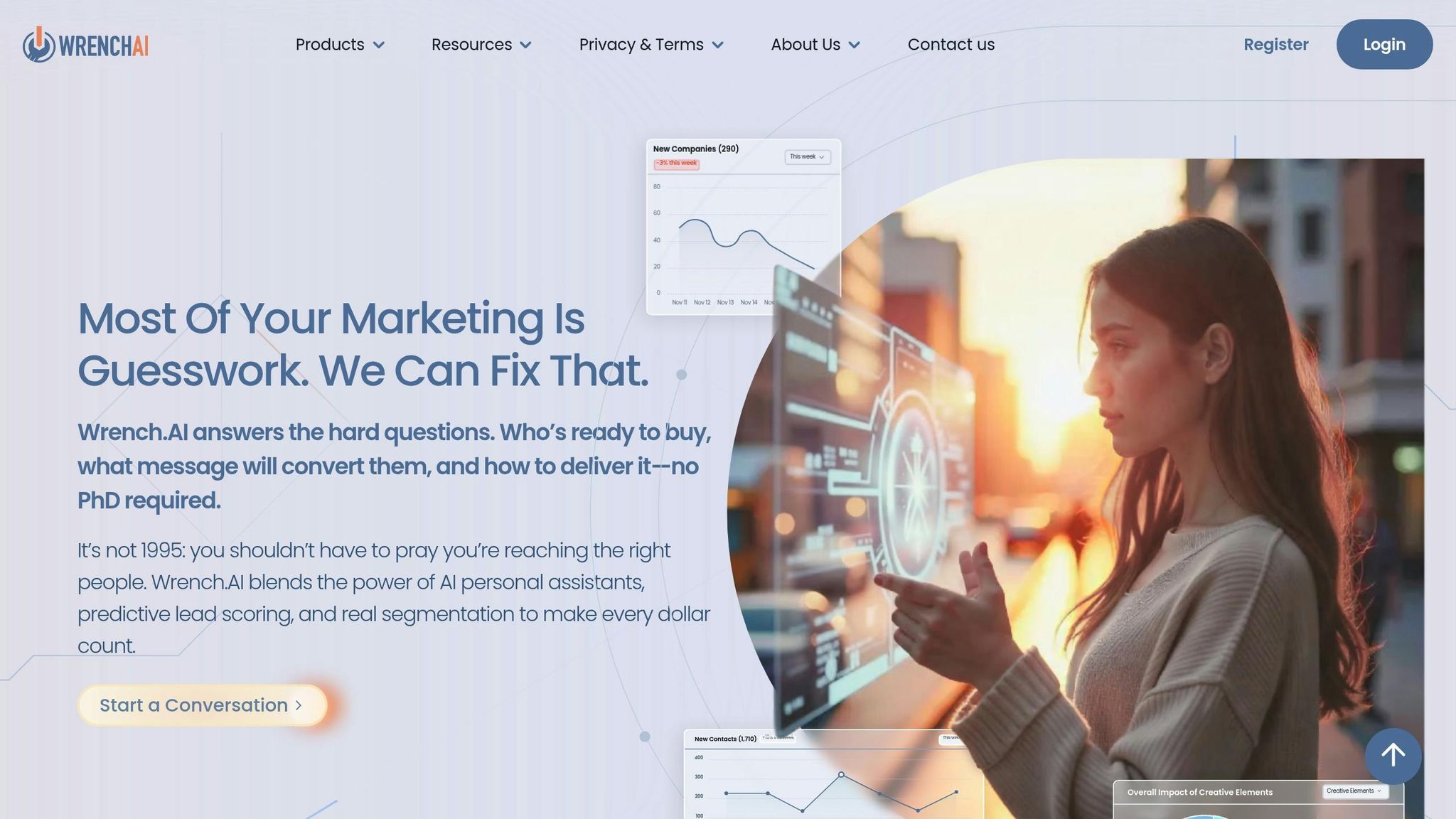
Wrench.AI simplifies the forecasting process by automating tasks like data integration, model selection, and optimization. With access to over 110 data sources, the platform identifies the best forecasting methods based on your specific data and goals, saving you the hassle of manual testing.
By analyzing data across multiple channels, Wrench.AI uncovers correlations that might go unnoticed in isolated datasets. For example, it can reveal how different campaign channels interact, leading to better attribution and smarter budget allocation.
The platform also provides account-specific insights, allowing you to forecast ROI for different customer segments. Whether you’re targeting enterprise clients, small businesses, or individual consumers, Wrench.AI helps tailor your strategies for maximum impact.
Another standout feature is its adaptive approach. Wrench.AI continuously monitors actual performance against predictions, automatically updating its models as market conditions shift. This ensures your forecasts remain accurate, even as key metrics evolve.
Transparency is a major focus. Unlike many "black box" AI tools, Wrench.AI explains the factors driving each forecast, making it easier to share insights with stakeholders and make confident, data-driven decisions.
Pricing is flexible, starting at just $0.03 to $0.06 per output. This volume-based structure scales with your needs, whether you’re analyzing a handful of campaigns or hundreds, eliminating the need for hefty upfront costs.
sbb-itb-d9b3561
Strategies to Maximize Cross-Channel ROI
Turn predictions into actionable strategies that deliver measurable results by refining budget allocation, optimizing performance, and scaling personalization efforts.
Smarter Budget Allocation for Maximum Impact
AI-powered forecasting takes the guesswork out of budget decisions by simulating spending scenarios and pinpointing the best allocation strategies. These models consider how channels interact, seasonal patterns, and customer behavior to recommend where your dollars will deliver the highest returns.
Marginal ROI analysis helps identify when a channel has reached its saturation point, signaling it’s time to shift funds to areas with untapped potential. This ensures you avoid overinvesting in one channel while missing opportunities elsewhere.
Real-time budget rebalancing keeps you agile. By continuously comparing performance to forecasts, it suggests immediate adjustments when channels underperform, which is especially valuable during campaign launches, seasonal peaks, or sudden market changes.
AI also highlights cross-channel synergies – those moments when combining efforts across platforms creates a multiplier effect on your ROI.
For a balanced approach, risk-adjusted forecasting incorporates uncertainty into your decisions. It provides expected ROI alongside a range of probabilities, helping you weigh high-reward, high-risk investments against safer, more predictable options.
These budget strategies naturally set the stage for real-time performance improvements.
Real-Time Insights to Optimize Performance
AI tools make it easier to spot and fix performance issues before they escalate. Real-time anomaly detection flags sudden drops in conversion rates or spikes in acquisition costs, enabling quick corrective actions.
By analyzing performance patterns, AI uncovers connections you might not notice, like how certain social media engagements drive higher email conversions or how mobile users are more active during specific times. These insights help you fine-tune your tactics over time.
Automated A/B test analysis speeds up optimization. By processing data instantly, it identifies winning variations faster, allowing you to run more experiments and refine strategies quickly.
Predictive performance alerts are another game-changer. If AI detects signs of audience fatigue or seasonal slowdowns, you can proactively tweak creative elements, adjust targeting, or redistribute budgets to maintain strong results.
Channel-specific recommendations take the guesswork out of decision-making by providing clear, actionable steps tailored to each platform.
Once performance is optimized, the next step is scaling personalization across channels.
Scaling Personalization Across Platforms
With a solid foundation of budget and performance strategies, AI can help you deliver personalized experiences on a larger scale.
Predictive journey mapping anticipates what your customers are likely to do next – whether it’s making a purchase, losing interest, or needing further engagement. This allows you to send timely, relevant messages across the right channels.
Dynamic content optimization ensures that each platform gets the right message. For example, AI might determine that a particular audience responds better to quick, value-driven posts on social media but prefers detailed information in email campaigns. This approach boosts both engagement and conversions.
Consistency is key, but messaging also needs to adapt to fit each platform. A single promotional campaign might emphasize social proof on social media, focus on detailed features in emails, and highlight competitive advantages in search ads.
Behavioral triggers create personalized, automated responses. If AI notices a customer taking a specific action – or becoming inactive – it can launch tailored campaigns across multiple channels to re-engage them.
Segment-specific channel prioritization ensures you’re focusing resources where they’ll have the most impact. By identifying the most effective platforms for different customer groups, you can better align your efforts with audience behavior.
Wrench.AI takes this to the next level by integrating data from over 110 sources to create detailed customer profiles. These insights reveal how individual customers and segments interact with your marketing mix, enabling highly targeted and effective campaigns across all channels.
Best Practices for Continuous Improvement
To keep AI-driven ROI forecasts dependable, it’s crucial to update models frequently and monitor their performance on an ongoing basis.
Keeping Forecasts Accurate with Regular Updates
Over time, market shifts can reduce the accuracy of forecasting models, making regular updates essential [2].
Using automated alerts is a smart way to stay ahead of potential issues. These alerts can notify teams when forecast accuracy dips below acceptable levels, allowing them to act quickly and minimize any negative impact [1][2][3].
Another common challenge is data drift – when real-world trends start to differ from the patterns the model has learned. Combat this by retraining models with fresh, high-quality data [1][2].
A/B testing can also be a valuable tool. By running parallel forecasting models, you can compare their performance and choose the most reliable option [2].
Finally, don’t overlook the value of stakeholder feedback. Insights from stakeholders can highlight emerging trends that might not yet be captured by your quantitative data.
Conclusion: Using AI for Smarter Marketing Investments
AI forecasting has reshaped how marketers approach optimizing ROI across multiple channels. By predicting campaign outcomes before spending a dime, businesses gain a competitive edge that traditional analytics simply can’t provide.
But it doesn’t stop at predictions. AI-powered forecasting allows for real-time budget adjustments, eliminating the need for rigid quarterly allocations that can quickly become outdated.
Clean, unified data is key. Without integrating data from all touchpoints, even the most advanced algorithms won’t deliver reliable results. Success starts with a strong foundation of well-organized information.
When machine learning identifies patterns and predictive analytics highlights upcoming trends, marketers get a well-rounded view of future performance across channels. This combination offers a clearer path toward smarter decision-making.
To stay relevant, continuous updates to AI models are essential. Regularly retraining these models with fresh data ensures forecasts remain accurate, even as market conditions shift.
Platforms like Wrench.AI make these capabilities accessible to businesses of all sizes. With tools like integration across 110+ data sources, audience segmentation, and predictive analytics, marketers can deploy advanced ROI forecasting without the need for custom-built systems. Plus, its scalable pricing – ranging from $0.03 to $0.06 per output – makes it practical for businesses at any stage.
The marketing world will keep evolving, but AI forecasting provides the tools to make smarter investments now. By adopting these technologies, marketers can adapt quickly to changes and maximize returns across every channel.
FAQs
How can businesses prepare their data for accurate AI-driven ROI forecasting?
To achieve reliable AI-driven ROI forecasting, businesses need to prioritize clean and consistent data. This starts with standardizing data formats, regularly verifying accuracy, and addressing any inconsistencies through scheduled audits. Leveraging automated tools for data ingestion and transformation can make this process smoother and help minimize errors.
Establishing clear data governance policies alongside scalable storage solutions is also key to maintaining uniformity across all platforms. Bringing together data from various sources into a single, integrated system and conducting regular validations further ensures data reliability. Focusing on high-quality data lays the groundwork for AI forecasting to deliver actionable insights and support smarter decision-making.
What are the main advantages of using AI to forecast cross-channel ROI compared to traditional methods?
AI-powered forecasting brings some clear benefits compared to traditional methods, especially when it comes to predicting cross-channel ROI. By tapping into real-time data and refining attribution models, it provides more precise revenue predictions and actionable takeaways. This means businesses can allocate their budgets more strategically, leading to stronger campaign results.
On top of that, AI speeds up decision-making by automating complex data crunching. This allows marketers to quickly adapt to shifting trends and changes in customer behavior. Many companies using AI report seeing better returns on investment and improved metrics like higher click-through and conversion rates. These advantages make AI an essential tool for fine-tuning marketing efforts across various channels.
How does Wrench.AI help optimize budgets and improve cross-channel marketing performance?
Wrench.AI takes the guesswork out of marketing budgets by leveraging AI to analyze campaign performance in real time. It doesn’t just stop at analysis – this platform automatically adjusts spending across different channels to help you get the most out of every dollar.
With its advanced algorithms, Wrench.AI delivers insights that empower businesses to make smarter decisions and quickly adapt campaigns to shifting market dynamics. By simplifying budget management and refining cross-channel strategies, it keeps your marketing efforts sharp, efficient, and perfectly aligned with your objectives.