

AI-driven personalization helps businesses deliver tailored experiences across various customer touchpoints – websites, mobile apps, emails, social media, and even physical stores. By analyzing massive amounts of data in real time, AI identifies patterns, refines recommendations, and predicts customer needs. Platforms like Wrench.AI stand out by integrating data from over 110 sources, enabling precise audience segmentation and multi-channel campaign coordination.
Key takeaways:
- AI Benefits: Simplifies data handling, improves customer engagement, and personalizes experiences across channels.
- Challenges: Data integration, outdated segmentation models, campaign consistency, and scalability issues.
- Wrench.AI Features: Advanced data unification, dynamic segmentation, lead scoring, and cost-effective scalability ($0.03–$0.06 per output).
While AI offers tools to enhance personalization, success relies on balancing automation with clear, customer-friendly data practices. Businesses must prioritize transparency and scalability to build trust and meet evolving customer expectations.
AI in Marketing: How CMOs Leverage AI for Personalization at Scale
1. Wrench.AI
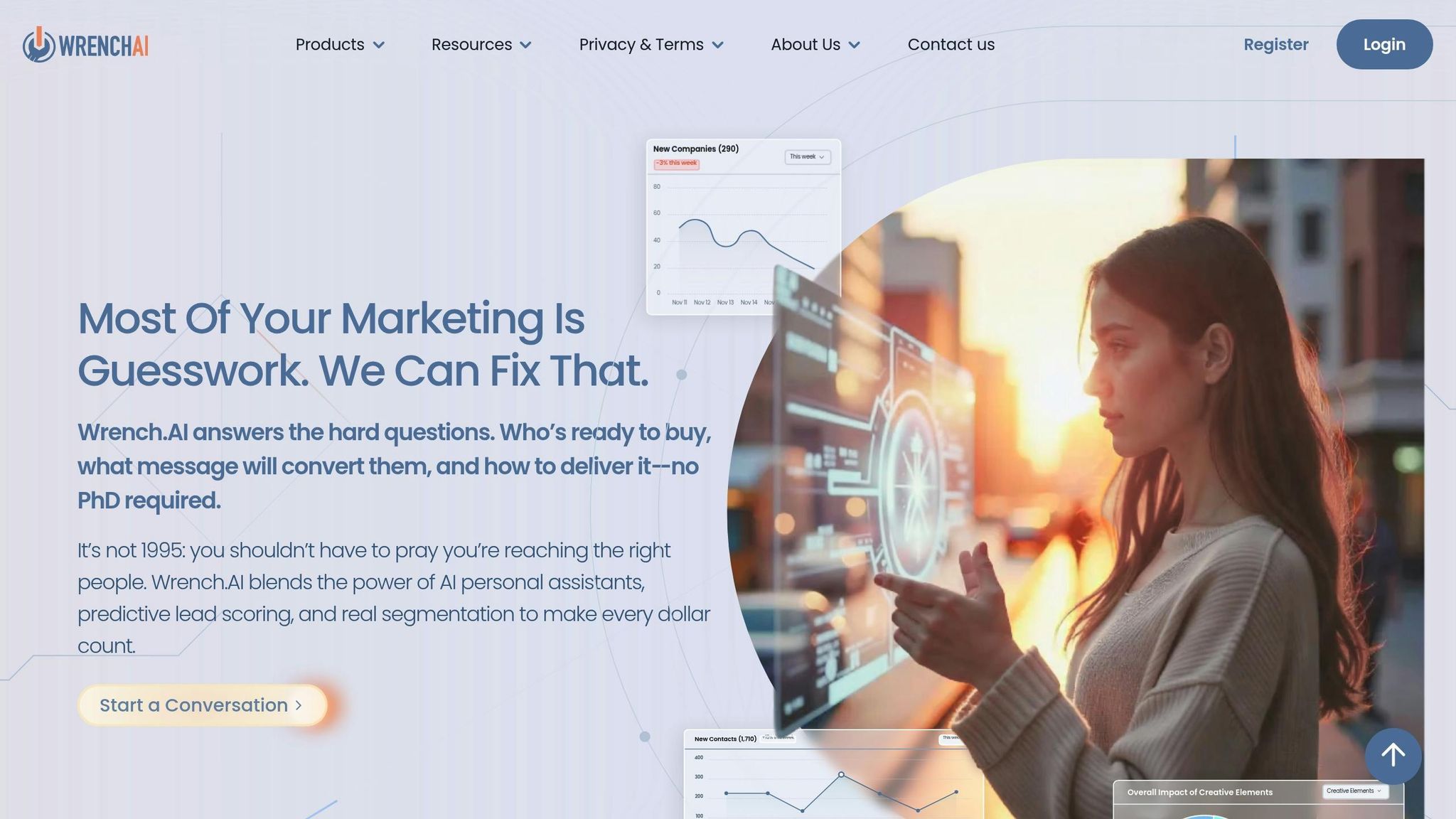
Wrench.AI turns massive amounts of customer data into actionable insights, making AI-driven personalization practical for businesses of all sizes – whether or not they have a dedicated tech team.
Data Integration
Personalization starts with gathering and unifying data, and Wrench.AI excels at this. It connects to over 110 different data sources, including CRM systems, email platforms, social media, website analytics, and customer service tools. By doing so, it creates comprehensive customer profiles and eliminates the problem of scattered or siloed data.
Audience Segmentation
Wrench.AI takes audience segmentation to the next level with its AI-powered approach. Instead of sticking to basic demographics, it analyzes real customer behavior and preferences across multiple channels. This results in dynamic personas that evolve as customer behavior changes. Whether you’re targeting broader groups or crafting one-to-one messaging, this segmentation ensures your efforts remain relevant and impactful.
Campaign Optimization
After defining customer segments, Wrench.AI helps businesses create tailored campaigns for each group. Its lead-scoring feature identifies the most promising prospects, allowing companies to focus on those most likely to convert. With built-in integrations for platforms like Meta, HubSpot, Salesforce, and Instagram, personalized messages reach customers on their favorite channels. Plus, the platform constantly refines campaign performance to keep results improving over time.
Scalability
Scaling personalization across multiple channels can be tricky, but Wrench.AI makes it manageable with a pricing model that ranges from $0.03 to $0.06 per output. This flexible pricing ensures businesses of all sizes can afford to grow their personalization efforts. The platform also supports adding new channels as needed, keeping pace with evolving marketing trends. For larger companies with unique needs, custom API plans offer advanced data processing options, whether for small, focused campaigns or large-scale initiatives. This adaptability ensures Wrench.AI remains a valuable tool as businesses and markets evolve.
2. Other AI-Driven Personalization Platforms
AI platforms designed for multi-channel customer engagement aim to deliver tailored experiences, but their methods and capabilities can vary widely. While they share the goal of personalization, these solutions often face hurdles in areas like data integration, audience segmentation, campaign coordination, and scalability. Let’s take a closer look at the challenges.
Data Integration
Data fragmentation is a persistent issue for many AI personalization platforms. Although they typically connect with CRM systems and analytics tools, the process often involves complex setups and ongoing maintenance. When integrations fall short, marketing teams may resort to manually consolidating customer data, which can lead to isolated silos. For instance, email activity and website interactions might remain disconnected, making it hard to build a unified customer profile. This fragmented approach can result in inconsistent personalization and a less cohesive customer experience.
Audience Segmentation
Many platforms rely on static, historical segmentation models. These systems might group customers into categories like "frequent buyers" or "high-value customers", but they often fail to keep pace with changing preferences. For example, if a customer’s interests shift, static models may not adjust quickly enough, leading to outdated messaging. This rigidity can result in missed opportunities for timely engagement. Additionally, discrepancies between channels can create conflicting customer profiles, further complicating efforts to deliver consistent messaging. Unlike more adaptive systems, such as Wrench.AI, traditional platforms struggle to implement dynamic segmentation effectively.
Campaign Optimization
Optimizing campaigns across multiple channels is another major challenge. While some platforms excel at improving performance within a single channel – like increasing email open rates or social media engagement – they often falter when coordinating messaging across various touchpoints, such as email, web, mobile, and social media. This lack of cohesion can result in conflicting messages that confuse customers and reduce engagement. Furthermore, without real-time adjustment capabilities, businesses may miss critical opportunities or continue using outdated strategies that no longer resonate with their audience. These limitations make it difficult to manage and scale personalization efforts effectively.
Scalability
Scaling AI-powered personalization solutions introduces both technical and financial obstacles. As organizations grow, computational demands increase, and pricing models that seemed reasonable during initial testing can become prohibitively expensive. Additionally, systems that perform well under moderate usage may encounter delays or other performance issues when handling higher volumes of data. Scaling often requires specialized technical expertise to fine-tune systems and address integration challenges, adding to the overall cost and complexity. These factors can make it harder to achieve a strong return on investment as personalization efforts expand.
sbb-itb-d9b3561
Benefits and Drawbacks
When it comes to AI-driven personalization platforms, understanding their strengths and challenges is key to making smart technology choices. The market offers a range of solutions, with platforms like Wrench.AI standing out for their multi-channel capabilities, while others focus on simpler, single-channel approaches. Let’s dive into the benefits and challenges of these options.
Wrench.AI: A Comprehensive Solution
Wrench.AI excels at integrating data from over 110 sources, enabling robust audience segmentation and seamless multi-channel campaign coordination. It also operates on a predictable, volume-based pricing model, charging between $0.03 and $0.06 per output. This transparency in pricing makes it easier for businesses to plan budgets as their campaigns grow. Additionally, its transparent AI processes and unified customer profiles give marketers the tools they need to deliver consistent and effective messaging across channels.
However, the platform’s advanced features come with a learning curve. Dedicated resources are often required during the initial setup to unlock its full potential and ensure smooth operation.
Other Platforms: Simpler but Limited
Many other personalization platforms focus on single-channel solutions. These can be easier to adopt initially and may offer lower entry-level pricing, which is appealing for smaller businesses or those just starting out with personalization. However, these platforms often lack the robust data integration and segmentation capabilities needed for effective multi-channel campaigns. This can lead to fragmented customer insights, making it harder to scale efforts efficiently.
| Platform Type | Benefits | Drawbacks |
|---|---|---|
| Wrench.AI | • Integration with 110+ data sources • Robust audience segmentation • Multi-channel campaign optimization • Transparent AI processes • Predictable volume-based pricing ($0.03–$0.06 per output) |
• Requires dedicated setup and configuration to maximize capabilities |
| Other Platforms | • Simplified, single-channel solutions • Lower initial costs for small-scale use |
• Limited multi-channel personalization • Fragmented customer data when scaling campaigns |
Cost and Scalability Considerations
While single-channel platforms might seem more affordable upfront, scaling campaigns across multiple channels often brings hidden costs, such as additional integration and maintenance expenses. In contrast, Wrench.AI’s volume-based pricing model offers clarity, helping businesses manage costs as they expand their personalization efforts. Its integrated features also reduce the need for multiple tools, simplifying operations.
Data Processing and Responsiveness
Another challenge for some platforms is data processing. Delays in analyzing customer data can hinder timely campaign adjustments, impacting customer engagement. Wrench.AI addresses this with efficient data processing, allowing businesses to respond quickly to changing customer behaviors. Its strong integration framework also minimizes system maintenance hassles, keeping operations running smoothly.
Conclusion
AI is reshaping the way businesses approach multi-channel personalization, but success lies in a thoughtful strategy. The benefits are clear: stronger customer engagement, higher conversion rates, and consistent messaging across various touchpoints. Yet, challenges like complex data integration, setup demands, and the importance of transparent AI processes remain significant hurdles. These factors collectively define the current state of multi-channel personalization.
Take Wrench.AI as an example. It addresses the issue of fragmented data by integrating over 110 sources, while also offering transparent AI processes and predictable pricing. This equips marketers with tools to achieve scalable personalization without unnecessary complications.
Building on the earlier discussion of AI ethics, success requires a balance between automation and human oversight. Ethical practices and transparency in data usage are crucial for earning customer trust. Businesses must clearly communicate how they use data and empower customers to control their personalized experiences.
Scalability is the true challenge. While single-channel solutions may work for smaller operations, growing businesses need platforms capable of managing complex customer journeys. The best solutions combine robust data processing with intuitive, low-maintenance interfaces that don’t demand extensive technical expertise.
Ultimately, businesses that view AI-driven personalization as a way to strengthen customer relationships – rather than just drive quick sales – will thrive. In a market increasingly focused on privacy, investing in platforms that balance advanced capabilities with transparency is no longer optional. Striking this balance between innovation and control is the key to staying ahead in the evolving world of AI-powered personalization.
FAQs
How does Wrench.AI protect customer data and ensure transparency in its AI-powered personalization tools?
Wrench.AI puts data privacy and transparency at the forefront by using practices like data minimization, anonymization, and secure handling methods. This ensures that only the necessary information is utilized, keeping sensitive customer data protected.
The platform also offers straightforward, easy-to-follow policies explaining how its AI processes data. By prioritizing clarity, Wrench.AI helps businesses earn customer trust while staying aligned with privacy regulations.
What challenges do businesses face when using AI to scale personalization across multiple channels?
Scaling AI-driven personalization across various channels is no small feat. One of the biggest hurdles businesses face is managing fragmented data sources. When customer data is scattered across different platforms, it often leads to inconsistent messaging and an incomplete understanding of the customer. Without a unified strategy to bring this data together, creating smooth, personalized experiences becomes an uphill battle.
On top of that, implementing advanced AI systems can put a strain on both technology and human resources. Teams may find themselves overwhelmed, facing inefficiencies as they try to adapt. The situation is further complicated by departmental silos and poor communication between teams, which can hinder efforts to build cohesive, customer-centered campaigns. Overcoming these obstacles demands strong data integration, better collaboration across departments, and a well-defined plan to scale personalization effectively.
How does Wrench.AI’s pricing model support businesses in scaling their personalization strategies?
Wrench.AI offers a pricing model that keeps personalization both scalable and budget-friendly. Starting at just $0.03 to $0.06 per output, their volume-based structure ensures businesses can tap into AI-driven tools without breaking the bank.
This setup empowers companies to grow their audience, deliver highly targeted messaging, and craft personalized customer experiences – all while staying within their financial limits.