

MCP (Marketing Cloud Personalization) and API-based solutions are two distinct approaches to marketing personalization. Here’s a quick breakdown:
- MCP: Pre-built platforms offering ready-to-use tools for personalization with minimal technical setup. Features include real-time engagement, AI-driven recommendations, automated workflows, and cross-channel campaign management. Ideal for businesses needing quick implementation and predictable subscription costs.
- APIs: Custom-built solutions allowing businesses to integrate various tools and data sources. APIs provide flexibility for unique personalization needs but require a skilled technical team and higher upfront investment.
Quick Comparison
| Factor | MCP | API-Based Solutions |
|---|---|---|
| Setup Time | Fast | Longer |
| Technical Skills | Minimal | Advanced |
| Customization | Limited | High |
| Cost | Subscription-based | High upfront investment |
| Maintenance | Handled by provider | Requires internal management |
| Integration | Pre-built connectors | Custom integrations |
| Scalability | Within platform limits | Depends on design and resources |
Key Takeaway: Choose MCP for speed and simplicity. Opt for APIs if your business requires custom solutions and has the technical resources to support them. A hybrid approach can combine the strengths of both.
Marketing Cloud Personalization (MCP): Ready-to-Use Solutions
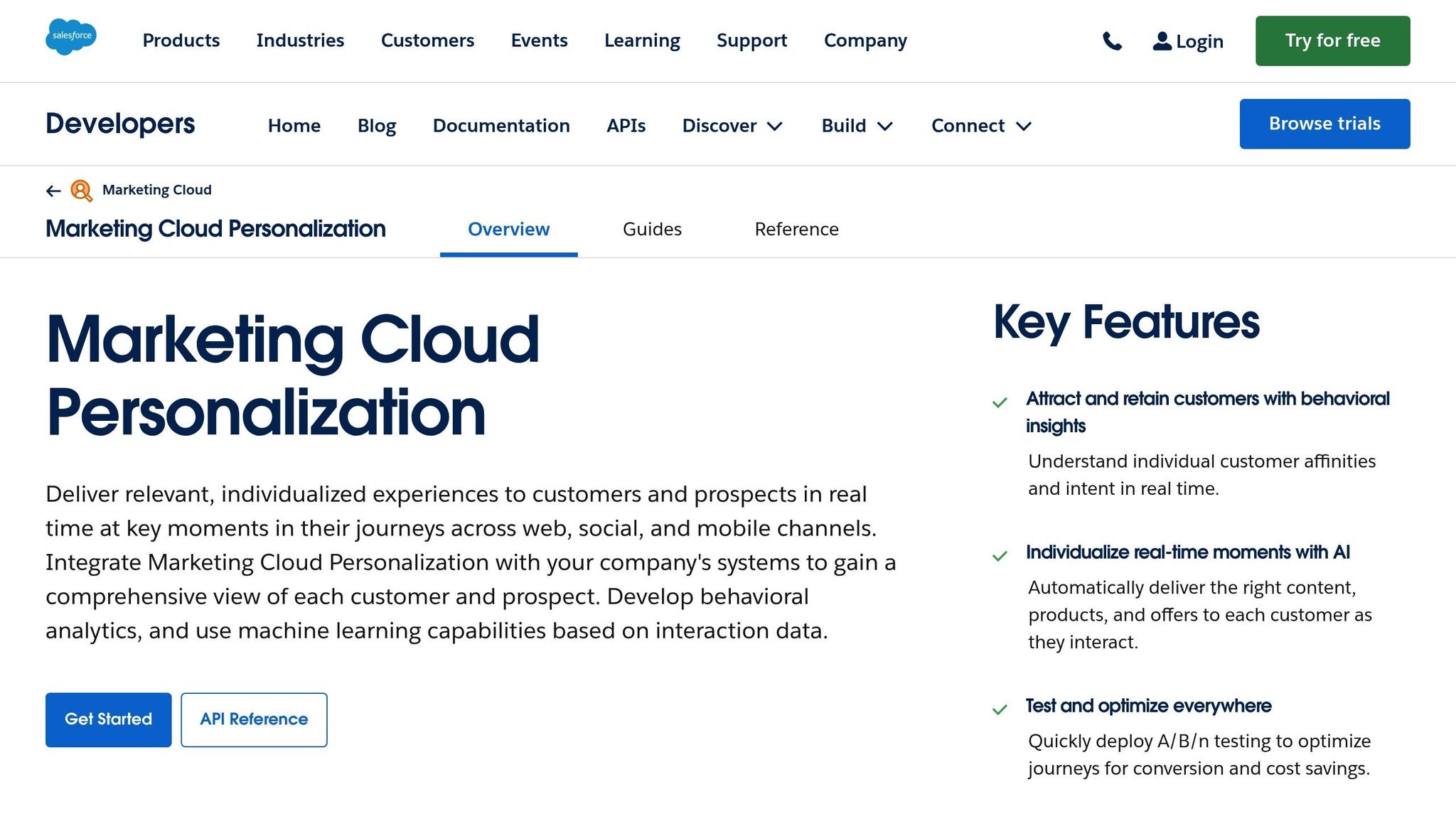
Marketing Cloud Personalization platforms are designed to offer quick and efficient solutions for teams that need to hit the ground running. Unlike custom solutions built through APIs, MCP provides a simplified, pre-built approach that skips the heavy technical development while still delivering a robust set of personalization tools.
Core Features of MCP
MCP platforms come with a suite of tools that are ready to use as soon as they’re implemented, including:
- Real-time customer engagement: Instantly adapt to customer behavior and preferences.
- Integrated A/B testing: Optimize campaigns with built-in testing tools.
- Automated workflow management: Execute campaigns with pre-set, automated processes.
- Machine learning recommendation engines: Use AI to suggest products or content tailored to users.
- Cross-channel campaign orchestration: Ensure consistent messaging across email, web, and mobile.
- Customer segmentation tools: Target audiences using behavioral and demographic data.
How MCP Benefits Marketing Teams
For U.S.-based businesses aiming to personalize their marketing efforts quickly, MCP platforms offer a clear advantage. They allow teams to launch advanced campaigns in weeks, not months, thanks to their pre-configured infrastructure. This means marketers can focus on crafting strategies and creative content rather than dealing with technical complexities.
Another major plus? Predictable costs. Most platforms operate on subscription pricing, simplifying budget planning. On top of that, they often include customer support and regular updates, keeping the system aligned with industry trends and compliance standards.
Typical Use Cases for MCP
MCP platforms are ideal when speed and simplicity are top priorities. Here are a few common applications:
- E-commerce: Drive product recommendations and recover abandoned carts with personalized campaigns.
- Content publishing: Suggest articles tailored to readers and boost subscription conversions.
- B2B marketing: Enhance lead nurturing and execute account-based marketing strategies.
This ready-to-go approach makes MCP platforms a practical choice for businesses looking to avoid the complexities of custom API integrations while still delivering powerful personalization capabilities.
APIs for Personalization: Custom Solutions
While MCP platforms offer ready-to-use options, API-based solutions provide a tailored approach for businesses with complex personalization needs. APIs require a greater technical investment but grant unmatched control and flexibility.
How APIs Enable Custom Personalization
APIs act as bridges between systems, allowing you to gather data from multiple sources and create personalization experiences that go beyond the capabilities of pre-built platforms. They enable seamless integration of data from customer relationship management systems, point-of-sale transactions, website analytics, social media, and even offline interactions into a unified personalization engine.
This capability lets you design highly targeted customer segments by combining unique data points. For instance, you could personalize content using a mix of a customer’s purchase history, local weather, browsing habits, and social media activity. APIs also allow you to trigger personalized actions based on specific events, such as when a customer reaches a loyalty milestone or completes a predefined sequence of actions.
Since APIs process data in real time, your system can dynamically adjust to customer interactions. This adaptability is key for managing complex datasets and delivering highly customized user experiences.
Technical Requirements for API Implementation
Creating a custom personalization system with APIs requires technical expertise and resources. Developers play a critical role in defining API specifications, designing interfaces and backends, and building the API using standard service description languages [1].
Securing API access is vital. Use strong authentication methods – such as API keys, OAuth 2.0, JWT, or key-pair authentication – to ensure only authorized users can interact with your system [1][2].
Data mapping is another crucial step. This involves aligning APIs with your data sources and structuring responses effectively. Developers must model the data architecture, choose primary keys, and map fields across various systems to produce coherent outputs [3].
Beyond development, ongoing maintenance is essential. Your team will need to manage API versioning, enforce rate limits, monitor performance, and ensure consistent uptime as part of the system’s lifecycle.
When APIs Work Best
When standard MCP features fall short, APIs shine by addressing unique business challenges. They’re especially useful for integrating distinct data sources that typical marketing platforms don’t support. For example, APIs can connect offline sales data, IoT device information, proprietary scoring systems, or specialized industry databases to your personalization strategy.
Businesses with intricate customer journeys across multiple touchpoints often find APIs indispensable. Take a financial services company, for example – they may need to personalize experiences based on account balances, transaction behaviors, and credit scores, all while adhering to strict regulatory standards. Such complexity usually exceeds the capabilities of pre-built platforms.
APIs also prove valuable for businesses using specialized or legacy systems without standard connectors. If your organization relies on custom software or industry-specific tools, APIs provide a way to integrate that data into your personalization efforts.
Additionally, companies with proprietary algorithms or unique personalization logic benefit from APIs. If your competitive advantage lies in analyzing customer behavior or predicting preferences through custom methods, APIs allow you to embed those algorithms into your system without being restricted by pre-built frameworks.
MCP vs APIs: Side-by-Side Comparison
When deciding between Marketing Cloud Personalization (MCP) and API-based solutions, understanding their differences can help refine your personalization strategy. Below, we break down their key features and how they align with various business needs.
Feature Comparison Table
| Factor | Marketing Cloud Personalization (MCP) | API-Based Solutions |
|---|---|---|
| Implementation Time | Quick setup with ready-to-use features | Longer development cycle due to custom integrations |
| Technical Expertise Required | Minimal technical skills needed; designed for marketers | Requires advanced developers and technical expertise |
| Customization Level | Limited to preset features | Highly customizable for unique business needs |
| Initial Cost | Predictable subscription fees | High upfront development costs |
| Ongoing Maintenance | Managed by the platform provider | Requires continuous internal technical management |
| Data Integration | Includes pre-built connectors for popular tools | Allows custom integrations with diverse data sources |
| Scalability | Scales within the platform’s ecosystem | Depends on internal infrastructure and design scalability |
| Time to Value | Delivers quick results with prebuilt capabilities | May take longer to realize full benefits |
| Compliance Support | Built-in support for common regulations | Additional effort may be needed for compliance implementation |
This table provides a clear overview of how each approach caters to different operational and technical requirements.
Pros and Cons of Each Approach
MCP offers a streamlined solution for quick deployment, ease of use, and built-in compliance support. It’s ideal for teams with limited technical resources, but its preset features might not meet the needs of businesses requiring complex customizations.
On the other hand, API-based solutions excel in flexibility. They are perfect for organizations with specific and evolving personalization needs, enabling tailored integrations, connections to multiple data sources, and the use of custom algorithms. However, this flexibility comes with trade-offs, such as longer development timelines and the need for dedicated technical expertise.
From a cost perspective, MCP’s subscription-based model simplifies budgeting, while API-based solutions demand a significant upfront investment and ongoing development costs.
Ultimately, the decision between MCP and API-based solutions depends on your organization’s personalization goals, available technical resources, and long-term strategy. Each approach has its strengths, so the best choice will align with your unique business priorities.
sbb-itb-d9b3561
How to Choose the Right Approach
Selecting between MCP and APIs comes down to aligning your personalization strategy with your organization’s resources and goals.
Key Decision Factors
When deciding, consider these factors:
- Budget: MCP offers predictable licensing costs, making it attractive for businesses with tighter budgets. On the other hand, APIs often require a larger investment upfront due to higher development and maintenance expenses, which may suit organizations with more complex needs and bigger budgets.
- Technical Expertise: If your team lacks advanced development skills, MCP’s ready-to-use features are a practical choice. However, APIs provide the flexibility to create custom solutions if you have a skilled technical team in place.
- Integration Complexity: MCP is ideal for standard systems, while APIs are better suited for unique or proprietary data sources that require tailored integration.
- Timeline: MCP enables faster deployment, making it a good option when time is a constraint. APIs, while slower to implement, are better for long-term, customized solutions.
Sometimes, a blended strategy may be the best route to achieve your personalization goals.
Using MCP and APIs Together
A hybrid approach combines the strengths of MCP and APIs, offering a balance between ease of use and customization. For instance, a retail company might rely on MCP to deliver personalized web content and email campaigns in real time while using APIs to integrate customer data from external CRM systems or trigger personalized push notifications in a mobile app. This setup allows businesses to leverage MCP’s efficiency while addressing specific needs through APIs[4][5].
This approach works particularly well when your organization has standard personalization needs that MCP can handle efficiently, alongside unique requirements that demand custom development. You can quickly launch core campaigns with MCP while gradually building API integrations to address specialized use cases.
How Wrench.AI Supports Both Approaches
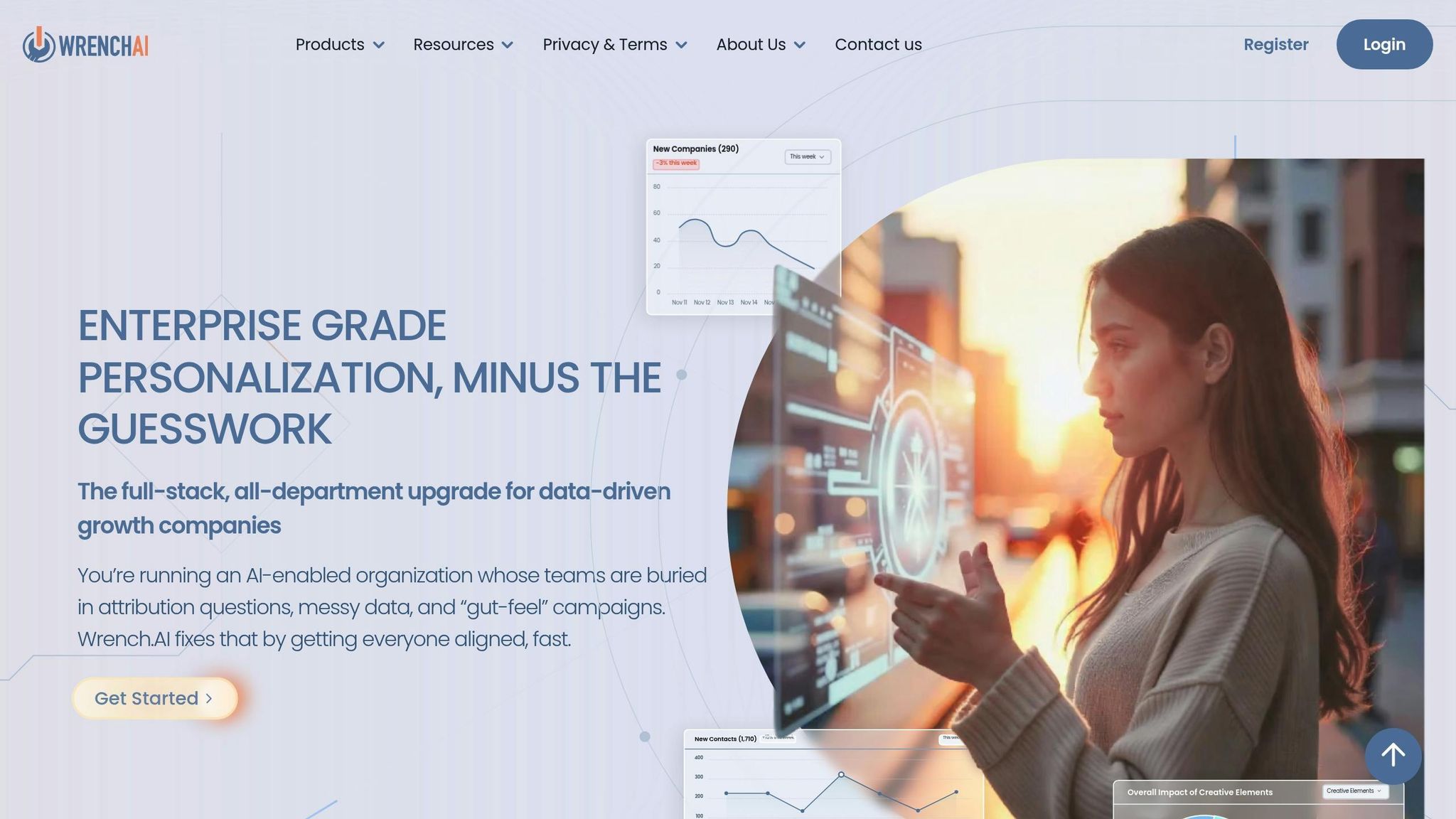
Wrench.AI is designed to accommodate both MCP and API strategies, giving organizations the flexibility to choose the approach – or combination – that best fits their goals. The platform caters to varying technical requirements and business objectives by offering both ready-made solutions and customizable options.
Its extensive integration capabilities work seamlessly with systems like CRMs, eCommerce platforms, behavioral analytics tools, and custom enterprise systems. Whether you’re using pre-built connectors or crafting custom API integrations, Wrench.AI simplifies the process of connecting your existing tech stack.
The platform also supports a wide range of data formats and sources, allowing you to start with straightforward data uploads and scale up to more advanced integrations as your needs evolve. For development teams, comprehensive API documentation ensures smooth implementation of custom solutions.
With volume-based pricing starting at $0.03-$0.06 per output, Wrench.AI makes it easy to run quick tests. For more advanced technical needs, custom API plans are available, supporting both small-scale experiments and large enterprise deployments.
Conclusion: Choosing Your Personalization Strategy
After exploring the options in detail, the choice ultimately depends on your business’s unique needs and capabilities. MCP stands out for its speed and ease of use, thanks to its built-in AI features, making it a great option for teams looking for quick implementation. On the other hand, APIs allow for deeper customization, enabling higher levels of engagement when tailored solutions are required. In many cases, combining these approaches can offer the best of both worlds.
When deciding, consider your team’s skill set, integration requirements, and project timeline. If your organization has limited development resources, MCP’s ready-to-use tools can help you launch personalization campaigns efficiently. For businesses operating in more complex environments with skilled technical teams, APIs provide the flexibility to create custom experiences that go beyond what standard platforms can offer.
A hybrid approach could be the perfect solution – using MCP for core functionalities while relying on APIs for more specialized customizations.
Wrench.AI supports both strategies seamlessly. It integrates effortlessly with MCP environments while also offering robust API endpoints for advanced implementations. With flexible pricing that adjusts to your needs and the ability to connect with over 110 data sources, Wrench.AI adapts to your chosen approach, whether you’re looking for out-of-the-box solutions or custom configurations.
As your business evolves, so should your personalization strategy. Start with the approach that aligns with your current goals and resources, but ensure your plan allows room for growth. The most effective personalization efforts are those that can scale and adapt to meet the changing needs of your organization over time.
FAQs
How do I choose between Marketing Cloud Personalization (MCP) and API-based solutions for marketing personalization?
When weighing Marketing Cloud Personalization (MCP) against API-based solutions, it all comes down to your team’s goals and resources. MCP is a great fit for businesses seeking a ready-to-use solution that requires minimal technical effort. It’s designed for those who want to roll out personalization across various platforms quickly and with ease.
In contrast, API-based solutions cater to teams with strong technical skills and a desire for extensive customization. APIs offer more flexibility and control, making them ideal for businesses with unique or complex personalization needs. The best option depends on what matters most to your team – speed, customization, or the technical resources you have available.
How can businesses combine MCP and APIs to create a well-rounded personalization strategy?
To craft a well-rounded personalization strategy, businesses can integrate Marketing Cloud Personalization (MCP) with APIs, combining the strengths of both tools. MCP shines when it comes to quickly rolling out ready-made personalization solutions. It streamlines campaign management across various platforms, making it a go-to choice for teams that prioritize speed and agility.
On the flip side, APIs offer the level of customization and control required for more intricate or long-term projects. They are particularly suited for businesses equipped with the technical expertise to develop and sustain bespoke solutions. By blending MCP’s rapid deployment capabilities with the flexibility of APIs, businesses can create a personalization strategy that’s both efficient and tailored to their unique needs.
What challenges and technical requirements should I consider when using API-based personalization solutions?
Implementing personalization solutions through APIs can be a challenging and resource-heavy process. It often calls for substantial development time and technical know-how, as each API integration needs to be built from the ground up. This typically means relying on an in-house team to handle the design, implementation, and upkeep of these connections.
On top of that, ongoing maintenance and updates are critical to keep the integrations running smoothly and compatible with changing systems. For businesses without strong technical resources, this can translate to higher costs and significant time investments. While APIs provide a level of flexibility, their successful implementation hinges on thorough planning and steady technical support.