
Tracking the ROI of AI can be tricky, but it’s critical for U.S. businesses to make informed decisions. Traditional spreadsheets fail to capture AI’s dynamic impact, especially in marketing and sales, where campaigns span multiple touchpoints like social media, email, and websites. Enter AI agents: tools that analyze data in real time, optimize campaigns without human intervention, and provide a clearer picture of what drives conversions.
Key takeaways:
- AI agents outperform spreadsheets by automating data integration and analysis across platforms like CRMs and ad tools.
- They use advanced models (e.g., Markov Chains, Shapley Value) to track multi-touch customer journeys and predict ROI trends.
- Metrics like revenue impact, CAC, CLV, and engagement rates help businesses measure AI’s influence.
- U.S. standards for financial reporting (e.g., $ formatting, MM/DD/YYYY dates) are integrated into tools like Wrench.AI for seamless reporting.
2025 AI Playbook: How to Determine ROI for Your AI Strategy
Main Challenges in Measuring AI ROI
Figuring out the return on investment (ROI) for AI initiatives isn’t as straightforward as it might seem, especially as businesses grow and their operations become more intricate. As customer interactions span multiple channels and touchpoints, pinpointing the impact of AI becomes a real puzzle. Let’s break down some of the key hurdles businesses face when trying to measure AI’s value.
Attribution Problems in Multi-Touch Customer Journeys
Today’s customer journey is anything but simple. Before making a purchase, customers interact with brands across a variety of channels – social media, websites, email campaigns, chatbots, webinars, and more. This creates a maze of touchpoints, making it tough to figure out which interaction actually led to a conversion.
Traditional attribution models, like first-touch or last-touch, fall short because they ignore the critical middle steps. These middle interactions often play a huge role in nurturing potential customers, yet they go unrecognized in such models.
Now, throw AI into the mix. AI-driven campaigns adjust things like ad spending, targeting, and messaging in real-time. While this is great for performance, it’s a nightmare for tracking. How do you know which tweak made the difference? Manual tracking methods simply can’t keep up with the speed and complexity of AI optimizations.
Then there’s cross-device behavior to consider. Customers might start their journey on a smartphone, continue it on a laptop, and complete it on a tablet. Without advanced attribution tools, businesses risk counting the same person as multiple leads. This inflates acquisition costs and distorts ROI calculations.
AI’s ability to personalize content and recommendations further complicates things. For example, if a customer makes a purchase after seeing a tailored product suggestion, how do you determine which personalized element sealed the deal? Basic analytics tools aren’t equipped to handle this level of complexity.
Data Silos and Manual Work
Disconnected data systems are another major roadblock. Marketing platforms, CRM tools, advertising accounts, email systems, and website analytics often operate in isolation. This creates data silos that make it nearly impossible to get a clear, unified view of ROI.
Manually consolidating data from these systems is time-consuming and prone to errors. It’s not just a waste of time – it can also lead to inaccurate ROI calculations. By the time the data is pieced together, the insights are often outdated, making them less useful for decision-making.
To make matters worse, inconsistent data formats across platforms add to the chaos. For instance, Google Ads might use one format for costs, while Facebook Ads uses another. Without extensive data cleaning and manipulation, comparing these datasets becomes a headache.
These manual processes also limit deeper analysis. Teams end up spending the bulk of their time gathering and organizing data instead of diving into more strategic insights, like predictive modeling or scenario planning, which could provide a richer understanding of AI’s impact.
Compliance and U.S.-Specific Data Formats
For U.S. businesses, compliance requirements add another layer of complexity. Regulations like the California Consumer Privacy Act (CCPA) and other state-level laws dictate how customer data can be collected, stored, and used. This impacts how ROI is tracked and reported.
Financial reporting in the U.S. requires strict adherence to specific formats. ROI reports must use dollar signs ($), comma-separated thousands (e.g., 1,000), and MM/DD/YYYY date formats to align with broader financial systems. When data from different platforms doesn’t match these standards, it complicates the reporting process.
Tax considerations also play a role. Certain AI investments may qualify for tax credits, like research and development incentives, or may involve depreciation schedules. Proper ROI calculations need to factor in these elements to give an accurate picture of returns.
Industry-specific regulations add even more challenges. For example, healthcare organizations must comply with HIPAA, while financial firms face SOX requirements. These rules limit how customer data can be used in ROI analysis. And if a business operates across multiple states, it must navigate varying privacy laws and regulations, further complicating the process.
To handle these compliance and formatting challenges, businesses need advanced AI tools that can adapt to these requirements while providing consistent and accurate reporting across all locations. Static analysis tools just don’t cut it in this dynamic environment.
How AI Agents Transform ROI Measurement
AI agents are reshaping how businesses measure ROI by leveraging advanced techniques like algorithmic attribution and predictive analytics. Instead of relying on outdated, rule-based methods, these systems apply machine learning to untangle the complex factors influencing today’s customer journeys. The result? A clearer, more accurate understanding of marketing effectiveness.
Advanced Attribution and Predictive Insights
Traditional attribution models – like first-touch or last-touch – often miss the mark when it comes to capturing the complexity of customer interactions. AI agents, on the other hand, use machine learning to analyze large datasets, uncover patterns that might escape human analysts, and continually adapt by learning from new information. This allows them to identify intricate relationships between marketing channels and adjust to changing consumer behaviors over time [1].
These systems account for various factors, including the timing of touchpoints, cross-device interactions, sequential customer behaviors, and external influences like seasonality, competitor actions, and market trends [1]. By moving beyond rigid, rule-based models, AI enables more nuanced approaches, such as:
- Markov Chain Models: Analyze the probability of transitions between touchpoints.
- Shapley Value Attribution: Distribute credit fairly across all interactions.
- Deep Learning Networks: Recognize complex, non-linear relationships in customer data.
Such methods make it possible to create personalized attribution models tailored to specific customer segments, delivering dynamic and highly accurate insights [1][3].
AI agents also excel at predictive analytics, using historical data to forecast which channels and strategies are likely to deliver the best ROI. This forward-looking capability helps businesses refine their strategies, allocate resources more effectively, and gain deeper insights into their markets [2]. By combining advanced attribution with predictive insights, AI agents empower marketers to make more informed, impactful decisions.
sbb-itb-d9b3561
Key Metrics for Measuring AI-Driven ROI
Harnessing the real-time insights of AI agents can help businesses measure their impact effectively. Below are key metrics that offer a clear picture of how AI is influencing your business outcomes.
Core Metrics for U.S. Businesses
Revenue Impact: This is one of the most direct indicators of AI’s effectiveness. Compare incremental revenue figures before and after AI implementation. Look for gains in areas like lead scoring and pricing strategies to gauge the financial benefits.
Customer Acquisition Cost (CAC): This metric highlights how efficiently your business attracts new customers. By comparing acquisition costs across AI-powered and traditional marketing channels, you can assess how AI contributes to reducing expenses.
Customer Lifetime Value (CLV): CLV captures the long-term benefits of AI on customer relationships. Regularly monitor this metric to identify shifts in customer behavior driven by personalized experiences and improved retention efforts.
Engagement Rates: Track how well AI-driven campaigns resonate with your audience. Metrics such as email open rates, click-through rates, social media interactions, and on-site activity often show higher engagement levels when AI is involved compared to traditional methods.
Cost Savings: Automation powered by AI can lead to measurable savings. Calculate reductions in manual labor, fewer operational errors, and faster data processing to highlight cost efficiencies.
Conversion Rate Optimization: AI’s ability to personalize the customer journey often results in better conversion rates. Analyze how conversions improve at different stages of the sales funnel to determine the success of targeted AI strategies.
These metrics provide a foundation for assessing AI’s impact, setting the stage for more detailed performance comparisons.
Methods to Measure and Compare Performance
To evaluate these metrics effectively, consider the following approaches:
A/B Testing: This method helps compare AI-driven strategies against traditional ones. By isolating one variable at a time and ensuring statistically significant sample sizes, you can pinpoint AI’s specific contributions.
Before-and-After Analysis: Establish a baseline by documenting key metrics prior to AI implementation. Then, track changes over a comparable period to measure AI’s impact, accounting for seasonal trends and market shifts.
Cohort Analysis: Group customers by shared traits, like acquisition date or behavior patterns, to see how AI affects different segments over time. This can reveal which groups benefit the most from AI-enhanced interactions.
Multi-Touch Attribution Analysis: Move beyond basic attribution models by using AI to track the entire customer journey. This approach provides a complete view of how various touchpoints contribute to conversions.
Customer Feedback Integration: Quantitative data is important, but qualitative insights add valuable context. Collect feedback through surveys, reviews, and direct interactions to better understand how AI-driven changes improve customer satisfaction and business performance.
Formatting ROI Data for U.S. Standards
When presenting ROI data, follow these formatting guidelines for clarity and consistency:
- Dollar Values: Always place the dollar sign ($) before numbers and use commas to separate thousands (e.g., $1,234,567).
- Dates: Use the MM/DD/YYYY format for all references.
- Percentage Calculations: Display percentages with at least one decimal place (e.g., 12.3%) and indicate changes with symbols like "+" or "-".
- ROI Formula: Use the standard formula: ROI = (Net Profit / Cost of Investment) × 100. Include reference periods, such as "over a 12-month period", for added context.
- Data Visualization: Use consistent color coding – green for positive trends, red for negative trends, and blue for neutral or baseline data. Ensure charts and graphs include clear legends and labeled axes.
- Reporting Frequency: Align reporting schedules with business needs. Weekly reports can guide short-term adjustments, while monthly or quarterly reports are better suited for strategic planning. Providing access to historical data can help stakeholders identify long-term trends.
These practices ensure that your ROI data is both actionable and easy to interpret, supporting better decision-making across your organization.
Using Wrench.AI Agents for Better ROI Measurement
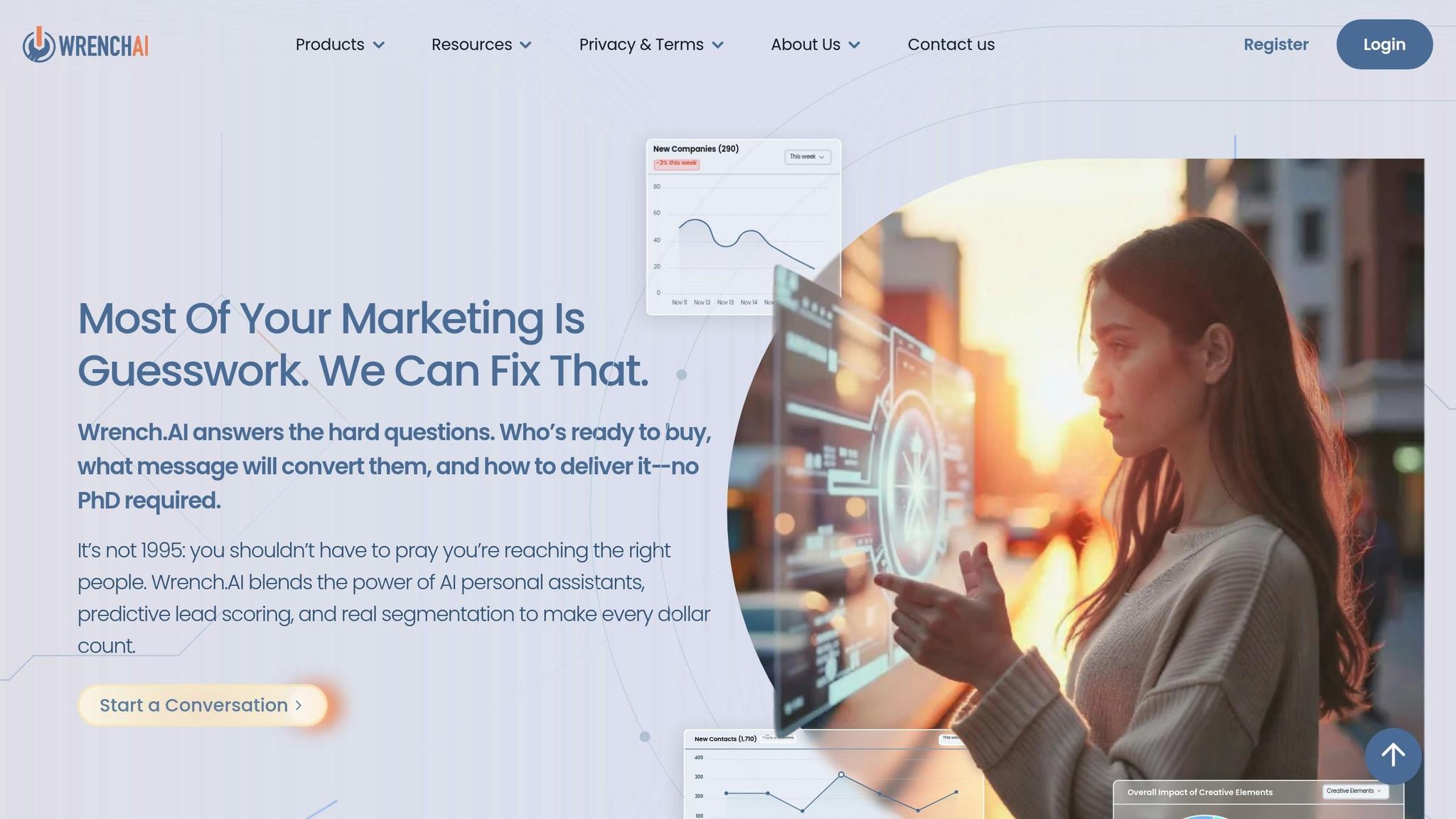
Wrench.AI agents streamline data processes to provide actionable insights into ROI, tackling challenges like data silos and the inefficiencies of manual integration. These AI-driven tools address the limitations of traditional spreadsheet-based analysis, making them an ideal solution for modern marketing and sales operations.
By building on earlier insights, Wrench.AI offers tailored features that address common hurdles in ROI measurement.
Wrench.AI Features for ROI Optimization
Data Integration Across Multiple Sources
Wrench.AI connects with over 110 platforms, pulling data from CRM systems, email tools, social media, and advertising networks. This integration creates a unified view of your customer journey, eliminating the need for manual data consolidation.
Advanced Audience Segmentation
The platform goes far beyond simple demographic splits. It analyzes customer behavior, purchase history, engagement levels, and interaction timing to identify high-value groups. These detailed segments allow for more precise ROI tracking and targeted strategies.
Campaign Optimization
Wrench.AI agents monitor performance metrics in real time, adjusting targeting and bids dynamically to improve campaign outcomes.
Predictive Analytics
Using historical and current data, the platform forecasts ROI trends, empowering businesses to make proactive decisions based on advanced analytics.
Account-Based Insights
For B2B companies with complex sales cycles, Wrench.AI provides detailed insights into account-level activities. It maps buying committees, monitors engagement across stakeholders, and attributes revenue to specific touchpoints within extended sales processes.
Aligning Wrench.AI Outputs with U.S. Business Standards
Wrench.AI ensures that all outputs align with U.S. business conventions. Financial data is formatted to match standard practices, and dates follow the MM/DD/YYYY format commonly used in American reports. Percentage metrics are displayed with precise decimals, ensuring clarity in ROI calculations.
The platform adheres to U.S. data handling and privacy standards, using ZIP codes and state abbreviations for geographic information and imperial units for distance measurements. Reporting templates and dashboards are designed with quarterly cycles and hierarchical key metrics, reflecting typical American business intelligence layouts.
Wrench.AI integrates seamlessly with widely used U.S. tools like Salesforce, HubSpot, and Microsoft Dynamics. Data exports are compatible with Excel and Google Sheets, preserving familiar formatting for numbers and dates. This ensures that Wrench.AI outputs fit effortlessly into existing workflows.
Business Impact of Wrench.AI Agents
Efficiency Improvements
By automating data collection and analysis, Wrench.AI reduces the time spent on manual tasks, allowing teams to focus on strategic initiatives.
Improved Accuracy
Automation minimizes errors in data entry and calculations. Standardized attribution models ensure consistent and reliable measurement across campaigns and channels.
Faster Insights
Wrench.AI provides rapid feedback, enabling quicker adjustments to marketing strategies. Alerts on significant metric changes help managers make agile, informed decisions.
Scalability
The platform easily handles growing data volumes and additional marketing channels, supporting business expansion without requiring a proportional increase in analytical resources.
Cost Savings
Wrench.AI helps cut costs by improving ad targeting, optimizing campaign timing, and using predictive analytics to allocate budgets more effectively. Its scalable pricing structure includes custom API plans for enterprises with specific needs, ensuring that ROI measurement capabilities grow alongside business complexity.
Conclusion: Getting the Most from AI ROI Measurement
Moving away from traditional spreadsheet-based methods to AI-powered tools is reshaping how businesses measure marketing and sales performance. Companies that adopt AI for ROI tracking gain access to real-time insights, automated data integration, and predictive analytics, all of which can dramatically enhance decision-making.
To make the most of these tools, businesses need to look beyond basic cost metrics. It’s essential to track multi-touch attribution, evaluate customer lifetime value, and assess engagement quality across all channels. AI excels at connecting these dots, offering a clear and detailed picture of what truly drives revenue growth.
Unified data integration is a game-changer. By consolidating information from CRM systems, advertising platforms, email tools, and social media channels into a single dashboard, businesses eliminate the errors and inefficiencies of manual data handling. This unified view uncovers the entire customer journey, highlighting the touchpoints that lead to conversions.
Automation is another cornerstone. With continuous monitoring and real-time adjustments, AI ensures marketing budgets are allocated to the most effective channels, directly boosting financial results.
As discussed earlier, these tools are designed to align with U.S. standards, making their outputs both practical and easy to implement within existing workflows.
The scalability of AI tools becomes invaluable as businesses grow. AI systems can process increasing amounts of data without requiring additional resources, allowing companies to expand their marketing efforts while maintaining accurate ROI tracking. This ensures that even as your campaigns scale, your measurement remains sharp and responsive.
Looking ahead, investing in AI-driven ROI measurement sets businesses up for sustained success. The ability to pinpoint what’s working, improve weaker areas, and anticipate future trends creates a proactive approach to growth. These tools provide a solid framework that shifts your focus from simply tracking results to actively driving better outcomes. It’s time for companies to embrace these technologies and start seeing tangible improvements in their marketing and sales performance.
FAQs
How do AI agents provide more accurate ROI measurements than traditional spreadsheets?
AI agents bring a new level of precision to ROI measurement through real-time data processing, predictive analytics, and automation. Unlike the limitations of traditional spreadsheets that depend on manual input and static calculations, AI agents can analyze massive datasets instantly, uncover patterns, and provide actionable insights with minimal effort from users.
By automating tasks like collecting, analyzing, and reporting data, these agents not only reduce the risk of human error but also ensure insights are always current – something traditional methods often struggle to achieve. Plus, with predictive models, AI agents can forecast outcomes more accurately, empowering businesses to make smarter, data-driven decisions that fine-tune their ROI strategies.
What challenges do businesses face with data silos, and how can AI agents help solve them?
Data silos cause problems like scattered information, restricted access, and an incomplete picture of your business operations. These hurdles can delay decisions, lower productivity, and make spotting growth opportunities more challenging.
AI agents tackle this by pulling data from various sources and connecting systems that were once isolated. They create a centralized view of your data, simplifying analysis and turning insights into action. By eliminating silos, they enhance teamwork and support more informed decision-making throughout your organization.
How can businesses in the U.S. ensure their AI tools comply with financial reporting standards when measuring ROI?
To meet financial reporting standards, U.S. businesses need to stick to established guidelines like the SEC’s regulations and Generally Accepted Accounting Principles (GAAP). Using AI tools with transparent and auditable processes is key. It’s equally important to document methodologies in detail and verify results through manual reviews or independent audits.
AI-driven compliance tools can also play a crucial role by automating the process of adhering to reporting standards. These tools not only reduce errors but also ensure consistency and simplify reporting, allowing businesses to stay compliant while effectively using AI to measure ROI.